NitroFusion2 drafts a 1024px image in 0.78 s of GPU time, but check the spelling
An open image model that draws in one or two steps: 0.78 s of GPU time per 1024px image on an RTX 4090, but small text needs checking.
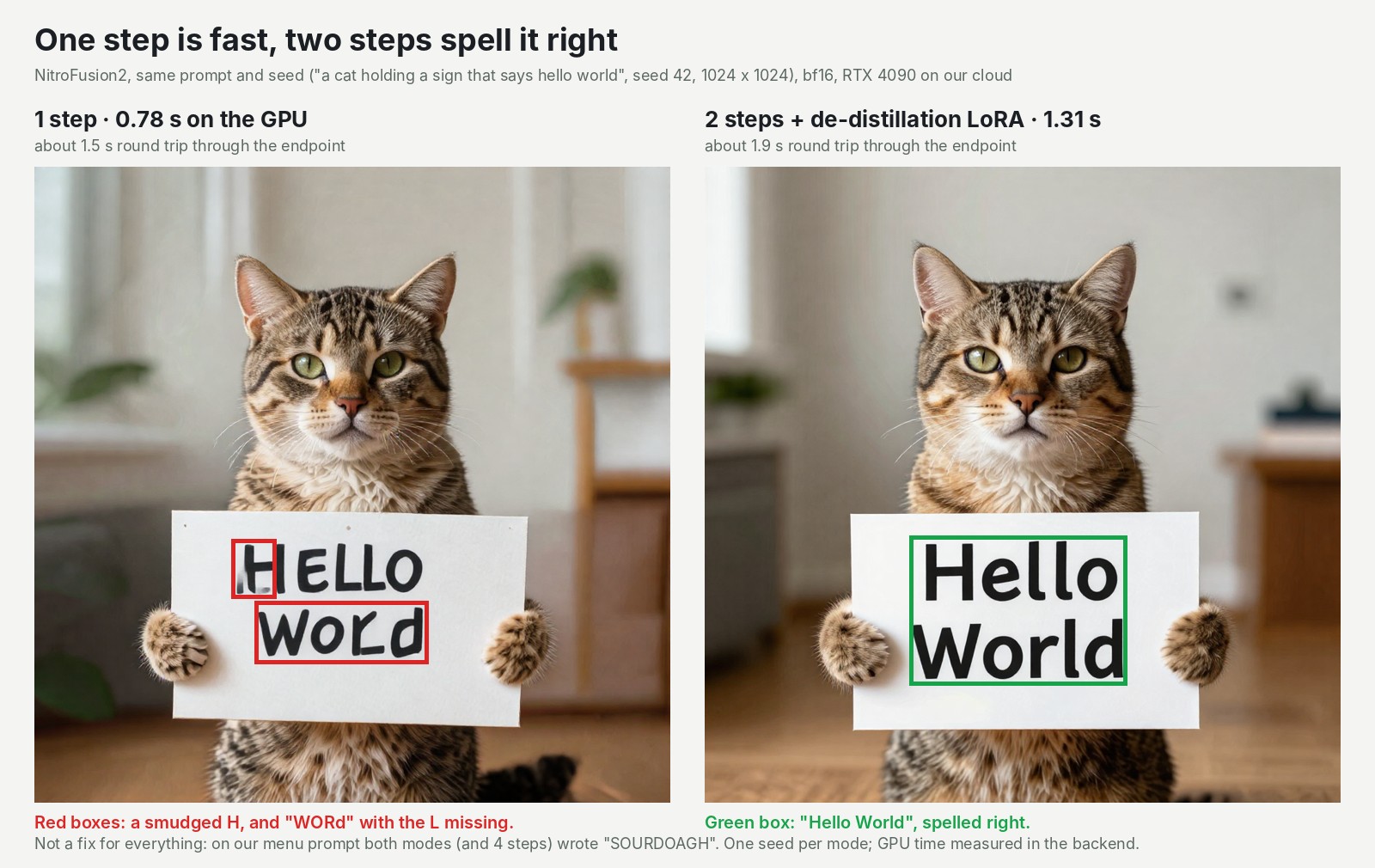
How many images can one card draw in a minute? With NitroFusion2 on a single RTX 4090 on our cloud, about 40, at 1024 x 1024 and through a real API. Each one costs 0.78 seconds of GPU time. NitroFusion2 is a new open model that does in one or two passes what its parent, Z-Image-Turbo, does in eight. For anyone who deploys image models, that changes the bill for previews: a fresh draft every second and a half, on your own GPU. It even runs on a real 16 GB card, at about 4 seconds an image. The catch is spelling. In one step the model wrote "HELLO WORd" on a cat's sign; in two steps it got "Hello World". What you can do with it today: use one step for drafts, two for anything with short text, and keep small print out of the picture.
A student that learned to skip seven passes
An image model like this one starts from random noise and cleans it up in passes. Each pass, a "step", runs the whole 6.2-billion-parameter network over the picture once. Z-Image-Turbo, the open model from the Tongyi-MAI lab, makes eight of them.
Dar-Yen Chen and Yi-Zhe Song, of the SketchX group at the University of Surrey, trained a student version that lands in one or two. Their paper came out on 3 November, and the training focuses on the words of the prompt. Weights and code are Apache-2.0. For two steps they recommend a small 0.38 GB add-on that makes the first pass half Z-Image-Turbo to clean up some flaws. They also ship compressed copies, from 2.0 GB to 7.2 GB, next to the 12.3 GB full file. We spotted it in AI Search's 8 November news video.
The authors are frank about the trade. On their test of long text inside images, one step scores 43 out of 100, two steps 76, and Z-Image-Turbo at eight steps 92. The paper calls it "a substantial gap" on text rendering. Those are their benchmarks; we did not rerun them.
What we measured: speed is settled, spelling is the decision
We served NitroFusion2 as an API on one RTX 4090 and asked for 1024 x 1024 images, one at a time, all with seed 42. We timed the model against itself, not against the eight-step original.
| 1024 x 1024, one image at a time | One step | Two steps |
|---|---|---|
| GPU time, RTX 4090, full 12.3 GB file | 0.78 to 0.82 s | 1.32 to 1.33 s |
| Round trip through the API | 1.45 to 1.50 s | 1.95 to 2.00 s |
| Real 16 GB card, 5 GB copy | about 4.0 s | about 7.3 s |
Each extra step adds a bit over half a second. The round trip (sending the request, encoding the picture, getting it back) adds about two thirds of a second, so at one step the plumbing costs almost as much as the drawing. Through the API that is about 40 images a minute at one step and 30 at two.
The words decide which setting you use. Big headlines held up in one step: a Lisbon tram poster came out with "LISBOA" and "Tram 28 - every 12 minutes" spelled right. Small print held up at no step count we tried. A chalkboard cafe menu asked for "SOURDOUGH" and got "SOURDOAGH" at one, two and four steps, and at two steps without the add-on. Prices and the other words on the menu were right. Four steps, the most the model accepts, took about three times as long as one and did not fix it.
Which card it needs
The 12.3 GB file is only part of the load. Z-Image-Turbo's text reader, the part that reads the prompt, adds about 8 GB, so the full setup needs a 24 GB card to stay on the GPU. On a 16 GB card, the authors' 5 GB copy is the one that leaves room. A real 16 GB RTX 2000 Ada, a small 70-watt workstation card, ran it with everything on the card at about 4 seconds an image, with less than half a gigabyte to spare. Moving the full file in and out of system memory also works under a 16 GB cap, but at 14 to 19 seconds an image. An 8 GB budget fails: the text reader alone fills it.
On InferenceKey, a fresh GPU machine was ready to serve 67 seconds after we asked for it, including setup, download and load. Nothing built in serves this model, so we wrote a small Python file that tells the platform how to load it; the platform itself needed no change. One trap: the dashboard's image tester starts at 20 steps, and NitroFusion2 rejects anything above 4. Set it to 1 or 2 steps and the guidance to 0.
Who should care
- Teams that need live previews, thumbnails or drafts: one step, under a second of GPU time, on a card you control.
- Images with short, large text that ship to customers: two steps, and check them.
- Menus, labels, prices, small print: neither. Render the text yourself on top, or try the eight-step Z-Image-Turbo.
- A 16 GB card: the 5 GB copy, kept entirely on the card.
The honest limit: we used one seed per prompt and one request at a time, and our 4090 was the 48 GB version capped to behave like the common 24 GB card, so read the quality results as a behaviour check, not a benchmark.
Read the timings, the memory ladder from 24 GB down to 8 GB and every sample in the full NitroFusion2 test.