SenseNova Code2Video renders a 12-second draft on one 24 GB card, then stalls
SenseTime's 27B video-by-code model rendered a full 12 s draft in 10 minutes on one RTX 4090, with a layout error, and never finished the film.
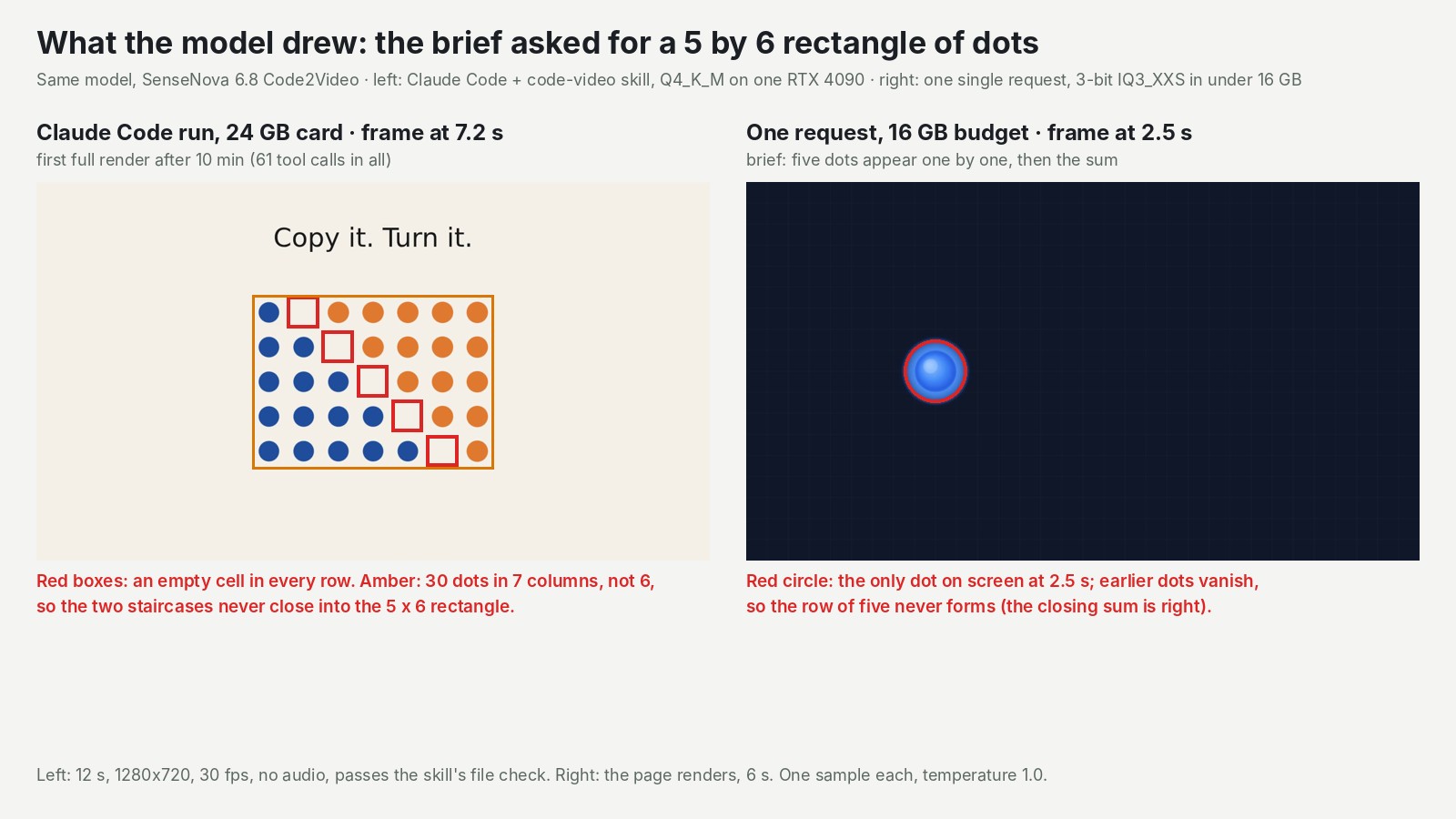
The caption on screen says "5 rows × 6 columns = 30". The dots underneath sit in 5 rows of 7, with an empty cell in every row. That frame comes from a 12-second explainer clip that SenseNova 6.8 Code2Video, SenseTime's open 27B model, wrote, rendered and checked on its own, driven by Claude Code on one 24 GB RTX 4090 on our cloud. The full draft was ready in 10 minutes. What changed for anyone who deploys models: making a video no longer needs a video model. A text and image model you already know how to serve writes a web page that draws every frame. You can run it on one gaming card, get a rough draft fast and edit any label in code. What you cannot do yet, on that card and with our settings, is leave it alone and come back to a finished film: our 40-minute run ended without one.
A video model that never paints a pixel
SenseNova 6.8 Code2Video does not draw images. Its authors describe it as a model that "builds and renders videos by generating executable code". The clip is a web page where every moment in time has exactly one picture.
Every element on screen is code, so you change one colour or one label and render again. And text comes out spelled exactly as written, because it is typed, not drawn.
SenseTime released the model under an open license, along with a Claude Code skill called code-video. The skill teaches a loop: plan, write the page, render stills, look at them, fix, then render the film and run a file check. The authors run the full-size model on four GPUs with a working memory of 512K tokens. They also say plainly that it is "clearly behind the strongest proprietary models on visual polish and long-horizon reliability".
Our question was smaller: can a compressed copy, a third of the size, finish a short clip on one 24 GB card?
Our test: the loop works, the one fact that matters does not
The brief was a silent 12-second explainer called "Half a Rectangle": a staircase of blue dots shows 1 + 2 + 3 + 4 + 5 = 15, an orange copy turns and closes it into a 5 by 6 rectangle of 30 dots. Half of 30 is 15.
We ran bartowski's 4-bit copy (17.2 GB) plus its vision part, so the model could see its own frames. The model wrote its plan at 5 minutes and had the full 12 seconds rendered at 10. Along the way it read 21 of its own frames as images and fixed what it saw. Motion is clean and every word on screen matches the brief.
The picture still breaks the fact that matters. We measured the dot centres: 7 columns, not 6, so the two staircases never close into the rectangle. The file check passed anyway, because it checks resolution, frame rate and length, not the picture.
Then the run ran out of room. Claude Code keeps everything the model has read and written in its working memory, and at 80% full it asks the model to summarize and start fresh. Ours held 98,304 tokens and filled after about 19 minutes. Three summary attempts each ran into our 16,384-token cap on a single answer, and took the last 21 minutes. The 40-minute limit stopped everything with no final film.
| On one RTX 4090 24 GB | What we saw |
|---|---|
| First full 12 s render | 10 minutes, one layout error |
| Peak card memory, agent run | 20.9 GiB |
| Final film within 40 minutes | none, stalled on summaries |
| Smallest copy whose page renders | 3-bit, 13.7 GiB peak, one dot shows at a time |
Who should care
- Teams that make explainers and motion graphics with exact text. Worth a try on a 24 GB card: a full draft in 10 minutes, and every label editable in code.
- Anyone who needs the picture right the first time. Review every frame yourself.
- Anyone who wants a finished film unattended. Plan on hours and far more working memory, as the authors do. In four of their six published runs, Claude Code cleared a working memory of 167K to 492K tokens with a 64K answer cap.
- Teams with a 16 GB card. The 3-bit copy fits on paper, but we measured it on the 4090, not a real 16 GB card, and its one sample had a bug.
One more thing you will hit on our platform: when Claude Code sent a frame, our platform dropped the picture or passed it on as text. It is fixed in our test build, not yet on the hosted service, where frames still arrive blind.
The honest limit: this was one attempt at one brief, with a working memory and an answer cap far below the authors' settings, so it shows what one card does with this setup, not what the model can do.
The pixel measurements, the memory ladder for smaller cards, the timeline of the stall and the SDK example are in the full SenseNova Code2Video test.