Qwen3.5-0.8B with 0.016% of its weights edited ends most thinking loops: 62% right against 8%
Same RTX 4090, same 50 math problems: the edited Qwen3.5-0.8B got 62% right, the base 8%, as 96% of base answers looped to the limit.
A small reasoning model that never finishes is a GPU slot with no answer at the end of it. That is what Qwen3.5-0.8B did on 96% of our math problems: it thought in circles until the 32,768-token limit (tokens are pieces of words) cut it off. Then we served an edited copy of the same model, where another AI had changed 0.016% of the weights, with no training at all. Same RTX 4090 on our cloud, same 50 problems, same settings: the edited copy got 62% right against 8%, and only 20% of its answers hit the limit. If you serve small reasoning models on your own GPUs, that is a story about card time as much as accuracy. The edited file loads and serves with the same command as the base model, so trying it means swapping one file. We tested math with thinking on, and nothing else.
A band that cannot find the outro
Qwen3.5-0.8B is a small open model with about 0.8 billion learned numbers (the weights). Before it answers, it writes a scratchpad: it thinks out loud, then gives the result. Qwen's own model card warns that this size is "more prone to entering thinking loops" than its siblings. Every note is in key, but the song never ends until someone pulls the plug.
On November 2, 2026, Rikiya Takehi, Jayden Teoh, Alex Zhang and Omar Khattab at MIT CSAIL published a blog post on what they call weight-space programming. A large model they call GPT-6 Astra got a tool to read and change the small model's numbers, plus practice problems that were not in the test. With a budget of 50 practice runs, it traced the loops to two places inside the model and erased that pattern from 64 columns of numbers in each. That is 131,072 weights, 0.016% of the model.
On MATH-500, a standard set of 500 competition math problems, the authors report a jump from 7.9% to 48.1% right, with answers cut at the limit falling from 93% to 33.1%. The Hugging Face user akhaliq rebuilt the edited model file from the authors' published change, reran all 500 problems and got 51.0% right, with 31.6% cut at the limit. We spotted the story in the AI Search news video of November 8.
The edit does not teach the band new songs. It shows them where the song ends.
Our test: 62% right against 8% on one RTX 4090
We ran both models side by side on a single 24 GB RTX 4090 on our cloud, each behind its own API endpoint, on vLLM (the open-source serving engine akhaliq's rerun used), with the thinking scratchpad on and the authors' randomness settings. The questions were the first 50 MATH-500 problems in the order of akhaliq's rerun, one try each, graded with the authors' own script.
| Edited | Base | |
|---|---|---|
| Right | 31 of 50 (62%) | 4 of 50 (8%) |
| Cut at 32,768 tokens | 10 (20%) | 48 (96%) |
| Average tokens per answer | 20,444 | 31,832 |
Our 62% is above both published figures, and that is the small sample talking: on these same 50 problems, akhaliq's rerun averaged 54%. The base model's 8% and 96% sit right on the authors' figures.
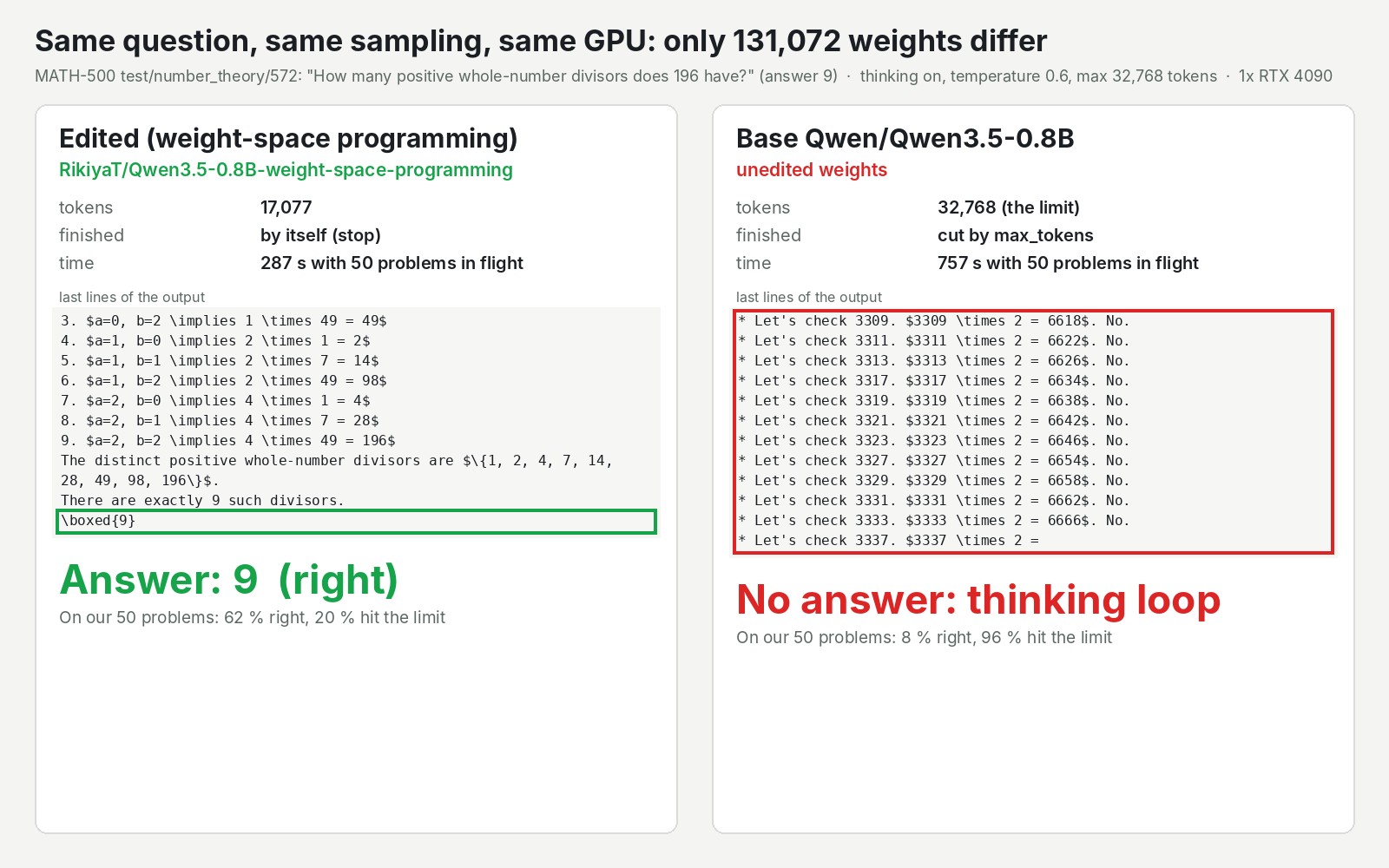
The image above shows the gap on one question: how many divisors does 196 have? The answer is 9. The edited model found it and stopped. The base model started listing numbers past 3,300, one by one, and was still going when the limit cut it.
Why the loops cost you card time
A GPU serves a fixed number of answers at once. With the base model, almost every one of those places was stuck in a loop, for up to 12.6 minutes on the divisors question, and usually ended with no answer. For the same 50 problems, the edited model wrote 1.02 million tokens and the base 1.59 million. Per right answer that is about 33,000 tokens against 398,000, though the base figure rests on just 4 right answers, so treat it as rough.
The edited model is not cheap to run per answer: it still writes long scratchpads, and one answer alone takes about a minute. But most of those minutes end with a result.
Both models fit on one 24 GB card at the same time, with 16.9 GiB used at the peak, and both were ready 418 seconds after we asked for them from a cold machine. Alone, the edited model still gave the same 5 right answers under a 6 GB memory cap we set on the 4090; at 4 GB it would not start. Those were emulated caps, not real small cards.
Who should care, and who should wait
- Teams already serving Qwen3.5-0.8B with thinking on for math: try the swap. Same size, same Apache-2.0 license, same engine.
- Teams that want the best math from a tiny model: treat it as a fix, not an upgrade. It brings out what the model already knew.
- Teams with another small model that loops: this is a published method with logs, not a product. The authors tried it on Gemma 3 270M, which rarely loops (8.5% of answers hit the limit), and it stayed between 6.8% and 7.7% on MATH-500. In their words: "Editing weights could remove an obstacle that hid an ability, but it could not add an ability the model lacked."
- Teams that would rather keep the base model: Qwen's card suggests a lower limit or stopping loops from the stream. That makes a loop fail sooner. We have not tried it, so test it before you swap files.
The honest limit: we ran 50 problems once each, math with thinking on only, so we have not checked chat, instruction following, thinking off or images on the edited file, and even edited, a fifth of its answers still looped.
The memory caps, the timings, the one streaming problem you will hit and the SDK example that runs both models on your own GPU are in the full Qwen3.5-0.8B weight edit test.