WeVisOne-VL-4B does seven vision jobs from one 16 GB card, and its fast engine miscounted a chessboard
Tencent's WeVisOne-VL-4B boxed, counted, read and cut out on a real 16 GB RTX 5080 in our test, with a one-second matte on an RTX 4090.
A vision feature in a product is often three models in a row: one draws boxes around the things you name, one turns each box into an outline, and one makes a clean cut-out that keeps the hair. Tencent's new WeVisOne-VL-4B does all of that in one open model of 4 billion parameters, and we ran it on our cloud to see whether that holds up. It does. On a real RTX 5080 with 16 GB, it passed all 14 of our requests across seven kinds of job, with a peak of 12.8 GiB on the card. On an RTX 4090, a full-resolution cut-out of a portrait took about one second. For a team that deploys models, that is one download, one card and one endpoint where there used to be three. The catch: the fast way to run it counted 15 chess pieces where there are 16, so check its counts before you trust them.
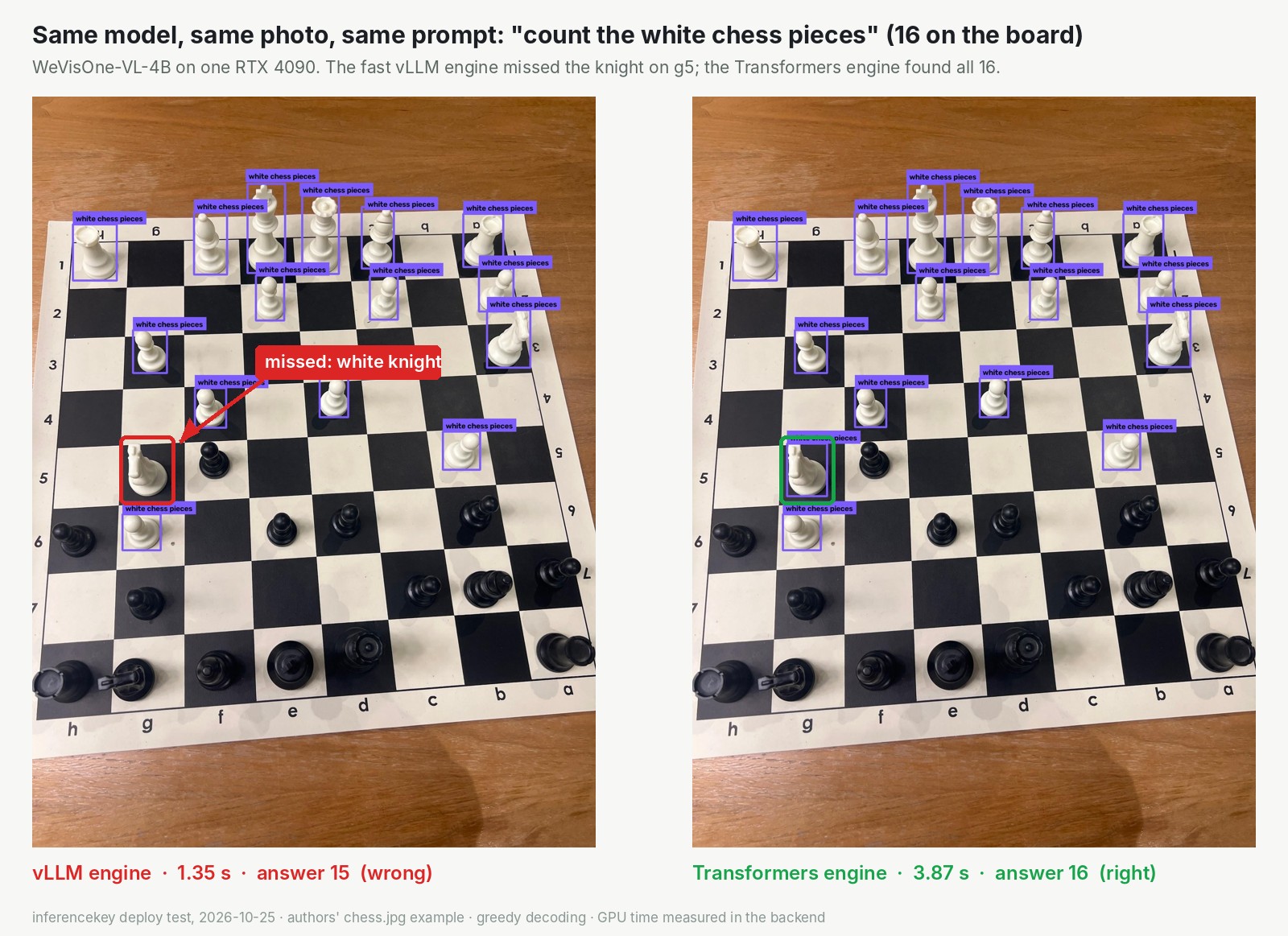
Same model, photo and prompt on one RTX 4090. The fast engine (left) answered in 1.35 seconds and missed the knight on g5. The reference engine (right) took 3.87 seconds and got 16.
What the model is
WeVisOne-VL ("WeChat Vision All-in-One") comes from the WeChat Vision team at Tencent, built on an open Alibaba model. According to its model card, it finds anything you can name, or one described thing like "the cat on the right". It also counts, points, reads text with its position, draws outlines and makes cut-outs.
The trick is simple to picture. The model answers in text, and a position on the image is just more text: a box is four special words, a point is two. For outlines and cut-outs, a tiny separate cutter of 9.6 million parameters, about 500 times smaller than the model, reads what the model saw and paints the pixels. No separate outline tool runs next to it.
The authors report that the 4B leads on more than 30 benchmarks. On their test of finding named objects it scores 55.3 out of 100, against 38.8 for GroundingDINO, a common box-drawing model. Those are their tables, not a side-by-side we ran. The weights are Apache 2.0, which allows commercial use, and the model card adds that it is not meant to identify individuals. That line matters if your product handles faces.
What we found: everything fits on 16 GB, and the two engines disagree
The authors' code package can run the model two ways: a fast engine built for serving, and the plain reference engine. We sent the same 14 requests, one image at a time, to each setup. They covered finding several named things, counting, finding one described thing (and refusing an absent one), pointing, reading text, outlining and cutting out.
| Job | RTX 4090, fast | RTX 5080 16 GB, reference |
|---|---|---|
| Cut out a person, 1620 x 1080 | 1.0 s | 2.1 s |
| Find "the cat on the right" | 0.21 s | 0.68 s |
| Count 12 people | 0.78 s | 2.8 s |
| Peak card memory (GiB) | 23.0 | 12.8 |
The fast engine is about three times quicker on most object jobs, but it holds the model twice and needs a 24 GB card. The reference engine peaked at 12.3 GiB on the same card, so the 24 GB card is a speed choice, not a requirement.
Speed came with one wrong answer. Both engines used greedy decoding, so the chessboard miss is not sampling noise. The engines also differed on a street sign (29 words read against 21) and on hanging pots and pans (19 against 20). One miss in 14 requests is not a rate. It is a reason to soundcheck on the PA you will actually play through: test your own images on the engine you will ship.
One result we liked: asked for "the dog" in a photo of cats, it answered that there was none, in every setup we ran. A detector that invents a dog is the bug that makes a product team stop trusting the feature.
Who should care
If you ship detection, outlines or cut-outs today, this is one model on one card doing jobs that usually take a chain. If you have a 16 GB card, every task ran on a real RTX 5080. If you need counts that are right, use the reference engine or check the fast one against your own images first. If you need speed, a 24 GB card with the fast engine gave one-second cut-outs and sub-second finds, after one warm-up request: the very first detection after a start took about 15 seconds.
On our platform it runs as a custom backend, a small Python program we run on your GPU machine instead of a standard model server, because the cutter lives outside what a standard server returns. A fresh RTX 5080 that had never seen the model was answering after 87 seconds, download included.
The honest limit: we sent one request at a time on single images, and under a strict emulated 12 GB memory cap every outline and cut-out failed, so plan for boxes and text only below 16 GB.
Read the full WeVisOne-VL-4B test in our Research post, with the memory ladder, every timing and the deployment example.