Limite 1B got 27 of 30 contest math problems right on one RTX 4090, as long as you only ask it math
Paradigma's 2.1 GB math model got 27 of 30 AIME 2026 problems right on one try each on an RTX 4090, and also ran on a 16 GB card.
The file is 2.1 GB. The exam is AIME 2026, the American invitational exam for top high school students. We gave Limite 1B Violetto, Paradigma's new math model, all 30 problems on one RTX 4090 on our cloud, one try each. It got 27 right. A real 16 GB workstation card also ran it. If you deploy models, that means competition-grade math no longer needs a big card: run all 30 problems at once and the batch took about 22 euro cents of GPU time. The model is Apache 2.0, so you can put it in a product. The catch is just as clear: it does math and only math, one question per conversation, and it thinks for a long time before every answer. If you have a stack of problems with one final answer each, it is worth trying.
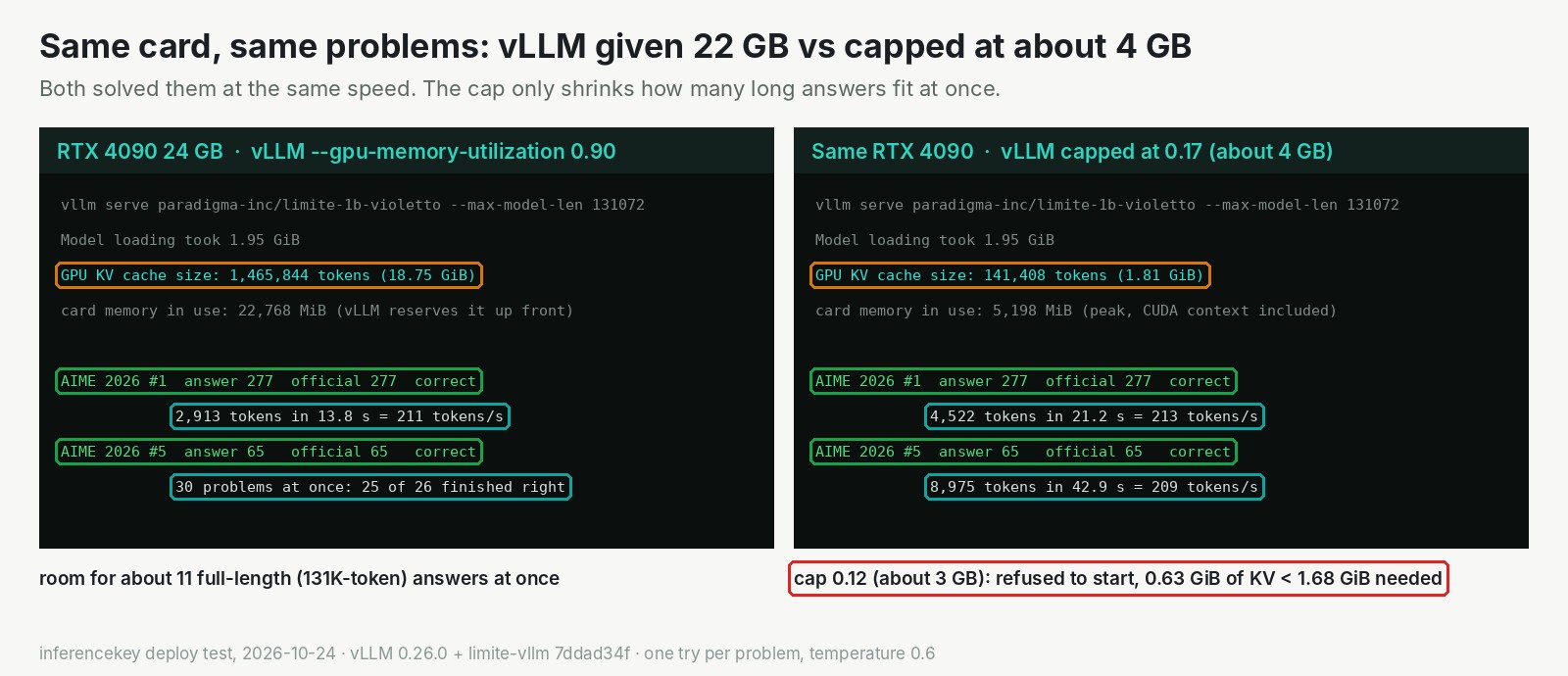
Same card, same problems. A smaller memory cap did not slow an answer down; it only shrinks how many long answers fit at once.
A small model with one job
Limite 1B Violetto is the first model from Paradigma. It has about one billion parameters, the numbers a model learns in training, and the team trained it from scratch in about six weeks. In Paradigma's own table it scores 94.01% on AIME 2026. Its headline claim is a second set of contest problems, BeyondAIME, where it reports 74.25% against 70% for MUSE-Glimmer-30B, a model thirty times its size.
It does not top that table everywhere. BeyondAIME is the only one of its seven tests where it has the highest reported score. It is not the best math model around. It is a very small one sitting among models tens of times larger, and small is what makes it cheap to check.
Credit goes to the people who built it: Prignano, Cirillo, Morosini, Cerovaz, Bartolocci, Rodolà, Starace and Pappone. They released the weights under Apache 2.0 with their evaluation code, and wrote a plugin so vLLM, the open-source program that serves models, can run it. The problems we graded come from MathArena. We spotted Limite in an AI Search news video. Our part was packaging the plugin so it deploys, running it on two cards and grading every answer.
27 of 30 on one try, which puts it in Paradigma's range
We copied Paradigma's evaluation setup: same 30 problems at the dataset version their evaluator pins, same instruction, same sampling settings, same writing budget of just under 127,000 tokens. Our script compared the last boxed answer with the official one.
| Outcome | Problems |
|---|---|
| Right | 27 |
| Wrong | 2 (#9 and #15) |
| No answer | 1 (#28 stopped mid-sentence after about 111,000 tokens) |
That is 90% on a single sitting. Paradigma's 94.01% is an average over 32 tries per problem, so our number confirms the range rather than the decimal.
Every answer comes after pages of working
A model like this works on paper, the way you would. It tries an approach, checks it, backs up and tries another, and you wait for every word of it. The shortest correct answer took 3,203 tokens. The longest took about 101,000. Half the problems needed fewer than about 21,000.
Alone, one answer runs at about 211 tokens per second on the 4090. A typical problem still takes under two minutes, and the longest eight. On the 16 GB RTX 2000 Ada it ran 2.5 times slower, with the same two test problems right.
So the way to use it is in bulk. Given all 30 problems at once, the 4090 at its peak wrote about 17 times faster than one answer alone. The whole batch took 16 minutes, held open by the single longest answer. At about 0.80 euros an hour for the card, that came to about 22 euro cents for 25 right answers, under one euro cent per solved problem. That counts only the time the card was busy, not startup or idle time.
It turns everything into math
Limite answers one math question per conversation, with a fixed opening instruction. Its input format rejects a custom opening instruction or tools. Ask it anything else and it answers with math anyway. In Paradigma's own blog, "What is photosynthesis?" came back as a problem about cells dividing. That is charming in a math model and a dealbreaker for anything else. It is not a chat assistant and not a tool for an agent.
Our deployment code drops any opening instruction that is not the standard one, so an app built for a chat model does not get its request rejected.
Who should care
- Teams that need worked solutions to competition-style problems with one final answer: worth running. Check the boxed answer before you trust it.
- Teams on a small card: a real 16 GB card worked, and capping vLLM to about 4 GB of the 4090 still got two short problems right. Real 8 GB and 12 GB cards were not tried.
- Anyone who needs fast answers for one person, a chat assistant or tools: look elsewhere.
On InferenceKey it ran as a custom backend, a short Python file that installs the exact versions Paradigma verified and starts vLLM with their plugin. With everything already on the card, a restart was ready in 31 seconds. One rough edge is open: our published SDK cannot answer chat requests yet, and the workaround until the next release is in the Research post.
The honest limit: we graded one try per problem on a set that was public before training, so this is consistent with Paradigma's number, not proof the model handles math it has never seen.
Read the full test, with the memory ladder, every answer's length and the deployment steps, in our Research post.