Nemotron 3.5 Transcribe: one deployment, a different transcript for each team, in under five seconds
One Nemotron 3.5 Transcribe copy gave verbatim, clean and speaker-tagged text of 3 minutes of audio in 4.4 s or less on a 32 GB card.
A compliance team wants every "um". A medical scribe wants clean prose. A meeting tool wants who said what, and when. Usually that means separate steps you bolt on yourself. NVIDIA's new open speech model, Nemotron 3.5 Transcribe, does all three from one loaded copy: the sentence you send with the audio picks the transcript. We ran it on one 32 GB Blackwell card on our cloud, with the open software NVIDIA ships. Three minutes of a doctor's visit came back split into doctor and patient, with a start and end time on each of its 561 words, in 4.4 seconds of GPU time. For anyone who runs their own GPUs, a new transcript style now costs a sentence, not another deployment. What you can do with it: serve verbatim, clean, speaker-tagged and translated text from one Blackwell card, chosen per request.
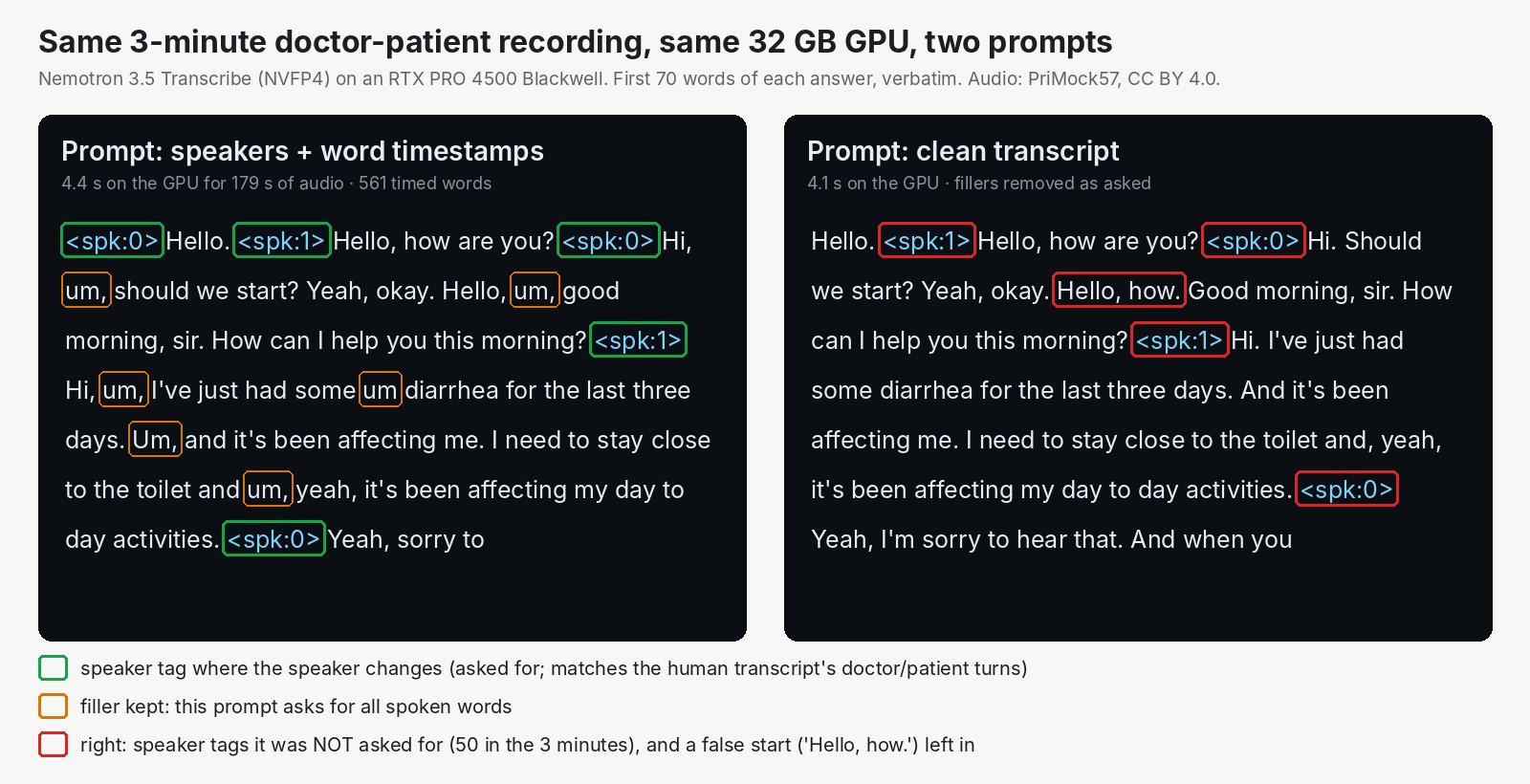
One recording, one card, two prompts. The clean version on the right adds speaker tags nobody asked for.
A speech model you talk to like a chat model
Nemotron 3.5 Transcribe listens and then follows an instruction. NVIDIA's model page lists what that instruction can ask for: word for word with every filler, cleaned up for reading, tagged by speaker with a time for every word, or translated. It covers 40 languages and recordings up to one hour.
It is big for speech: 34 billion parameters in total, but only about 4.3 billion work on each piece of audio. Picture a large team of specialists where each word consults a handful while the rest wait. That is why it runs fast for its size.
NVIDIA released it on 28 October in three file sizes. We used the smallest, 21.6 GB, which only runs on Blackwell, NVIDIA's newest card generation. NVIDIA says it makes 3.6% more errors than the largest version. The license, OpenMDW-1.1, lets you use, change and share the model, and NVIDIA's page states plainly that commercial use is allowed. NVIDIA built the model and its serving recipe, the vLLM project built the engine it runs on, and we spotted it in the AI Search news video of 1 November. Our part was packaging it, running it on cards a team can rent and counting the errors.
What one 32 GB card did
Our card was an RTX PRO 4500 Blackwell, a workstation card with 32 GB. Every prompt on the three-minute consultation finished in under five seconds of GPU time, about forty times faster than the recording plays.
| Prompt | GPU time for 3 minutes | What came back |
|---|---|---|
| verbatim | 4.1 s | 33 of the 34 "um" and "uh" kept |
| clean | 4.1 s | every filler removed, plus tags nobody asked for |
| speakers + word timestamps | 4.4 s | doctor and patient turns, 561 timed words |
A Spanish translation came back after 4.9 seconds; we did not score it. Five minutes of earnings-call audio took 4.8 seconds, in one request.
The accuracy number that compares across models comes from 40 short English clips, the same ones we used last week for Underdog Bark and Qwen3-ASR. Nemotron got 6.82% of words wrong. Bark 3.0 Pro got 6.28% and Qwen3-ASR-1.7B 7.03%, scored the same way. So it sits between them, closer to Qwen. Its gain is the choice of output, not raw accuracy. It was best of the three on audiobook speech, at 0.94%, and weakest on recorded office meetings, at 14.62%, behind Bark and ahead of Qwen.
The smallest hardware that worked was a real 24 GB slice of a bigger Blackwell card. Same 6.82% on the clips, but four to eight times slower: the three-minute speaker run took 35.3 seconds instead of 4.4. Like a band on a smaller stage, same setlist, slower changeovers.
Who should care
- Teams that need different transcripts for different readers. One deployment answers all four styles at the same address. On InferenceKey it uses the standard OpenAI speech route our Qwen3-ASR deployment already answers, so the request keeps its shape. The new part is the prompt field.
- Anyone with a 32 GB Blackwell card. It runs fast. A 24 GB Blackwell slice also runs, slower.
- Teams on RTX 4090s or older cards. The small file will not run there; it needs Blackwell.
- Anyone who needs live captions. Not this model. NVIDIA's page says it is offline only: you hand it a finished recording.
On speed, read NVIDIA's headline figure with care. Its page quotes about 37 minutes of audio per second on one 96 GB card, but from NVIDIA's own packaged engine, not yet open. The open version "is expected to be roughly two times slower". That open path is the one we used.
The honest limit, once: the clean prompt is the one to check before you trust it, since it added 50 speaker tags in three minutes and kept a false start, and our whole sample is small, 924 words of clips plus one three-minute and one five-minute file, one request at a time.
The full test
The Research post has the full measurements, the 24 GB ladder, NVIDIA's own benchmarks, the platform limits we hit and the SDK example. Read the full Nemotron 3.5 Transcribe test.