Hy-Nomas keeps one video world steady on a 24 GB card, but ignores the weather
Hy-Nomas on one RTX 4090: 88 to 94 s per 5 s turn, a scene that holds for 3 turns, and 1 of 4 scene changes followed.
Five seconds of video, about ninety seconds of GPU work, and a fox that is still the same fox three calls later. That is Hy-Nomas, Tencent Hunyuan's new open video world model, running on a single 24 GB RTX 4090 on our cloud with the authors' own one-card recipe. The default launch wants eight GPUs. The one-card version worked, peaked at 18.5 GiB, and kept the scene steady across three turns. It is also Apache-2.0, free for commercial use. If you deploy models, that means a world you can steer by text, call by call, on a card you can rent by the hour. What it does not do well yet is follow orders: one scene change in four landed. Use it to prototype scenes that must stay consistent from turn to turn, and test your own prompts before you count on it changing the weather.
A video model that remembers what it drew
Most open video models take one brief, render one clip, and forget it. Hy-Nomas works in turns. Each turn adds five seconds to the same scene, with a new text instruction. Before it draws the next piece, it reads its notes on everything it already drew. That memory is the whole point: the character, the path and the light carry over from one call to the next.
The paper went up on 27 October with 39 authors. The model reads instructions with a borrowed open model, Qwen2.5-VL-7B. Weights and code are on Hugging Face and GitHub.
The download is smaller than it looks. The full repository is 196 GB, but the one-card recipe reads only three parts, about 35 GB.
The one-card recipe works, at about 18 times slower than real time
The authors publish a second recipe next to the eight-GPU launch, aimed at one RTX 4090. It compresses the big parts and parks them in the computer's main memory, moving each to the GPU only for its own stage. The paper gives no speed for it. That was our question.
| Fox world, one RTX 4090 | GPU time | Peak GPU memory |
|---|---|---|
| Turn 1: the fox walks the path | 88.4 s | 17.4 GiB |
| Turn 2: blue flowers open | 93.1 s | 17.6 GiB |
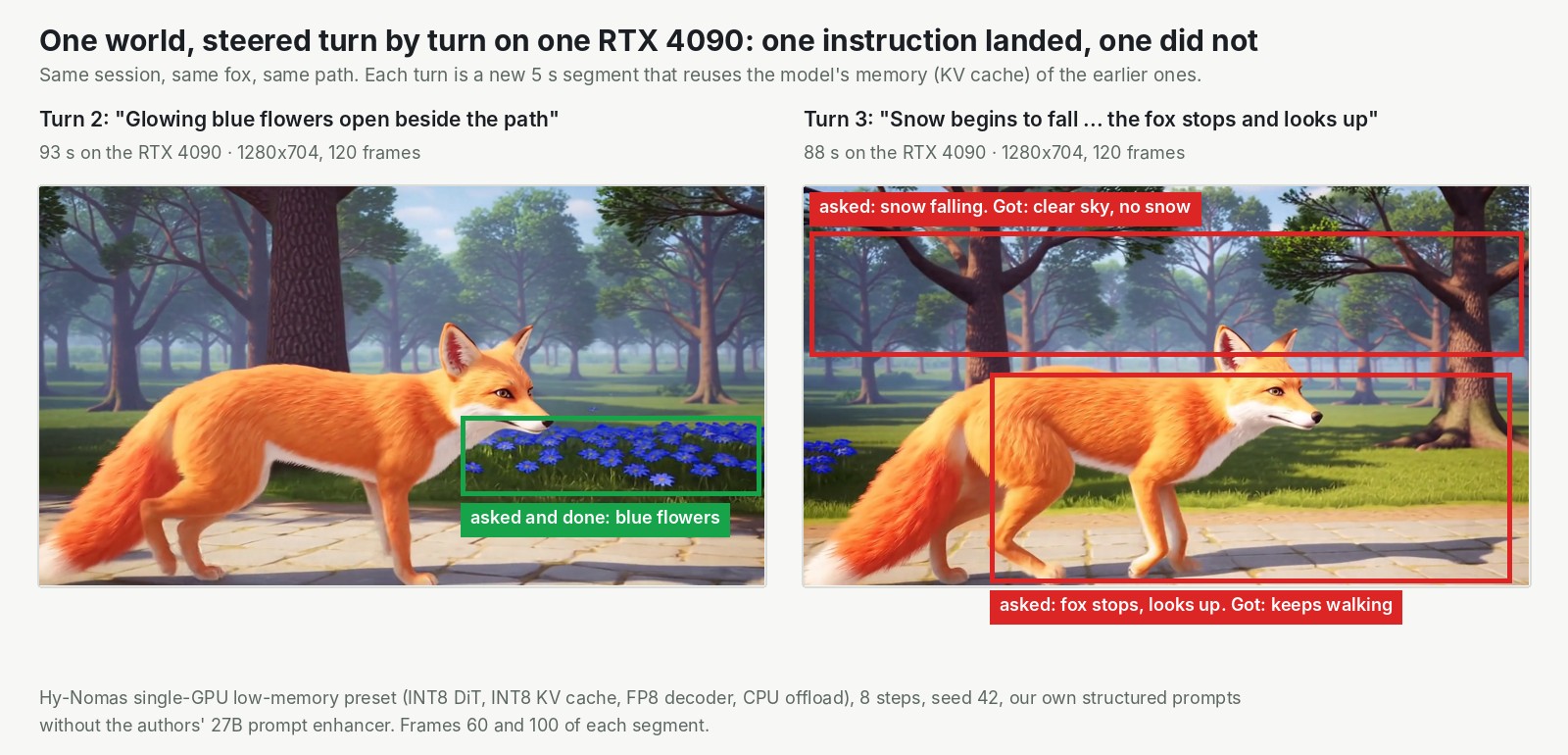
| Turn 3: snow, fox stops | 88.2 s | 17.9 GiB |
Once warm, each 5-second segment took 88 to 94 seconds. If that pace holds, a one-minute world is twelve turns and about 18 minutes of GPU work. The first call after a fresh start took up to 138 seconds.
The scene held. The fox kept its fur, its size and its walk. The trees and the light stayed put. In a second world, a lighthouse keeper kept his raincoat and lantern between calls. Each call was a separate request, a minute and a half apart, and the result still read as one take.
It is repeatable too. The same turns with the same seed gave byte-identical video files across four runs, on one machine. For a team, a bug report can carry the exact inputs and reproduce the exact clip.
Steering is the weak part: flowers yes, snow and storms no
Hy-Nomas added the object we asked for. In turn two, blue flowers appeared beside the path as the fox walked past. Changes to the whole scene never came. Snow did not fall, not even with stronger wording, and a storm in the keeper's world never arrived. That is one scene change in four. The fox also kept walking when asked to stop and look up, and the keeper never raised his lantern.
It played like a band that holds the groove for three songs and misses the key change the singer called. One suspect: we wrote our prompts by hand, without Nomas-PE, the much larger rewriter the authors' demo runs on every instruction. We have not tested whether it fixes the weather, so treat that as a guess.
Who should care, and which card
If you prototype scenes, game ideas or short sequences that must stay consistent, try it. If you need real time, look elsewhere. If you need the model to obey scene-wide changes, test your own prompts first.
The card matters more than usual. A real 24 GB RTX 4090 worked, and the same card held to 20 GiB passed two turns. Held to 16 GiB, it ran out of memory before drawing anything. Part of the recipe only runs on NVIDIA's Ada generation, the RTX 4090's family, so a newer RTX 5090 or an older A40 should fail it, though we did not run them. Main memory grows too, about 5.9 GiB for every 5 seconds of world.
On our platform, a small custom program (our wrapper around the authors' own generation service) kept one world in memory between calls. Each call sends one turn and gets back a 5-second MP4. That means one card serves one world, and one user, at a time.
The honest limit: we tested two short worlds, the longest three turns or 15 seconds of video, one seed per world, no camera paths, and our platform software ran on our own server, so the hosted service itself is untested here.
Read the full test, with every timing, the memory ladder and the fixes we needed, in the Hy-Nomas Research post.