Ming-3.0-tts fits voice cloning, voice design and Spanish into 3 GB, at two thirds of real time
Ming-3.0-tts peaked at 2.9 GB on a 16 GB card, got 17 of 19 lines word for word, and made speech at about 0.65x real time.
How small a graphics card does a voice clone need? For Ming-3.0-tts-0.5B, a new MIT-licensed speech model from inclusionAI, the answer from our test is about 3 GB of GPU memory. On a 16 GB RTX 2000 Ada it peaked at 2.9 GB. Capped at 3 GB, it made byte-for-byte the same audio. That matters if you run your own GPUs: one small workstation card can clone a voice from a short clip, invent a new voice from a written description and speak Spanish as well as English, with a license that allows commercial use. The price is speed. It makes speech slower than it plays, about two thirds of real time on the small card, and still below real time on a far faster one. So use it for recorded narration and voice-overs, not for a voice agent that has to answer live.
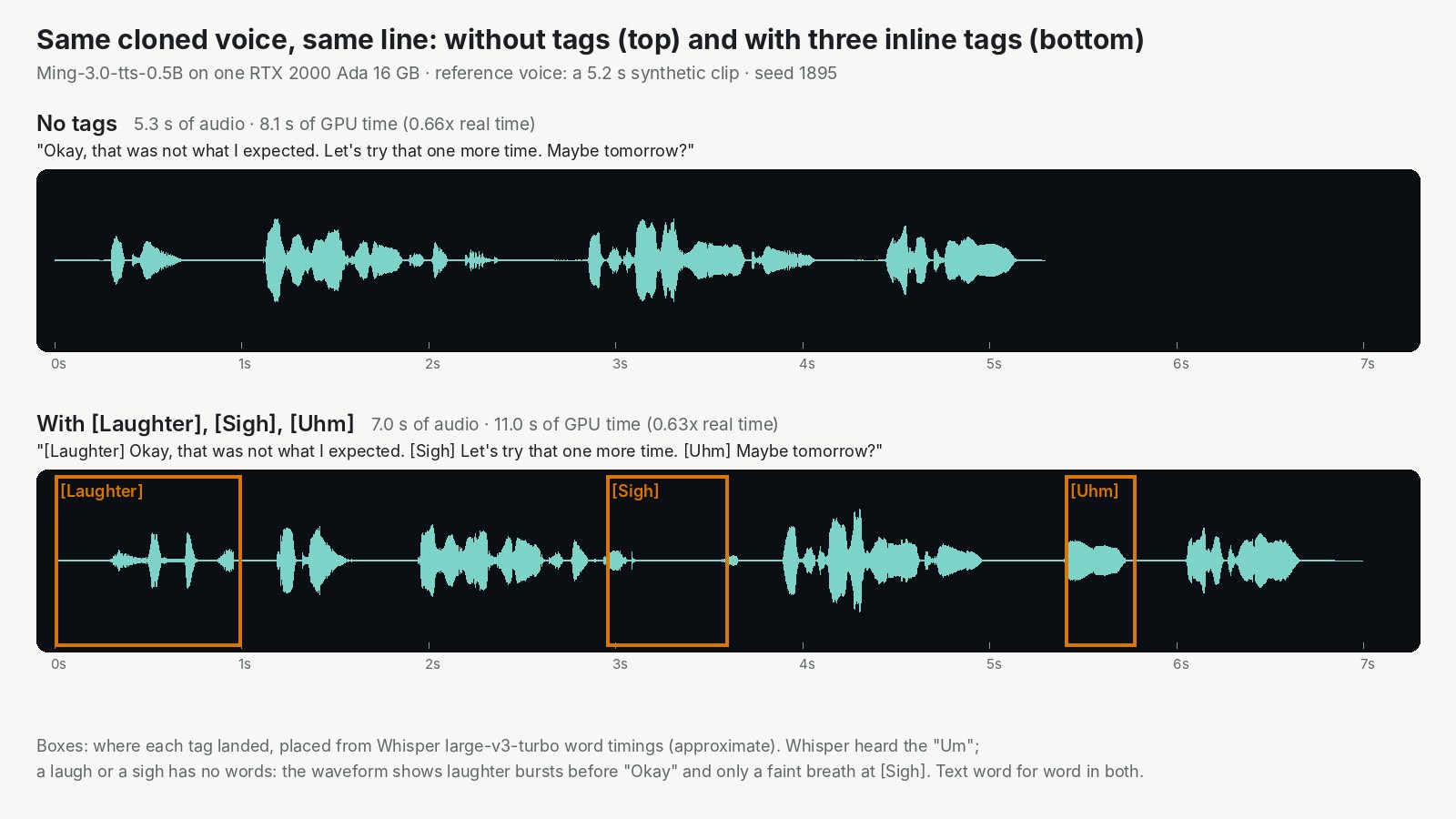
One cloned voice, one line, one card. Three tags in square brackets added 1.7 seconds of sound, and the words came out right both times.
A five-way voice toolkit in one small download
The model comes from the inclusionAI team at Ant Group, who released the weights and the code under MIT, with their own benchmarks and an honest limitations section. The credit for the model is theirs. Our part was packaging their code, running it on a smaller card than they list, and checking the output.
The model page lists five ways to shape a voice. It clones a voice from a short clip. It builds a new voice from a sentence, which the authors call voice design. It follows free-form directions on how to say a line. It ships built-in English and Chinese voices. And it takes 14 inline tags, words in square brackets such as [Laughter] or [Sigh], that turn into sounds in the middle of a sentence.
We spotted it in the AI Search news video of 25 October, where the presenter said it should run on many consumer GPUs. The authors only say they tested it on two data-center cards with 80 GB and 96 GB, and give no memory figure. That gap is what we went to check.
What we found: small on memory, right on words, slow on time
We ran the authors' code, unchanged, on one RTX 2000 Ada on our cloud. It is a small workstation card with a 70-watt power limit. We sent 19 test lines in English, Spanish and Chinese, then repeated five of them on an RTX 4090.
The words were almost always exact. Whisper, OpenAI's speech-to-text model, transcribed every clip, and 17 of 19 came back word for word, including paragraphs of 18 to 21 seconds. Both misses were numbers.
The clones held, even across languages. A speaker-recognition model scored each clip from 0 (unrelated) to 1 (identical) against our reference voice:
| Clip | Same voice as the reference? (0 to 1) |
|---|---|
| English clone | 0.87 |
| Spanish clone, from the English reference | 0.84 |
| Designed narrator voice (not a clone) | 0.32 |
From an English reference, the Spanish clone kept the voice as well as the English one. The reference itself was synthetic, a stock voice from Pocket TTS, so we cloned a voice nobody owns. That follows the authors' own rule against impersonating anyone without consent.
Speed is the catch. On the small card, a 20.7-second English paragraph took 31 to 32 seconds to make. The RTX 4090 made a 20.9-second paragraph in 27 seconds, about 17% faster for a far bigger card. The card was not the bottleneck: the small one was busy less than a third of the time. Ming writes audio in 80-millisecond slices, one after another, and a Python loop between slices sets the pace. Think of a session guitarist waiting for the bandleader to call every chord: a faster guitarist does not make the song shorter.
Who should care
- Teams making voice-overs, audiobook samples or narrated demos. One small card gives you cloning, designed voices and tags, under a commercial license.
- Anyone who needs Spanish narration from an English voice. The cross-language clone held on our machine checks.
- Teams on small GPUs. We estimate about 4 GB is enough for memory, untested on a real card that size.
- Anyone building a live voice agent. Look elsewhere for now: it speaks slower than it plays, and a bigger card barely helps.
Two smaller warnings. Numbers are unreliable: a phone number came out as a subtraction, and Spanish prices came out garbled, so check every price, date and order number in the audio. And on InferenceKey there is no ready-made support for Ming, so we wrapped the authors' code in a custom backend, a short Python file our platform installs and runs on your GPU machine. It was serving in 60.3 seconds from a clean machine.
The honest limit: every check was done by machine and nobody listened, so we vouch for the words and the voice match, not for how natural it sounds.
Read the full test
The Research post has the audio samples, the per-line numbers, the memory caps we tried, the numbers that broke and the SDK example that deploys it on your own GPU. Read the full Ming-3.0-tts test in the Research post.