Underdog Bark 3.0 Pro writes down every "you know", and edges past Qwen3-ASR at a quarter of the size
Bark 3.0 Pro got 6.28% of words wrong on 40 English clips, Qwen3-ASR-1.7B 7.03%. It also ran with no GPU, on four CPU threads.
"Bark 3.0 writes what was said, fillers included. It does not clean speech up." That line from its authors explains most of what we saw. Underdog Bark 3.0 Pro is a new open speech-to-text model, 1.25 GB on disk. On 40 English clips it got 6.28% of the words wrong. Qwen3-ASR-1.7B, a 4.7 GB model, got 7.03% wrong on the same audio and the same RTX 3090. Close, with Bark slightly ahead. For a team that deploys models, the size is the news: Bark needs about 2 GB of GPU memory once long audio is cut into pieces, and four processor threads transcribe a recording faster than it plays. What you can do with it: get word-for-word English transcripts of meetings and calls on hardware you already have, with no GPU at all if you must.
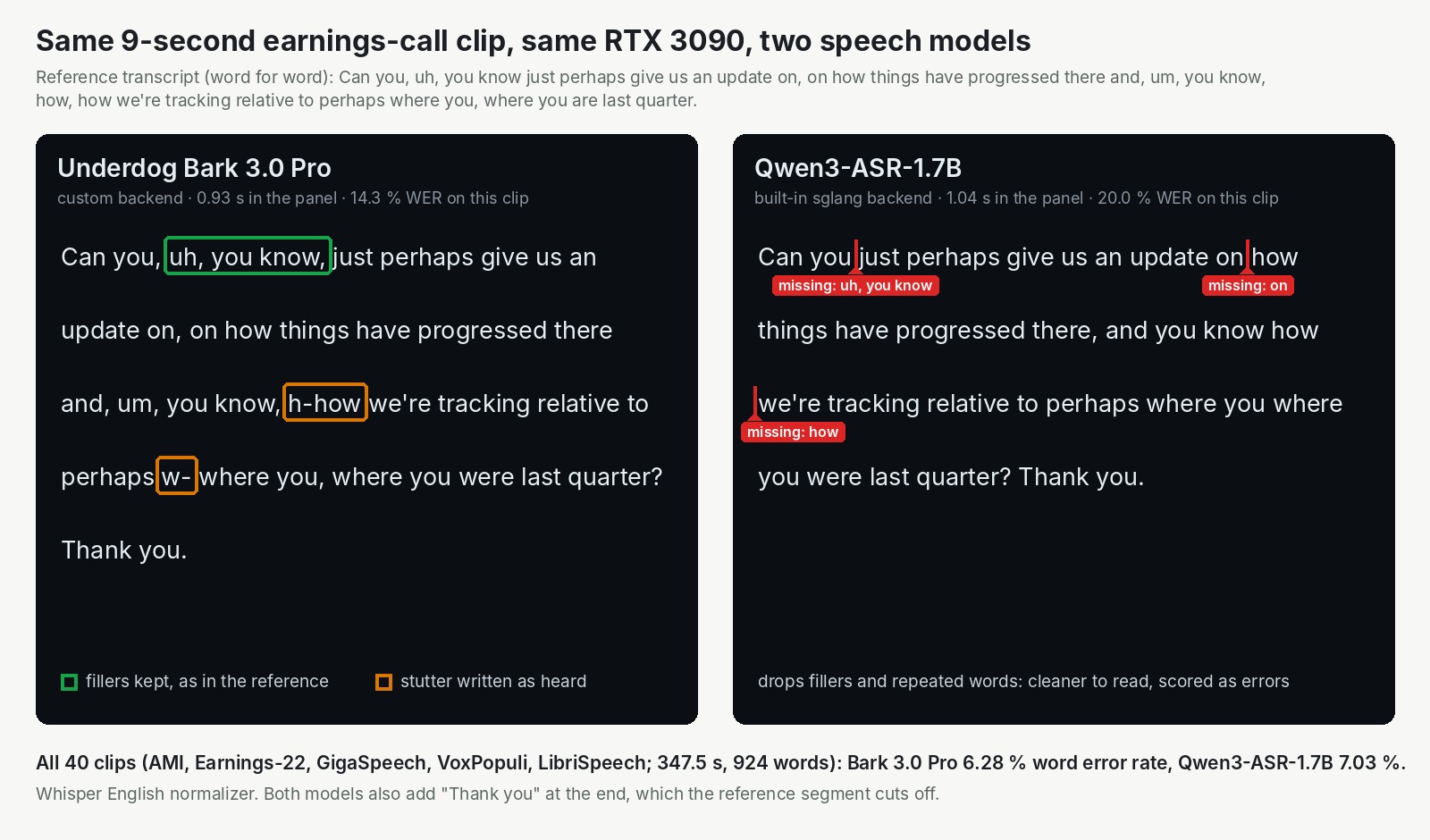
One earnings-call clip, one card. Bark keeps the fillers and repeats the reference keeps. Qwen's tidier text loses points for it.
A small model built by four teams
Bark has a family tree. NVIDIA trained the base model, Parakeet TDT 0.6B v3. Moondream made an improved version of it. Conway Research then retrained and shrank it into Bark 3.0 Pro and published it on Hugging Face on 15 October. The Underdog team wrote the release post. All three models in the chain use CC-BY-4.0, which allows commercial use as long as you credit NVIDIA, Moondream and Conway Research.
We spotted it in the AI Search news video of 25 October. The claim that made us look is on the model's page: a 4.29% average word error rate on the Open ASR Leaderboard, a public speech-to-text ranking, the lowest of any open model by its own count. Word error rate is the share of words a model gets wrong, so lower is better. That score is self-reported, and we did not try to reproduce it. Our part was smaller and more practical: package Bark for deployment, put it next to Qwen3-ASR on one card and count the errors.
The gap is mostly "you know"
We drew eight clips each from five standard test sets: office meetings, earnings calls, podcasts, European Parliament speeches and audiobooks. That is almost six minutes and 924 words. Both models ran on our cloud, through a local test build of InferenceKey, scored with the same rules.
| On our 40 clips | Bark 3.0 Pro | Qwen3-ASR-1.7B |
|---|---|---|
| Words wrong | 6.28% | 7.03% |
| Words left out | 11 | 29 |
| Words heard wrong | 32 | 28 |
| Size on disk | 1,254 MB | 4,699 MB |
The middle rows tell the story. The human answer keys are verbatim: they write what people said, false starts and all. Think of the live bootleg, coughs included, against the studio cut. Bark writes the bootleg. Qwen leans toward the studio cut, and most of the 29 words it left out were fillers and repeats like "you know", "on, on" and "how, how". On words actually heard wrong, Qwen was slightly ahead. So Bark's lead comes from keeping what was said, not from better ears.
That is why Bark's lead was largest on meetings and earnings calls, where the answer keys keep the most fillers and repeats. Qwen did better on parliament speeches and audiobooks, and we did not find out why.
Fast enough that the network is the slow part
A typical clip came back in half a second, counting the trip over the network. Five minutes of earnings-call audio took 2.8 seconds of GPU work in a single request, 4.5 seconds counting the upload and the answer, and Bark returned the whole transcript. Qwen3-ASR returned 212 words on the same file and stopped. We did not look into why.
Then the part that matters if you are choosing hardware. With only Bark loaded, the 3090 never went above about 2.8 GB of its 24 GB. We capped the memory Bark could use to copy smaller cards: under about 2 GB, everything passed once long audio was cut into 60-second pieces. And with no graphics card at all, four threads of a server processor did the five-minute file in 31 seconds, sixteen threads in 14. The transcripts matched the GPU word for word on all 40 clips.
Who should care
- Teams that transcribe English meetings, calls or interviews and need every word as spoken. Bark made fewer verbatim errors than Qwen3-ASR-1.7B on our meetings and earnings calls.
- Teams with no spare GPU. A few processor threads handle one recording faster than it plays, so a machine you already run can do the job.
- Anyone shipping it in a product. The license allows it, with attribution.
If you want text people read without editing, plan a cleanup step: the authors ship a separate Bark 3.0 Clean that drops fillers, which we did not test. If your audio is not in English, look elsewhere. Bark is English only and, according to its authors, has no word timings or speaker names yet.
The honest limit, once: 924 words is a small sample on one real GPU, so read the result as "close, with Bark ahead", not as a ranking, and treat smaller cards as untested, since none of the seven types we tried to rent was in stock.
The full test
The Research post has the set-by-set table, both transcripts of the earnings clip, the memory ladder, the CPU runs and the two rough edges we hit on the platform. Read the full Underdog Bark 3.0 Pro test.