MemT-1.0-Nano saves what a chat remembers to a file, and needs an 80 GB card to do it
MemTensor's MemT-1.0-Nano reloaded a 41.9 MB memory file into an empty session and got 9 of 9 facts right on one 80 GB A100.
Most chat models forget a person the moment the session closes. The app keeps the history as text and the model rereads all of it next time. MemT-1.0-Nano, a new open model from MemTensor, works another way: it folds the turns you flag into a memory of fixed size and lets you save that memory as a file. We ran it on one 80 GB A100 on our cloud to see if the file really carries the facts. It does. We saved the file, closed the session and loaded it into a new one with zero messages. The model then answered 9 of 9 questions about what it had been told. For a team that deploys models, each person's memory becomes a file you can store, back up, move and delete, and it reloads in under two seconds. What you can do today: run a pilot on your own long histories, on an 80 GB card.
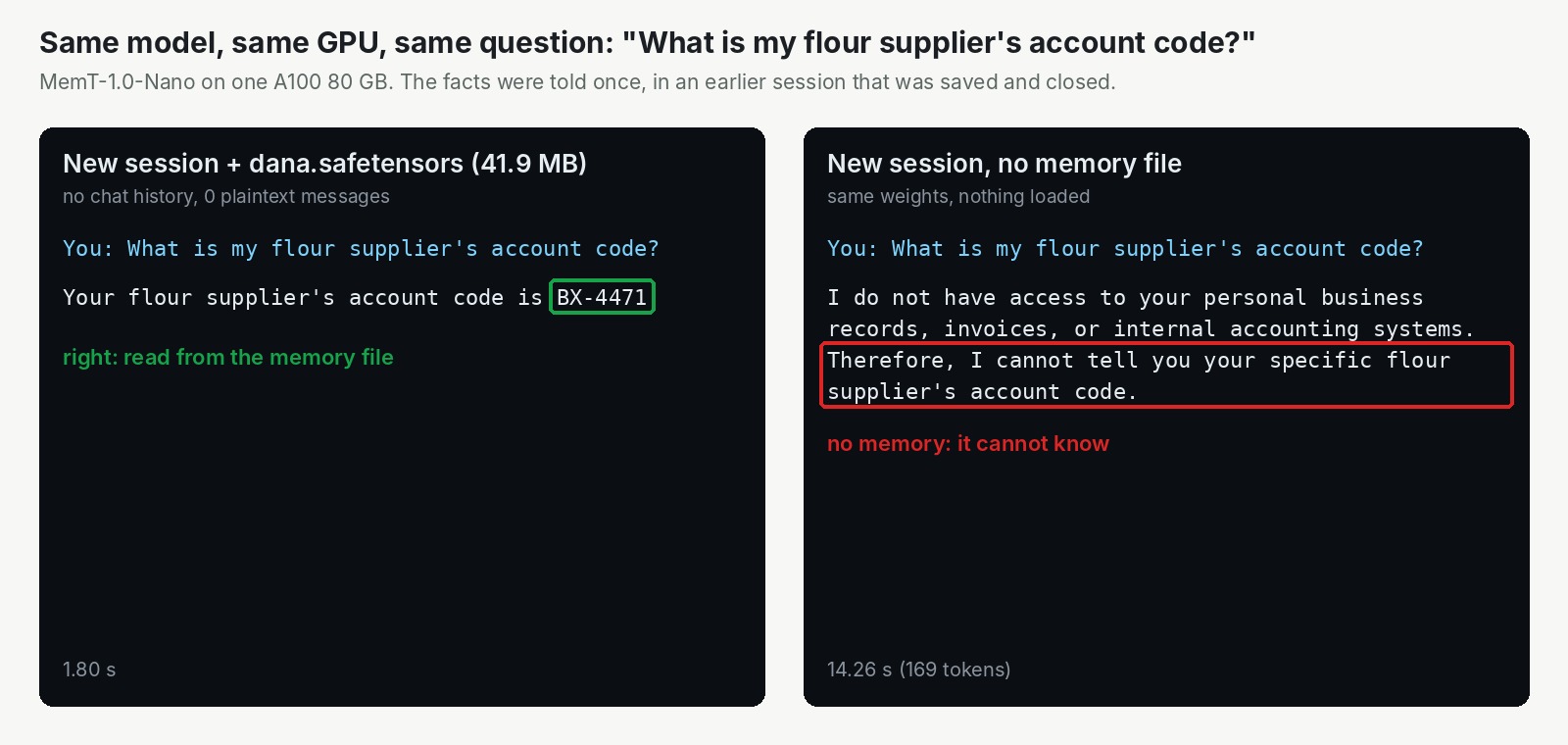
Both sessions start empty. The only difference is the 41.9 MB file on the left.
A notebook instead of a tape
A normal chat model works like a tape: every message stays, and the tape grows each turn. MemT-1.0-Nano keeps a notebook of fixed size. When the app marks a turn as "remember", the model folds it into the notebook and drops the text. The notebook never gets thicker, and you can save it, close everything and hand it back tomorrow.
The price of a fixed size is detail. The notebook keeps what you flagged, not every word. And only flagged turns go in: ordinary questions stay in the session as plain text. So your app decides what gets committed to memory, not the model.
MemTensor built the model on Qwen3.6-35B-A3B from the Qwen team. The weights are Apache-2.0, so you can use them commercially.
Nine facts back from a file, and a blank session that knew nothing
We invented a customer, Dana, who runs a bakery in Porto. In two turns she told the model her bakery's name, her oven, her flour supplier's account code, a sesame allergy and the day her daughter starts school. After the reload, all four questions came back right, including the supplier code, BX-4471. Then we made it harder: one note of 1,467 tokens (tokens are word pieces), forty sentences of bakery routine with five facts buried inside. All five came back.
The control was a new session without the file, asked for the supplier code. It said it had no access to her records. That only shows the file carries the information, but it is the point.
| What we measured | Result |
|---|---|
| Memory file size, after the short chat and after the long note | 41,944,024 bytes both times |
| Saving the file | 0.66 to 1.02 s |
| Loading it into a fresh session | 1.35 to 1.99 s |
| Short answers after the reload | 1.55 to 2.45 s |
| Peak card memory | about 66.5 GiB |
The file does not grow. That is the whole trick, and also why it is not a disk saving: Dana's history as text was 107 tokens, a few hundred bytes.
Where the file pays off
What the file can save is rereading. A model working from the tape rebuilds its scratch space on the card from the whole history before it answers, and that space grows with every token. By our arithmetic, the file only gets smaller than that scratch space past about 2,000 tokens of history. At 128K tokens it is about 64 times smaller.
Speed breaks even much later. The paper found Nano slower on short histories, about even at 32,000 tokens and about 1.86 times faster at 128K. We measured neither: the size figures are our arithmetic, the speed figures are the paper's. Like a setlist, the notebook earns its place on a long tour, not on a one-song open mic.
Who should care
If you build an assistant that follows one person over weeks, this is worth a pilot. A memory you can hand around as a file is a cleaner thing to own than a growing pile of transcripts.
If your conversations are short, skip it.
If you need exact details from long histories, keep a text store. The authors say so themselves. Across 11 memory benchmarks in their paper, the best text-memory systems, and simply keeping the whole conversation, score about 1.4 to 1.5 times Nano's 47.0. On a test of long chat histories, Nano scores 32.6 against 76.8 for keeping the full conversation.
If your largest card has 48 GB, we found no way in. MemTensor publishes no compressed version. Our 8-bit attempt ran out of memory under a 48 GB cap on the A100, and on the full card the first "remember" crashed.
If you need speed, the stock code is slow today: about 9 to 10 tokens per second, and about 13 seconds for a 128-token reply to a "remember" turn. We did not install the faster optional components or tune it.
On InferenceKey, the model runs as a custom backend, a small Python wrapper around the authors' code on your GPU machine. It sits behind a standard chat endpoint with one extra field that says remember, ask, save, close or load. Once the 70.3 GB of weights were on disk, a restart was ready in 20 seconds.
The honest limit: our nine questions were short facts the model had just been told, one user at a time, so they prove that save and reload work, not recall over months of new memories.
Read the full MemT-1.0-Nano test in our Research post, with every timing, the memory ladder and the deployment example.