Hy-SimulMT keeps pace with the speaker on one 48 GB card, but English to Chinese drops sentences
Tencent's open live interpreter on one 48 GB RTX 6000 Ada: first words 2.3 to 5.5 s in, solid into English, uneven into Chinese.
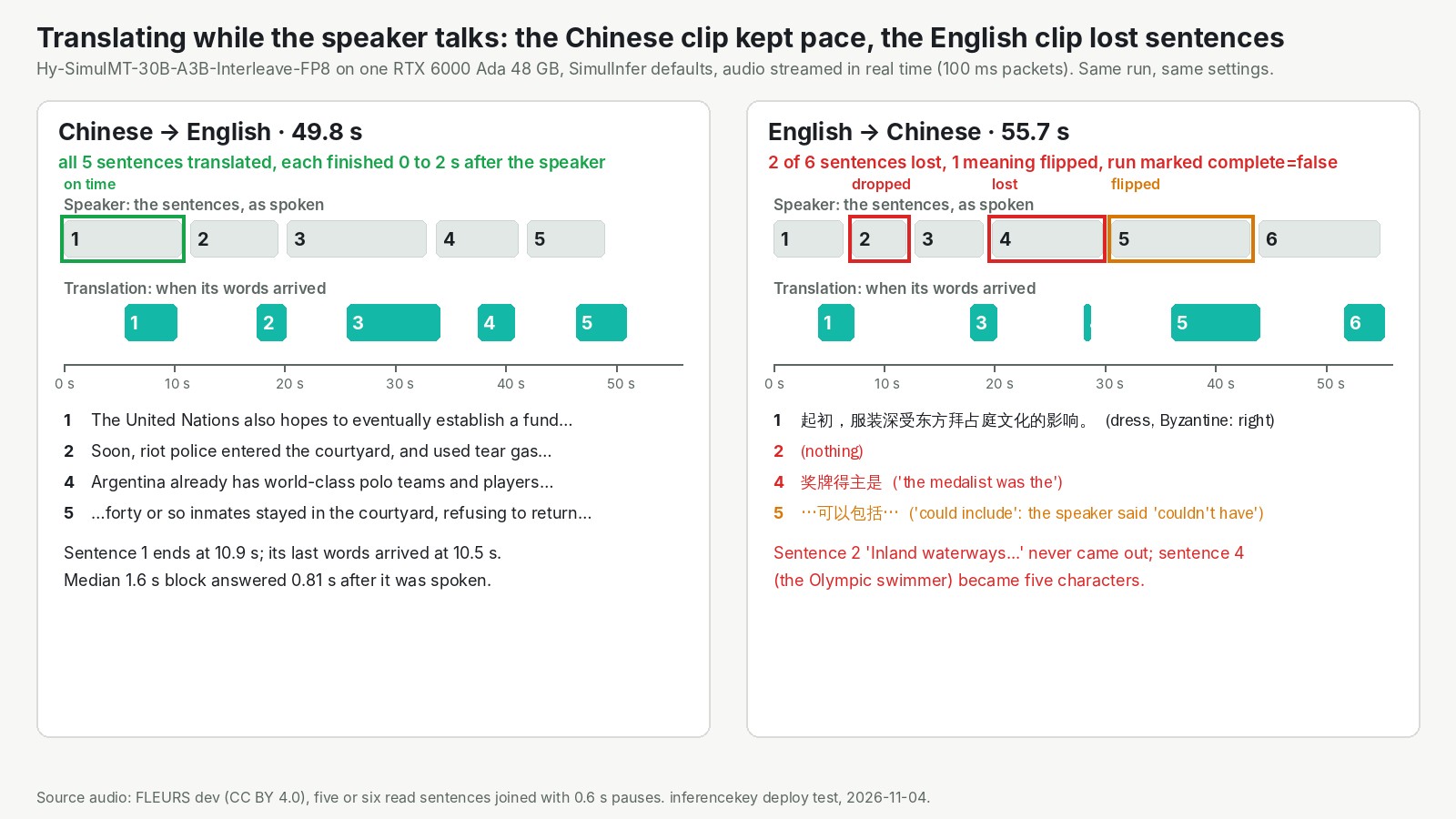
Chinese in, English out: in our first clip, every sentence was translated within about 2 seconds of the speaker finishing it. English in, Chinese out: one clip lost two of its six sentences. Both results came from the same setup, Hy-SimulMT, Tencent Hunyuan's open model for live interpreting between Chinese and English, on one 48 GB RTX 6000 Ada on our cloud. Across four test clips, the first translated words arrived 2.3 to 5.5 seconds in, while the speaker was still talking. For a team that deploys its own models, that is a live interpreter on a single card you own or rent. The meeting audio and its translation never leave it. It served in 38 GB of the card, and a voice clone of the speaker filled the rest. Use it for Chinese to English now. Test English to Chinese on your own audio before anyone relies on it.
An interpreter in the booth, not a relay
Most speech translation is a relay: one program writes down what was said, a second translates the finished text, and the delay grows with every long sentence.
Hy-SimulMT listens and translates in the same model, like the person in the booth at a conference. It hears a slice of speech and decides whether it has enough to say something. A small service from the same authors, SimulInfer, feeds it audio in 1.6-second slices and stitches the pieces together.
Tencent Hunyuan released it on 26 October under Apache-2.0, which allows commercial use. It is a 30B model where only about 3B parameters work on each word: a large team of specialists, a handful consulted per word. That keeps it fast, but the card still holds the whole team. We tested a compressed 32 GB build.
Two limits up front. It only does Chinese to English and English to Chinese, even though its download page lists 40 languages. And it does not speak by itself: spoken output needs a second model, Qwen3-TTS, running next to it.
The authors say it trailed the speaker by about 3 seconds on long recorded talks, the lowest in their comparison. We spotted it in AI Search's news video of 1 November, and we did not re-run the authors' tests.
It kept pace in both directions
We built four clips of 50 to 56 seconds from FLEURS, a public set of read sentences, and streamed each one in tenth-of-a-second pieces at normal speaking speed, as a microphone would. A typical slice of audio was answered 0.4 to 0.8 seconds after it ended, in all four clips. In the first Chinese clip, the opening sentence ended at 10.9 seconds and its translation was already complete at 10.5.
| Clip | First words | Quality score (0 to 100) | Finished? |
|---|---|---|---|
| Chinese 1 into English | 5.5 s | 60.6 | yes |
| Chinese 2 into English | 2.3 s | 51.7 | yes |
| English 1 into Chinese | 4.4 s | 42.2 | yes |
| English 2 into Chinese | 4.0 s | 23.4 | no |
The score measures how closely the wording matches human translations. For an anchor, a smaller build that got every sentence of the first Chinese clip right scored 66.
Speed was even, accuracy was not. The 23.4 clip lost a sentence about inland waterways entirely, and dropped it again when we ran the clip a second time. Another flipped its meaning: the speaker said "couldn't have included" and the translation says "could include". A wrong "could" sounds perfectly fluent. Uploaded as a whole file, the same clip came back incomplete too, so the live setup is not the only cause.
The voice fills the card, and a real 48 GB card is the proven size
The voice clone copies the speaker's voice from the first few seconds of their own speech and reads the translation with it. It runs as Qwen3-TTS-0.6B, from Alibaba's Qwen team, on the same card. On the first Chinese clip, the first English speech came out 8.7 seconds in, and the text kept its pace. The card went from 38 GB to 48 GB in use. English to Chinese with the voice on never answered. Status: open, not investigated.
Cheaper cards are unproven. Under a simulated 32 GB limit it translated both test clips at the same live pace, but startup briefly takes the whole card in every run, so a real 32 GB card may fail at startup. The authors' 4-bit build ran in about 21 GB, for finished files only.
On InferenceKey, this model needs more than a plain model server, so we wrote Python code that installs it with SimulInfer and starts both. A first deploy on a fresh machine was up in about 6 minutes, a restart in 73 seconds. SimulInfer did not recognise the compressed build, so our code writes the small file it looks for. Status: fixed in our example. One limit is ours: our API takes an uploaded file of up to about one minute and plays it at speaking speed, so a live microphone cannot go through it yet. Status: open.
The model, SimulInfer and the benchmarks are Tencent Hunyuan's work. Our part was the deployment, the streaming harness and the measurements.
Who should care
- Teams that need live Chinese to English on their own hardware. This is a strong open option on one 48 GB card.
- Teams that need English to Chinese. Test it on your own audio first, and watch for flipped negations.
- Teams that want the speaker's voice too. Plan for the full 48 GB card and the Chinese to English direction only, for now.
- Teams that need any other language. This is not your model.
The honest limit: four read clips, one session at a time, so long talks, spontaneous speech, accents and noisy rooms are still untested.
Read the full test
The Research post has the timelines, the memory ladder, every rough edge and the SDK example for your own GPU. Read the full Hy-SimulMT test in the Research post.