ZONOS3-Mini clones a voice from a 9-second clip on a 24 GB card, but spell out the numbers
ZONOS3-Mini cloned a voice in 4 languages, every word right, first sound in 55 ms on a 24 GB card. Whisper heard 3 of 6 numbers wrong.
Nine seconds of a voice, no transcript, one 24 GB card. That is all ZONOS3-Mini, the new open speech model from Zyphra, needed in our test to speak English, Spanish, German and French in the cloned voice, with every word heard right by a machine check. The cloned voice started sounding 55 ms after the request on an RTX 4090 and 99 ms on an NVIDIA L4. For anyone who deploys models, that puts fast voice cloning on a gaming card or a small datacenter card, with weights under Apache-2.0, an open license that allows commercial use. What you can do with it today: deploy it on a 24 GB card with our SDK example, clone a voice you have permission to use from about 10 seconds of audio, and write prices, order numbers and phone numbers out as words. In our test line, Whisper heard three of six numbers wrong.
A voice from a bare clip, in a language it never heard
ZONOS3-Mini turns text into speech in 43 languages. Give it a clip of a voice, from half a second up to a minute, and it speaks in that voice without being told what the clip says. A separate decoder turns its output into CD-quality audio, and that decoder, not the model, is what fills the GPU.
The work belongs to Gabriel Clark, Sofian Mejjoute, George Close and Beren Millidge at Zyphra, who published the blog post on 9 November 2026 and the technical report on 12 November. The SGLang-Omni team added ZONOS3 to their open server, where one command starts it and code written for OpenAI's speech API works against it. We spotted the model in the AI Search news video of 15 November. Our part: wrapping that server for InferenceKey and testing it on two real cards on our cloud. Across all the runs, the server answered over 1,000 requests with no crash, no error and no empty file.
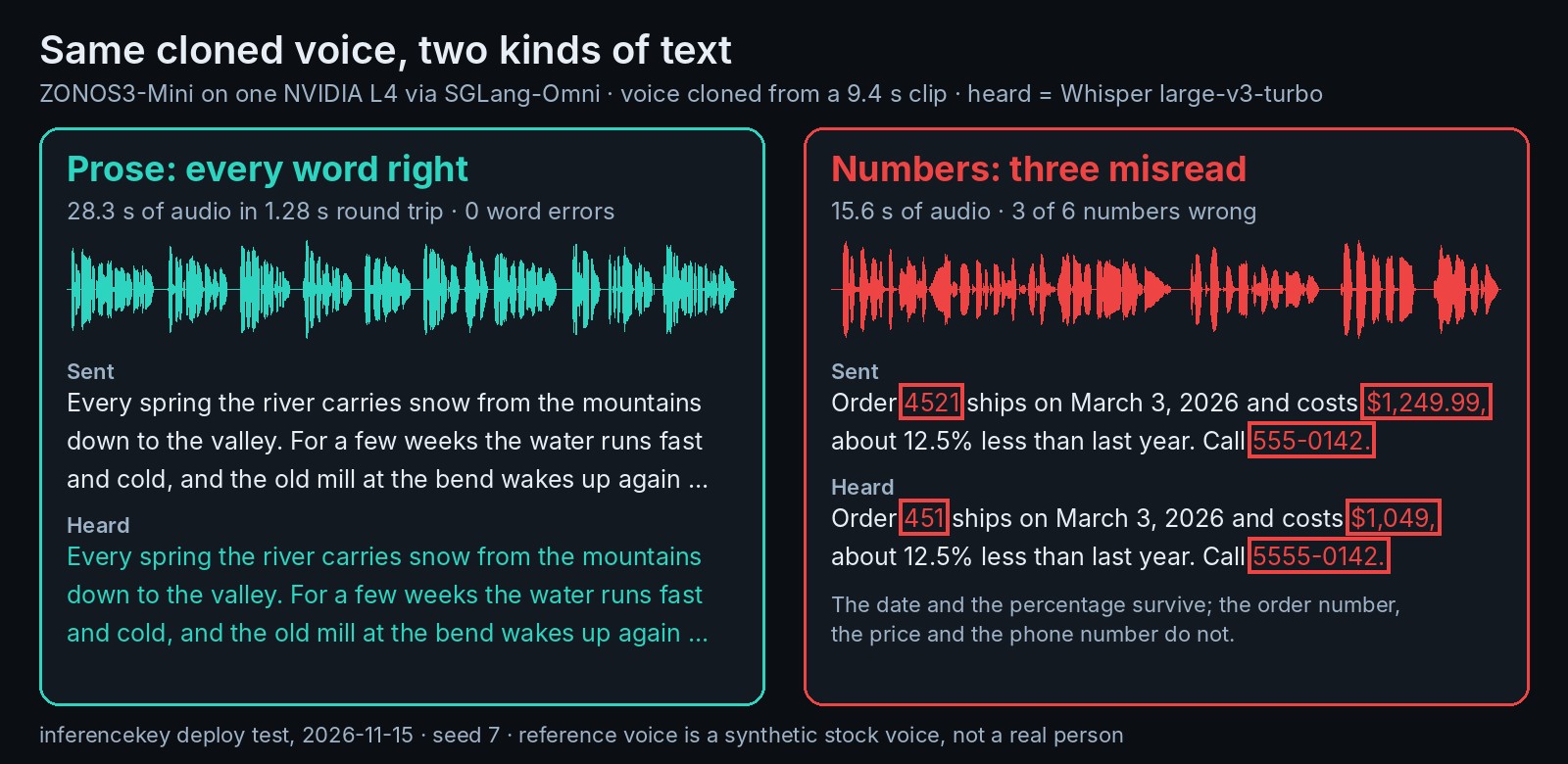
Our reference was a 9.4-second English clip of a synthetic stock voice from our own tools, not a real person. Whisper, OpenAI's speech recognizer, wrote down what each clip said, and a speaker model from Microsoft scored how close each voice was to the reference, from 0 to 1. The clones scored 0.96 in English and 0.90 in Spanish, a language the reference never spoke, and 0.94 in German and 0.91 in French, all word for word. A 28-second paragraph of 90 words came out with zero errors at 0.97. A different preset voice already scores about 0.8, so the clones are closer, not identical.
First sound in 50 ms, and nine seconds of speech in a fifth of a second
| ZONOS3-Mini, 9-second English line, warm | RTX 4090 24 GB | NVIDIA L4 24 GB |
|---|---|---|
| First sound, one request | 50 ms | 70 ms |
| First sound, cloned voice, one request | 55 ms | 99 ms |
| First sound, cloned voice, 8 requests at once | 102 ms | 193 ms |
| Peak GPU memory | 18.1 GiB | 17.6 GiB |
These were measured on the GPU machine itself, streaming audio as it was made. The 4090 produced the 9-second line in about 0.21 seconds, about 43 times faster than it plays. With 8 streams at once it made up to 176 seconds of audio every second; the L4 made 82 to 89.
Zyphra reports 80 ms with 8 requests at once and 457 seconds of audio per second at peak on one 80 GB H100, with a different voice prompt. We did not reproduce those figures.
Where it slipped: order numbers, prices and phone numbers
The prose was perfect. One cloned line with numbers was not. "Order 4521" became "Order 451". The price "$1,249.99" became "$1,049". The phone number "555-0142" got an extra five. The date and the percentage survived. That is one line, one run, transcribed by machine, but in an order confirmation a wrong number costs money, so spell numbers out before you send them.
Who should care
- Voice agents and phone lines: the 50 ms stream comes from the server directly. Our platform does not pass streaming through for custom backends yet, so through our API you get the whole file, in 0.42 s on the 4090.
- Narration, prompts and short replies in a known voice: clone from about 10 seconds of audio, in your language or another one, with a voice you have permission to clone.
- Teams choosing a card: the smallest card that worked was a 24 GB one, and both the gaming RTX 4090 and the L4 passed. Trimmed settings brought it down to 16.4 GiB, a little more than a 16 GB card holds, and every 16 GB card we tried to rent was out of stock.
- Teams deploying on InferenceKey: we wrote a custom backend, a small Python file that tells the platform how to run SGLang-Omni. From an empty machine the 4090 was serving 214.7 seconds later, on a local copy of our stack.
- Anyone weighing this against a hosted voice API: we did not compare prices, so this test does not pick a winner.
The honest limit: we cloned one clean synthetic voice and checked every output by machine, so a real, noisy recording is untested and nobody judged naturalness by ear.
Read the speed tables, the memory ladder and the voice samples in the full ZONOS3-Mini test.