Sophon-Realtime-4B answers in 0.28 s on a gaming card, but it jumped in early on a sum
Open full-duplex voice model on one RTX 4090: 0.28 s median to first sound, 0.34 s with 8 calls. It cut in early on a sum and got it wrong.
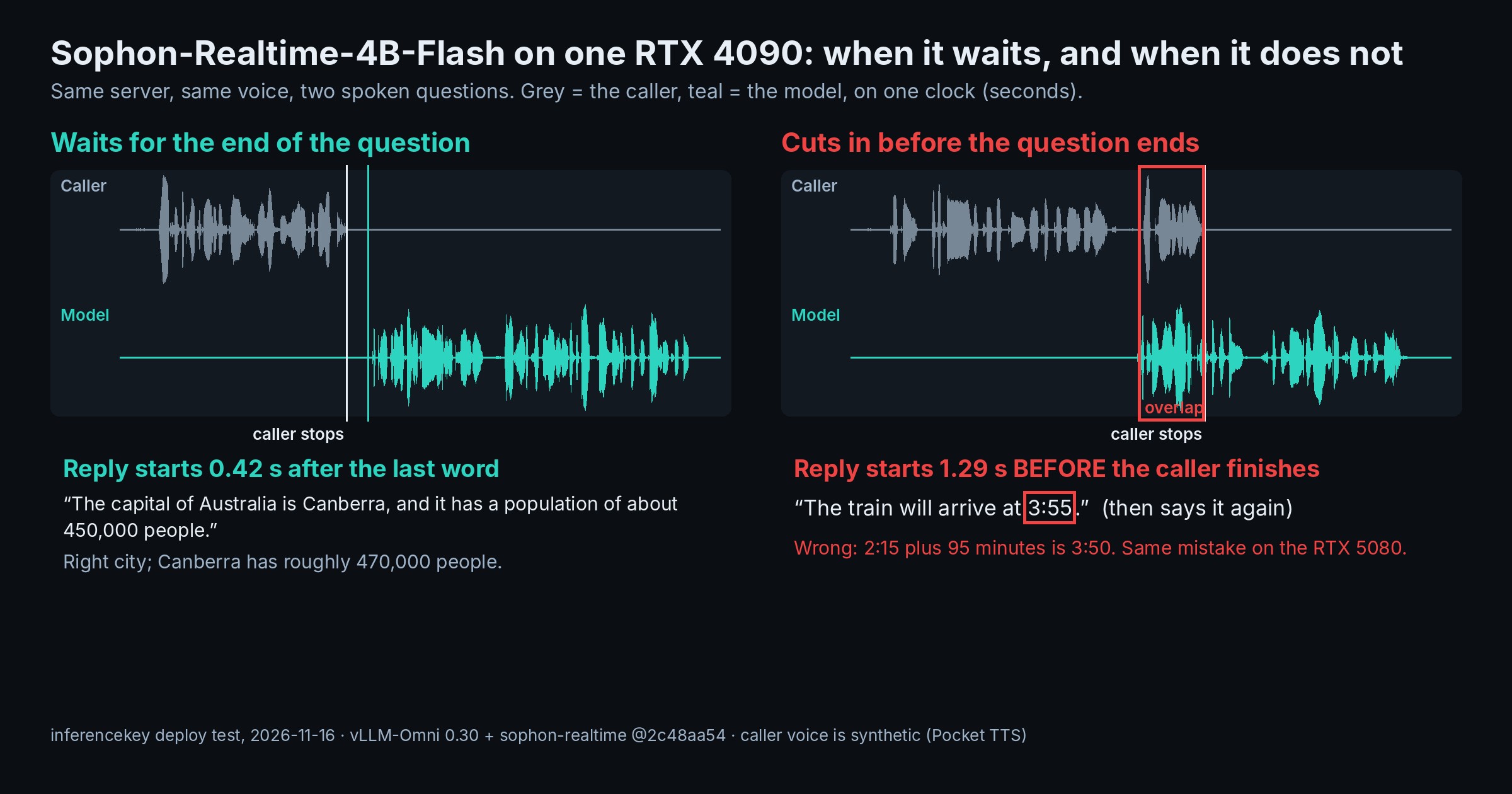
A voice model that answers in a third of a second is only as good as its sense of when you have finished. Sophon-Realtime-4B-Flash, a new open voice model from Adventists AI that listens while it talks, gets the speed right on one RTX 4090 on our cloud. On simple questions, its first sound came a median 0.28 seconds after the caller's last word, and 0.34 seconds with eight conversations at once. For a team building a voice product, that is a live-feeling voice on a 24 GB gaming card the team controls, in 19.5 GiB. With its brain stored more compactly, it also ran on a 16 GB RTX 5080. The sense of timing is shakier: on a small sum about a train, it started answering 1.3 to 1.5 seconds before the caller finished, in every run, and got the sum wrong every time. You can deploy it on your own GPU with our SDK example and send it a recorded question.
It listens the whole time, including while it speaks
A walkie-talkie lets one side speak at a time. Sophon-Realtime works like a phone call. At every pause in your voice, it asks itself whether you have finished, are still talking, are just saying "mm-hm", or are thinking. It starts drafting a reply at your first pause, quietly, and throws the draft away if you keep going. A good bass player does the same with a singer, reading the breath before taking the next bar.
It also clones a voice from a 3 to 10 second clip dropped into a folder, with no training and no restart.
All of this is the work of Adventists AI. Their first open release, on 8 November 2026, was a 32B version that needs one 80 GB datacenter card. Today, version 1.4.0 added 4B builds: the brain, the part that decides what to say, is eight times smaller and fits consumer cards. The authors are blunt about the trade. Their 4B brain "knows and reasons much less than the 32B brain", and on their spoken-question test it scores 62.4 against 82.8.
Mind the licences. The code and the Sophon weights are Apache-2.0, but the 4B brain is built from DuplexJev-4B-Para, which is limited to non-commercial use. Our part: wrapping the authors' two scripts so InferenceKey can deploy them, running them on two cards and measuring what happened.
About a third of a second after your last word, even with eight callers
We played four recorded English questions into the model's live voice line, in a synthetic voice, at the speed a person speaks. The microphone stayed open afterwards and nobody told the model when the caller had finished. It had to decide by itself.
On the joke and capital questions, the 4090 answered 0.25 to 0.42 seconds after the caller's last spoken sound. The gap barely moved with more callers:
| RTX 4090, authors' configuration | Gap after the caller's last word (median) |
|---|---|
| 1 conversation | 0.28 s |
| 4 conversations at once | 0.33 s |
| 8 conversations at once | 0.34 s |
We measured on the GPU machine itself, before any network, so a real call adds its own round trip. Speech came out several times faster than it is spoken, so playback never waits on the voice.
The pause test went the way the authors describe. On a 1.5-second "um" in the middle of a cooking question, the model drafted a reply silently, dropped it when the caller carried on, and answered 0.88 seconds after the real end of the sentence. With a cloned voice, the joke and capital replies came 0.25 to 0.41 seconds after the caller stopped.
Where it broke: it answered the train question too early, and wrong
The question was "if a train leaves at two fifteen and the trip takes ninety five minutes, what time does it arrive?". In all four runs, on both cards and both memory settings, the model was already talking over "what time does it arrive". Then it said the answer again once the caller stopped.
The right answer is 3:50. The model said 3:55 in seven of eight realtime answers and 4:53 once. Facts held up better: Canberra was right every time, though once, on the 5080, its population came out as "about 4.4 million".
Wrong sums and shaky facts are what the authors warn about for the 4B. The early cut-in is our own observation, still open: we left the authors' turn settings at their defaults, and the joke and capital questions never started early.
Who should care
- Companions, characters, demos and game voices: this is the model's home ground. The turn-taking and replies in under half a second on simple questions held up on a gaming card. Check the brain's non-commercial licence before you ship a product.
- Support lines, bookings, anything with times, prices or facts: not the 4B on its own. The authors point you to their 32B builds, which need an 80 GB card, or to their hosted service.
- Teams with a 16 GB card: it works with the brain in 8 bits, at a price. The RTX 5080 held 2 conversations, peaked at 12.7 GiB, answered with a 0.38 s median and took about 12 minutes to start from empty.
- Teams deploying on InferenceKey: we wrote a custom backend, a small Python file that tells the platform how to install, start and talk to a server. From an empty machine, the 4090 was answering about five and a half minutes after our deploy call. The catch: our endpoint cannot hold a live audio line open yet, so one request is one recorded caller turn and the reply comes back as one WAV file.
The honest limit: four English questions, a synthetic caller and one run per setting cannot tell you how often the early cut-in happens in real calls.
Hear the conversations and see the memory ladder in the full Sophon-Realtime-4B test.