Sophon-Realtime-4B talks back 0.28 s after you stop on a 24 GB card, and sometimes before you finish
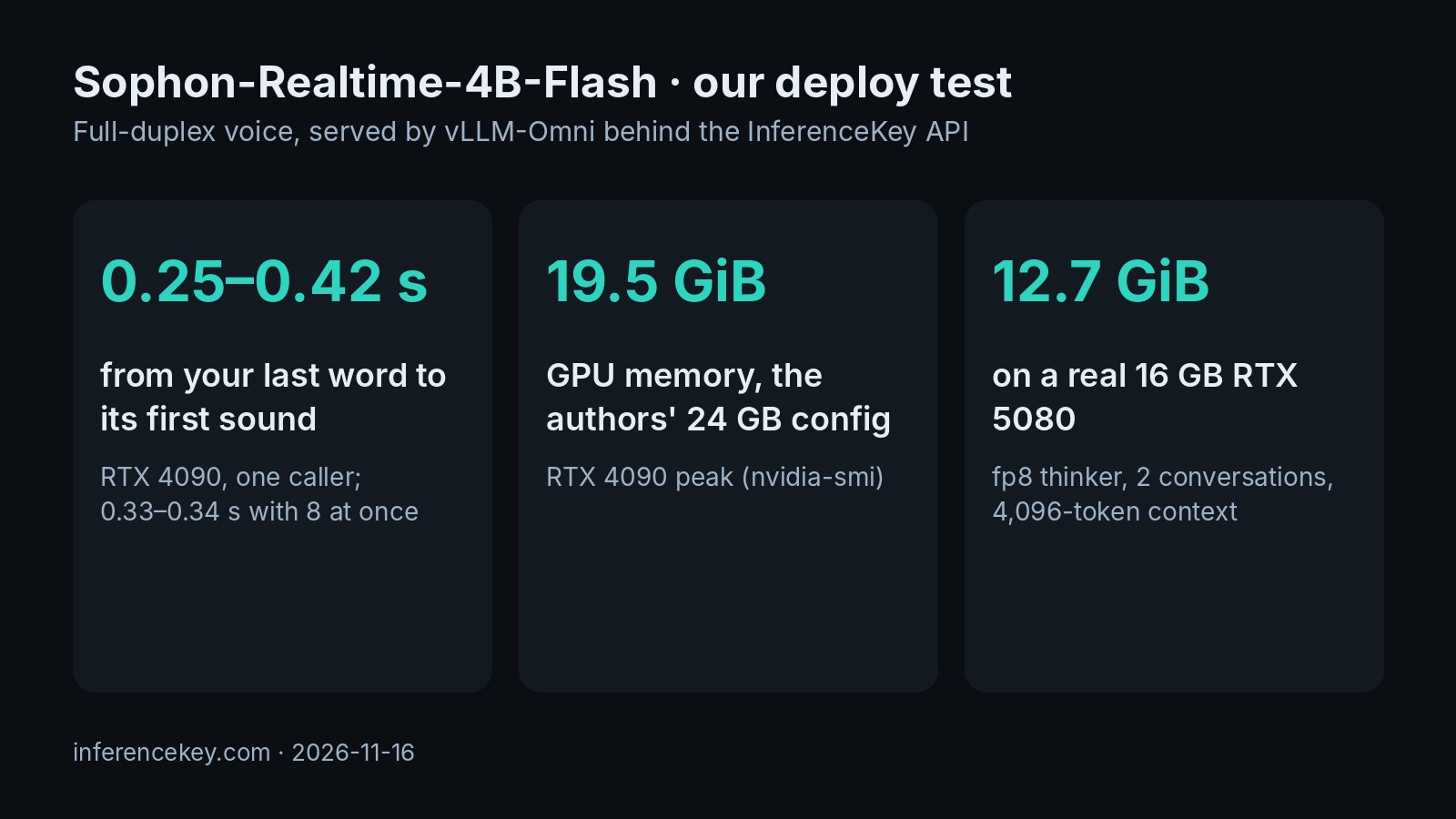
Open full-duplex voice model on an RTX 4090: median 0.28 s to first sound on simple questions, in 19.5 GiB; it also ran on a 16 GB RTX 5080.
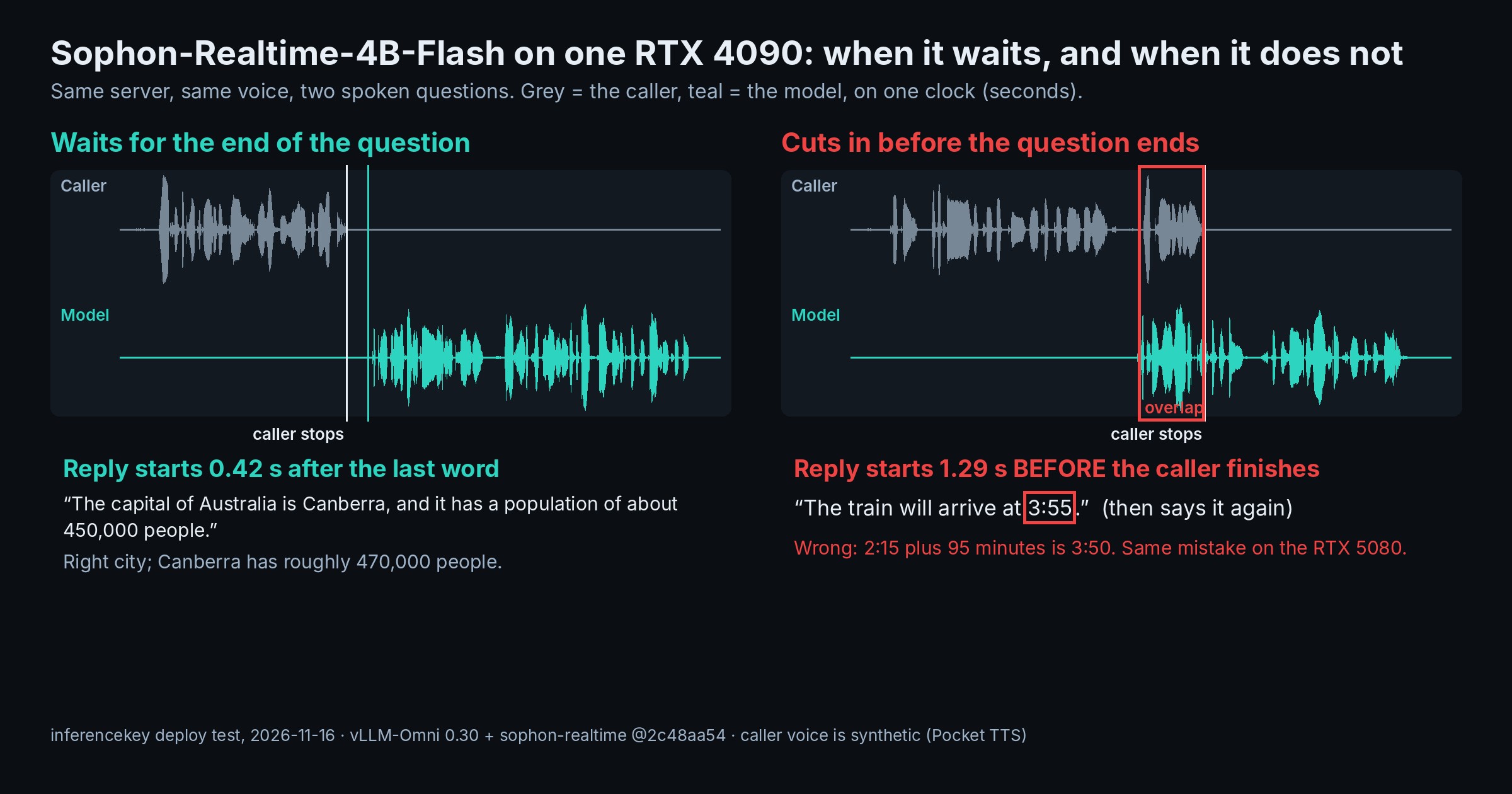
The caller was still saying "what time does it arrive?" when the model started to answer. Sophon-Realtime-4B-Flash, an open voice model from Adventists AI that listens and talks at the same time, was running on one RTX 4090 gaming card on our cloud. On the joke and capital questions, its first sound came a median 0.28 seconds after the caller's last word. With its brain stored more compactly, it also ran on a smaller 16 GB RTX 5080. On a small sum about a train, it jumped in 1.3 to 1.5 seconds early in every run and got the sum wrong every time. For a team building a voice product, that is a voice that answers simple questions in under half a second, from a machine the team controls. Our SDK example deploys it on your own GPU; for now you send a recording, not a live call.
A phone call, not a walkie-talkie, on one gaming card
A walkie-talkie lets one side speak at a time. You talk, you let go of the button, and only then can the other side answer.
Sophon-Realtime works like a phone call. It listens the whole time, including while it speaks. At every pause in your voice, the model asks itself one question with four possible answers. Have you finished, are you still talking, are you just saying "mm-hm", or are you thinking? A good bass player does the same thing with a singer, reading the breath before deciding whether the next bar is theirs.
The model also starts drafting its reply at your first pause, quietly, and throws the draft away if you keep going. If you cut it off mid-sentence, it keeps in its memory only the part you actually heard. We did not interrupt the model or test the "mm-hm" case; those are the authors' claims. Its replies carry sound tags, such as [laughter], [sigh] or [breath], which the voice performs instead of reading aloud. Drop a 3 to 10 second clip of a voice into a folder and it answers in that voice, with no training and no restart.
All of this comes from Adventists AI. The code and the Sophon weights are published under Apache-2.0, but the 4B brain is built from their DuplexJev-4B-Para, whose own licence limits it to non-commercial use. Read both licences before you build a product on it. We spotted the family in the AI Search news video of 15 November, which predates the 4B release. Our part: wrapping the authors' scripts so InferenceKey can deploy them, running them on two cards and measuring what happened.
Their first open release, on 8 November 2026, was a 32B version, which needs one 80 GB datacenter card. Today, version 1.4.0 added 4B builds: the brain, the part that decides what to say, is eight times smaller and fits consumer cards.
The authors are blunt about the trade. Their 4B brain keeps the conversation skills but "knows and reasons much less than the 32B brain", and can state wrong facts with confidence. On the authors' spoken-question test, the 4B scores about three quarters of the 32B (62.4 against 82.8). They recommend it for local demos, companions, characters and turn-taking research, and the 32B or their hosted service when answers must be right. We tested Flash, the fastest 4B build and the one made for a 24 GB card.
The test: nobody told the model when the caller had finished
We played four recorded English questions into the model's live voice line, at the speed a person speaks. The microphone stayed open afterwards. Nobody told the model when the caller had finished. It had to decide by itself, as on a live line.
The caller asked for a joke and for the capital of Australia and its population. Then for cooking advice, with a 1.5-second "um" pause mid-sentence. Last, for a train's arrival time after a 95-minute trip. The caller's voice was synthetic, from an open text-to-speech model.
The main run used an RTX 4090 24 GB on our cloud, with the authors' own configuration. Then we went down in memory, first by capping the 4090 to a 16 GB budget, then on a real 16 GB RTX 5080. The model writes each reply as text, then speaks it. We read all 50 realtime replies, and Whisper, OpenAI's speech recognizer, transcribed 29 so we could check the two match. We tested English only.
About a third of a second after your last word, even with eight callers
On the RTX 4090, on the joke and capital questions, the model's first sound came 0.25 to 0.42 seconds after the caller's last spoken sound, median 0.28 seconds. We measured it on the GPU machine itself, before any network, so a real call adds its own round trip.
The gap barely moved as more people called at once:
| RTX 4090, authors' configuration | Gap after the caller's last word (median) |
|---|---|
| 1 conversation | 0.28 s |
| 4 conversations at once | 0.33 s |
| 8 conversations at once | 0.34 s |
Speech came out several times faster than it is spoken: a 10-second answer took 1 to 1.5 seconds to make with one caller, and under 2.5 seconds with eight. So on a direct connection, playback never waits on the voice.
Here is the joke conversation, caller and model mixed as you would hear them on the line:
- Joke request on the RTX 4090: the model answers 0.28 s after the caller stops
The pause test went the way the authors describe. On the "um" in the cooking question, the model drafted a reply inside the pause and kept it silent. It dropped the draft when the caller carried on, and answered 0.88 seconds after the real end of the sentence:
- Cooking question with a 1.5 s pause mid-sentence: the model waits through the pause and answers at the end
For cloning, we dropped a 6.7-second clip in the voices folder and asked for it by name. The clip was a synthetic narrator voice, not a real person. On the joke and capital questions the reply changed voice and came 0.25 to 0.41 seconds after the caller stopped. We did not measure how close it sounds to the clip. The authors ask that you only clone your own voice or one you have permission to use.
- The same joke answered in a voice cloned from a 6.7 s synthetic narrator clip
What Whisper heard matched what the model wrote in every reply we transcribed. The sound tags were a different story. None of the 50 realtime replies wrote one. Only the joke, sent as a whole clip in chat mode, carried a [laughter].
Where it broke: it answered the train question before the caller finished
On the train question, the model started speaking 1.3 to 1.5 seconds before the caller finished. It did so in all four runs, on both cards and both memory settings. The question was "if a train leaves at two fifteen and the trip takes ninety five minutes, what time does it arrive?". The model was already talking over "what time does it arrive". Then it said the answer again once the caller stopped.
The answer was wrong every time. The right one is 3:50. The model said 3:55 in seven of eight realtime answers, 4:53 once, and 4:25 in chat mode.
- The train question: the model cuts in before the caller finishes and answers 3:55, which is wrong
Facts wobbled less. Canberra was right every time. The population came out between 440,000 and 500,000, and once, on the 5080, as "about 4.4 million".
The wrong sums and the 4.4 million are what the authors warn about. The early cut-in is our own observation, still open: we did not run the 32B to compare, and we left the authors' turn settings at their defaults. The joke and capital questions never started early. With four questions and one run per setting, we cannot say how often this happens in real calls.
Which GPU: 24 GB as shipped, 16 GB with the brain in 8 bits
The smallest card that worked was a real 16 GB RTX 5080. The model's brain was stored with 8 bits per number instead of 16. It held 2 conversations at once with a shorter conversation memory, and peaked at 12.7 GiB (the unit the card reports, slightly larger than a GB). So the 24 GB the authors ask for is the comfortable setting, not the floor.
| Card or setting | Real card or memory cap | Peak memory | Result |
|---|---|---|---|
| RTX 4090 24 GB, authors' setup, 8 conversations | real | 19.5 GiB | works |
| 16 GB budget on the 4090, brain in 16 bits | capped | none | does not start |
| 16 GB budget on the 4090, brain in 8 bits | capped | 13.5 GiB | works, said "What kind of" into the "um" pause |
| RTX 5080 16 GB, brain in 8 bits, 2 conversations | real | 12.7 GiB | works |
The smaller card is a bit slower to answer: the median gap rose from 0.28 to 0.38 seconds. A third conversation on the 16 GB setup is refused, because that setting allows two.
On InferenceKey: the authors' two scripts, ready in five and a half minutes
The authors' two scripts ran unchanged on our cloud. From an empty machine, the 4090 was answering about five and a half minutes (326 seconds) after our deploy call. Most of that was the server's first start, including compiling its code. A second start on the same machine, with the 16 GB settings, took 95 seconds. The RTX 5080 was slower: about 12 minutes from empty, most of it the first start.
No backend built into InferenceKey runs this model, so we wrote a custom backend. That is a small Python file that tells the platform how to install a server, start it and hand requests to it. Ours fetches the authors' repository at a pinned version, runs their two scripts, and passes the memory settings for smaller cards through.
The problem you will hit: our endpoint cannot hold a live audio line open, and custom backends cannot send audio back while it is being made. So one request is one recorded caller turn. The backend plays it into the model at speaking speed, lets the model decide when the turn is over, and returns the finished reply as one WAV file. A live microphone would have to connect to the model directly; we have not built that path. Status: open.
Haru-4B: smaller and more languages, but not an assistant
Sophon-4B-Flash is built to answer you, while Haru is built for people studying how machines hold a conversation. We did not run Haru; this is from its README. higurashi-ai released Haru-4B, another Apache-2.0 full-duplex voice model at the same size. Its README says it runs on an NVIDIA GPU with about 12 GB and speaks nine languages, Spanish, German and Japanese among them. It clones a voice from a sample clip and takes a written description of the character it plays.
The catch is in its own description: Haru is a base model, not trained to act as an assistant, released for research. Its authors say it is not a reliable source of facts and does not follow instructions the way an assistant does.
Should you use it? Yes for a voice that feels live, not the 4B for answers that must be right
- A companion, a character, a demo or a game voice: yes. The turn-taking, the silent drafts and replies in under half a second on simple questions are the point of this model, and they held up on a gaming card. For a commercial product, check the brain's non-commercial licence first.
- Support lines, bookings, anything with times, prices or facts: not the 4B on its own. It got a two-step sum wrong in every run. The authors point you to their 32B builds, which need an 80 GB card, or to their hosted service.
- A 16 GB card: workable with the 8-bit settings above, at a price: 2 conversations, a 0.38 s median and a 12-minute cold start.
- Research on turn-taking: both Sophon-4B and Haru-4B are open, and Haru covers more languages.
- Your own card or a hosted realtime API: for live calls today, their hosted API or a direct connection to your own server; for recorded turns, our example. One 4090 held eight conversations at once for one hourly price.
To hear your own recorded question answered in a cloned voice on your GPU, run python publish.py, then python main.py my-question.wav my-voice.wav, from the Sophon-Realtime-4B-Flash SDK example. It needs a private NVIDIA worker, which is a GPU machine linked to your InferenceKey account. Its card needs 24 GB (or 16 GB with the 8-bit settings), plus about 40 GB of free disk.
For engineers
Credits
- Adventists AI (Adventists.ai): Sophon-Realtime, the code (Apache-2.0), the 4B Flash, 4B E2E and 32B Flash weights, the DuplexJev turn-decision model,
install.shandstart.sh, the vLLM-Omni plugin, the 4B configuration, the benchmarks and the demo videos used in our video with credit. - The Qwen team, Alibaba: Qwen3-4B (Apache-2.0), and Qwen3-ASR-0.6B (Apache-2.0), the audio encoder that hears the caller, the bases of DuplexJev-4B-Para, from which the 4B brain is built with a tag-writing adapter merged in (CHANGELOG 1.4.0); and Qwen3-TTS-12Hz-1.7B-Base (Apache-2.0), the base of the Flash talker, which the 4B shares unchanged with the 32B (
flash/NOTICE). - Licences: the Sophon-Realtime code and the 4B Flash repository are Apache-2.0, but the DuplexJev-4B-Para card is
cc-by-nc-4.0("CC BY-NC 4.0, non-commercial use only") because of its non-commercial training data. Check both before commercial use. - The FunAudioLLM team, Alibaba: CosyVoice, from which the Tag build's expressive code and the E2E decoder and vocoder derive (repository
NOTICE). - The vLLM and vLLM-Omni projects: the serving engine and its multi-stage omni runtime, which serve the model as one process with an OpenAI Realtime-style WebSocket at
/v1/realtimeand/v1/chat/completions. - Silero Team: the Silero VAD voice-activity detector in the duplex session layer.
- higurashi-ai: Haru-4B and its code, discussed from their README only.
- OpenAI: Whisper medium, used to transcribe the replies.
- Kyutai: Pocket TTS, whose stock voices
anna(the caller) andalba(the clone reference) we used. - AI Search: the news video of 15 November (Sophon-Realtime at 25:33, Haru 4B at 20:10) where we spotted both models. It predates the 4B release and nothing said in it is used as a source.
- Our part: the custom backend
sophon-realtime-4b-flash0.1.0, the SDK example, the runs on two cards, the memory ladder, the transcripts, the demo video and the samples.
The model, as published
- Three builds that share one brain and differ in how the reply becomes sound. Tag: an expressive speech model performs the tagged reply. Flash: the same tagged reply spoken by a lighter talker (one forward pass per 80 ms frame) and a 24 kHz codec decoder. E2E: a compact talker that writes continuous voice vectors and a decoder.
- 4B builds (v1.4.0, 2026-11-16), per the authors' README and cards:
| Tag-4B | Flash-4B | E2E-4B | |
|---|---|---|---|
| GPU | one 32 GB (uses ~27 GB) | one 24 GB (uses ~21 GB) | one 32 GB (uses ~31 GB) |
| Full-Duplex-Bench v1.0, average (32B: 94.0) | 94.3 | 87.7 | 92.3 |
| First audio, one user, RTX PRO 6000 held to each card's memory | 0.40 s | 0.21 s | 0.31 s |
- 4B against 32B (authors): VoiceBench 62.4 vs 82.8; Big Bench Audio 44.3% vs 81.8%; sound-tag rate on held-out conversations 0.36 (reference 0.36). The 4B VoiceBench is above Freeze-Omni (55.2) and Moshi (29.5) and below MiniCPM-o (71.2). Reported by the authors, not reproduced by us.
- 4B Flash weights:
adventists-ai/Sophon-Realtime-4B-Flash, shaae4a8591d0ae4c3b3da0250a613828bc2435963b, 36 files, 12,999,734,621 bytes:thinker/(4B, bf16,hidden_size2560),talker/andtalker/speech_tokenizer,voices/(built-inchelsieandbrand). Speech only, no image input. HF languages: zh, en. - 4B E2E: sha
eb7a57ab, 13,918,781,270 bytes,cd e2e; SIZE=4B bash install.sh, thenGPU=0 PORT=8000 bash start.sh. Not run by us. - 32B Flash: sha
13b33529, 40,888,824,724 bytes, one 80 GB GPU, about 55 GB per instance, FP8 brain. Authors' H100 first audio median/P90: 0.31/0.34 s at 1 stream, 0.45/0.52 s at 20, 0.58/0.67 s at 40, 0.84/1.03 s at 64; up to about 40 streams per 80 GB GPU recommended. Their "24 GB GPUs are not enough" note is about the 32B Flash-4bit build, not the 4B. - Release timeline: repository created 2026-11-04; v1.0 2026-11-08; v1.1 voice cloning 2026-11-11; Mac/MLX Flash-4bit 2026-11-13; hosted OpenAI Realtime-protocol API at
wss://api.adventists.ai/sophon/v1/realtime2026-11-14; v1.4.0 4B builds 2026-11-16 (mainHEAD2c48aa54). - Turn decisions (
flash/plugin/sophon_realtime/duplex.py): checks at pauses of 0.2/0.35/0.5/0.8/1.3/2.0 s (SOPHON_TURN_CHECKS) with thresholds 0.95/0.85/0.7/0.5/0.35/0.25 (SOPHON_TURN_THRESHOLDS), fallback reply at 2 s (SOPHON_TURN_FALLBACK), speculative draft after 0.05 s of silence (SOPHON_SPEC_AT) once the user has spoken 0.3 s (SOPHON_SPEC_MIN_SPEECH). Barge-in by the framework VAD. We left them all at their defaults.
Setup
| Item | Value |
|---|---|
| Model | adventists-ai/Sophon-Realtime-4B-Flash at ae4a8591 |
| Server | flash/install.sh (uv, Python 3.12 venv, vllm==0.30.0, vllm-omni==0.30.0, duplexjev-vllm==0.3.0, -e ./plugin) and flash/start.sh at repo commit 2c48aa54. start.sh detects the 4B thinker ("hidden_size": 2560) and picks config/sophon_realtime_flash_4b.yaml; CUDA MPS on by default; VLLM_DISABLE_COMPILE_CACHE=1, so every start recompiles |
| Authors' 4B config | thinker gpu_memory_utilization 0.55, max_model_len 8192, max_num_seqs 16, temperature 0.7, top_p 0.9, max_tokens 400; talker 0.20, len 4096; decoder 0.07 bf16; max_sessions 8, idle_ttl_s 60, Silero VAD |
| Backend | custom Python backend sophon-realtime-4b-flash 0.1.0 (text2audio, chat route). setup() fetches the repo tarball at the pinned commit, downloads the weights at the pinned revision in parallel, runs install.sh, links flash/model, runs start.sh on a free loopback port with optional config patches; a watchdog runs stop.sh if the backend dies |
| Realtime turn | one /v1/realtime session: session.update with turn_detection: server_vad and extra_body.auto_response: true; caller audio resampled to 16 kHz float32, sent as 80 ms input_audio_buffer.append frames at speaking pace after 0.3 s of silence, then silence until response.done |
| Chat mode | the same request as the authors' client_example.py, sent by our backend on /v1/chat/completions |
| Cards | RTX 4090 24 GB (24,564 MiB, driver 595.91.07, CUDA 13.2, no nvcc); RTX 5080 16 GB (16,303 MiB, driver 580.178.04, compute capability 12.0) |
| Platform | local InferenceKey manager and worker built from main, never production |
| Inputs | four English questions in a synthetic stock voice (Pocket TTS anna): joke 5.82 s, capital and population 4.27 s, cooking with a 1.5 s "um" pause 8.26 s, train arithmetic 6.66 s. Clone reference: 6.7 s of the synthetic stock voice alba |
| Checks | Whisper medium on CPU, 29 replies; nvidia-smi sampled every second for card peak |
Step by step with the SDK example
The example (commit dd2f3a1b on main) holds backend.py, publish.py, main.py, requirements.txt, README.md and .env.example.
git clone https://github.com/inferencekey/inferencekey-sdk.git && cd inferencekey-sdk
(cd bindings/python && maturin develop --release)   # client: local SDK build (Rust toolchain + maturin, in your venv)
pip install requests                                # client: the only other dependency of main.py
cd examples/sophon-realtime-4b-flash-vllm-omni-custom-backend-private-nvidia
cp .env.example .env    # INFERENCEKEY_SDK_TOKEN, INFERENCEKEY_API_KEY, INFERENCEKEY_PROJECT, IK_WORKER_ID,
                        # plus INFERENCEKEY_TENANT_ID and INFERENCEKEY_USER_TOKEN for publish.py and the chat route
python publish.py       # once: packages the backend and uploads it (without the two dashboard variables,
                        # upload dist/*.tar.gz in Dashboard -> Custom backends instead)
python main.py my-question.wav my-voice.wav
main.py calls ensure() (fixed policy, ready_timeout_secs 3600, SOPHON_* variables passed through), wait_until_ready(3600), turns on the chat route when INFERENCEKEY_USER_TOKEN is set (otherwise turn on Chat in Dashboard -> Endpoint settings), sets max_in_flight to 8, then sends three requests: a realtime turn in the built-in voice chelsie, a realtime turn in your cloned voice (only when you pass a 3 to 10 s clip), and the same question in chat mode. Each writes outputs/<name>.wav (24 kHz reply), <name>.conversation.wav (caller left, model right, one clock) and <name>.json (text with tags, timings, server events). IK_KEEP_ALIVE=1 keeps the workload afterwards. No CUDA toolkit is needed on the worker.
For a 16 GB card:
export SOPHON_THINKER_QUANTIZATION=fp8          # thinker weights 4.74 GiB instead of 7.92
export SOPHON_STAGE_GPU_MEMORY=0.44,0.30,0.075  # thinker, talker, decoder: fractions of THIS card
export SOPHON_THINKER_MAX_MODEL_LEN=4096
export SOPHON_MAX_SESSIONS=2
python main.py my-question.wav
Request options in extra_body: mode (realtime by default, or chat), voice, language, voice_clip_b64, pace (1.0 = speaking speed), max_wait_s (how long the microphone stays open after the caller stops, default 25), max_tokens, temperature.
Note on the numbers main.py prints: it measures the gap against the end of the clip, which includes up to 0.36 s of trailing silence, so it can print small negative values (for example -0.079 s). The gaps in this article come from scripts/metrics.py, against the caller's last voiced sample (energy threshold).
Time to ready
| Run | Ready after ensure() | Breakdown |
|---|---|---|
| RTX 4090, empty caches, authors' config | 326.4 s | install.sh 72.2 s, 13 GB of weights 12.1 s in parallel, start.sh 251.8 s incl. kernel compile and the authors' realtime warm-up (reply in 10.4 s) |
| RTX 4090, caches warm, 16 GB fp8 settings | 94.8 s | start 93.9 s |
| RTX 4090, caches warm, 16 GB bf16 settings | failed after 61.6 s | talker KV check, below |
| RTX 5080, empty caches, 16 GB fp8 settings | 750.3 s | install 182.4 s, weights 25.3 s, start 566.5 s; the authors' turn-check warm-up timed out 3 times, then the realtime warm-up replied in 14.0 s |
Realtime turns through the InferenceKey API
POST /endpoint/<project>/<workload>/v1/chat/completions with mode: realtime. Gap = first reply audio minus the caller's last voiced sample, on the backend's clock on the GPU host.
| Card / config | Turn | Gap | Reply speech |
|---|---|---|---|
| 4090 as shipped | joke (main.py) | 0.28 s | 8.64 s |
| 4090 | joke, cloned voice (main.py) | 0.25 s | 8.00 s |
| 4090 | joke | 0.25 s | 8.24 s |
| 4090 | capital and population | 0.42 s | 6.65 s |
| 4090 | capital, cloned voice | 0.41 s | 5.84 s |
| 4090 | cooking with pause | 0.88 s after the end; a reply was created in the pause at 6.45 s and cancelled 0.12 s later, no audio | 12.64 s |
| 4090 | train | -1.29 s, two replies | 5.76 s |
| 4090 | train, cloned voice | -1.45 s, two replies | 3.75 s |
| 4090 | capital x2 / x4 / x8 at once | 0.33-0.34 / 0.329-0.340 / 0.336-0.343 s | 5.4-7.7 s |
| 4090, 16 GB fp8 budget | joke / capital / capital cloned | 0.26 / 0.35 / 0.35 s | |
| 4090, 16 GB fp8 budget | cooking with pause | first audio 1.93 s before the end ("What kind of"), then answered | 14.24 s |
| 4090, 16 GB fp8 budget | train | -1.47 s, "It arrives at 3:55. It arrives at 4:53." | |
| 4090, 16 GB fp8 budget | capital x4 at once | 2 answered (0.40 / 0.42 s), 2 refused (max_sessions 2) | |
| 5080 16 GB fp8 | joke / joke cloned / capital (2 runs) | 0.26 / 0.34 / 0.41, 0.40 s; clone in main.py 0.38 s | |
| 5080 | cooking with pause | 0.74 s after the end, pause draft not voiced | 12.88 s |
| 5080 | train | -1.45 s, "3:55" twice | |
| 5080 | capital x2 at once | 0.35 / 0.38 s |
Medians: 4090 0.28 s alone, 0.33 s at 4, 0.34 s at 8; 5080 0.38 s. Speech generation speed (reply seconds over generation time): 4090 6.9 to 9.9x real time with 1 conversation, 5.3 to 5.7x at 4, 4.3 to 4.8x at 8; 5080 6.6 to 9.3x. A realtime turn ends at response.done, when generation is complete, not when playback would end.
Chat mode, request to first audio (our backend sent the same request as the authors' client_example.py, a whole recorded question in one piece): 4090 0.18 s (joke, 11.76 s of speech), 0.18 s (capital), 0.155 s (train); 5080 0.197 s (capital), 0.185 s (joke). The authors report 0.21 s for this build the same way on an RTX PRO 6000. It is not comparable with the realtime gap, which includes the model deciding that the caller has finished.
GPU memory and the ladder
vLLM-Omni has no single memory cap for its three stage processes, so each rung sets each stage's share of the card and records the card peak it actually used. Capped rungs ran on the 4090 through the platform with the same turns.
| GPU or setting | Configuration | Card peak | Gap | Output OK? | Real or capped |
|---|---|---|---|---|---|
| RTX 4090 24 GB | authors' config: bf16, shares 0.55/0.20/0.07, len 8192, 8 sessions | 20,009 MiB (19.5 GiB; 19,767 MiB right after start) | 0.25-0.42 s; 0.34 s at 8 | yes, including the train cut-in | real |
| 16 GB budget on the 4090 | bf16, shares 0.40/0.18/0.05 (15.5 GiB), thinker len 4096, 2 sessions | none | none | no: talker stage ValueError: To serve at least one request with the model's max seq len (4096), (0.44 GiB KV cache is needed, which is larger than the available KV cache memory (0.19 GiB). The thinker itself fit (7.92 GiB weights, 0.74 GiB KV) | capped |
| 16 GB budget on the 4090 | thinker fp8, shares 0.30/0.20/0.05 (12.9 GiB), len 4096, 2 sessions | 13,797 MiB (13.5 GiB) | 0.26-0.35 s | mostly: voiced "What kind of" into the 1.5 s pause | capped |
| RTX 5080 16 GB | thinker fp8, shares 0.44/0.30/0.075 (same absolute budget), len 4096, 2 sessions | 13,049 MiB (12.7 GiB) | 0.26-0.41 s, chat 0.19-0.20 s | yes; pause not voiced; train cut-in as on the 4090; one "4.4 million" | real |
5080 vLLM log: thinker loading 4.74 GiB (bf16 on the 4090: 7.92 GiB), KV 1.25 GiB; talker 3.94 GiB, KV 0.47 GiB.
Not tried: 12 GB cards, bf16 with a shorter talker context (the backend has no switch for the talker length), Ampere 16 GB cards such as the A4000 (fp8 would run weight-only there), other 24 GB cards such as the RTX 3090 or L4, the 4B Tag and E2E builds, the 32B builds, Live mode and the Mac/MLX path.
Quality
- 29 replies transcribed with Whisper medium; every transcript matches the written reply, punctuation and number format aside ("3:55" heard as "3.55", "4:25" as "425"). Tags in the text are not heard as words.
- Capital of Australia: Canberra in every reply; population 440,000 to 500,000, once "about 4.4 million" (5080, one of two concurrent replies).
- Train arithmetic (2:15 + 95 min = 3:50): "3:55" in 7 of 8 realtime answers, "4:53" once, chat mode "4:25".
- Turn-taking: the train question cut in 1.29 to 1.47 s before the caller finished in all 4 runs and repeated the answer. The cooking pause: bf16 on the 4090 and fp8 on the 5080 drafted silently and yielded; the 4090 fp8 budget voiced "What kind of" into the pause. Joke and capital: never early.
- Cloning: the 6.7 s clip was accepted by name (
voices/<name>.wav); replies came in a different voice fromchelsie. Similarity not scored, not every clip listened to. - Sound tags: none in 50 realtime replies; the chat reply to the joke wrote
[laughter]. Tag rate not measured.
Problems and their status
- Cut-in before the question ends on the train question, then a repeated answer. Model behaviour, open; the drafting and turn thresholds above are environment variables we did not tune.
- Wrong arithmetic and an occasional wrong fact. Model limit, stated by the authors.
- 16 GB needs the thinker in fp8: bf16 fails at the talker KV check. Shares are fractions of the card: our first 5080 launch reused the 4090 shares, which are too small on 16 GB, and was relaunched. Documented in the example.
- No WebSocket passthrough and no audio streaming back for custom backends: one request is one recorded turn; the reply returns as one WAV after generation. Platform, open.
- A third conversation on the 16 GB setup is refused with
custom backend returned 500: {"error": "no close frame received or sent"}, surfaced by the manager as 503backend_unavailable(max_sessions2). A clearer message is a backend change, open. - Slow cold start on the RTX 5080: 750 s, 566 s of it server start, with three warm-up timeouts.
start.shdisables the compile cache, so every start recompiles. - Harmless log noise:
Dropping unknown OmniEngineArgs field 'enable_broadcast_weight_load'andtorch.compile cache is disabled.
Limits
One run per setting at temperature 0.7, so single differences can be chance. We did not interrupt the model mid-reply or test backchannels (the "mm-hm" case). Four questions are not enough to say how often the cut-in happens in real calls. Synthetic caller and clone voices, English only (the 4B card lists Chinese and English; other languages in the family README were not checked on the 4B). A request is a recorded turn, not a live microphone session. The gap is measured on the GPU host, before any network, and through our platform the reply arrives as one WAV after generation. Our numbers came from a local manager; the hosted service was not called. Hardware and builds not tried are listed under the memory ladder; the only 24 GB card we ran is the RTX 4090. The authors' benchmarks were not reproduced. Haru-4B was not run.
Demo video and samples
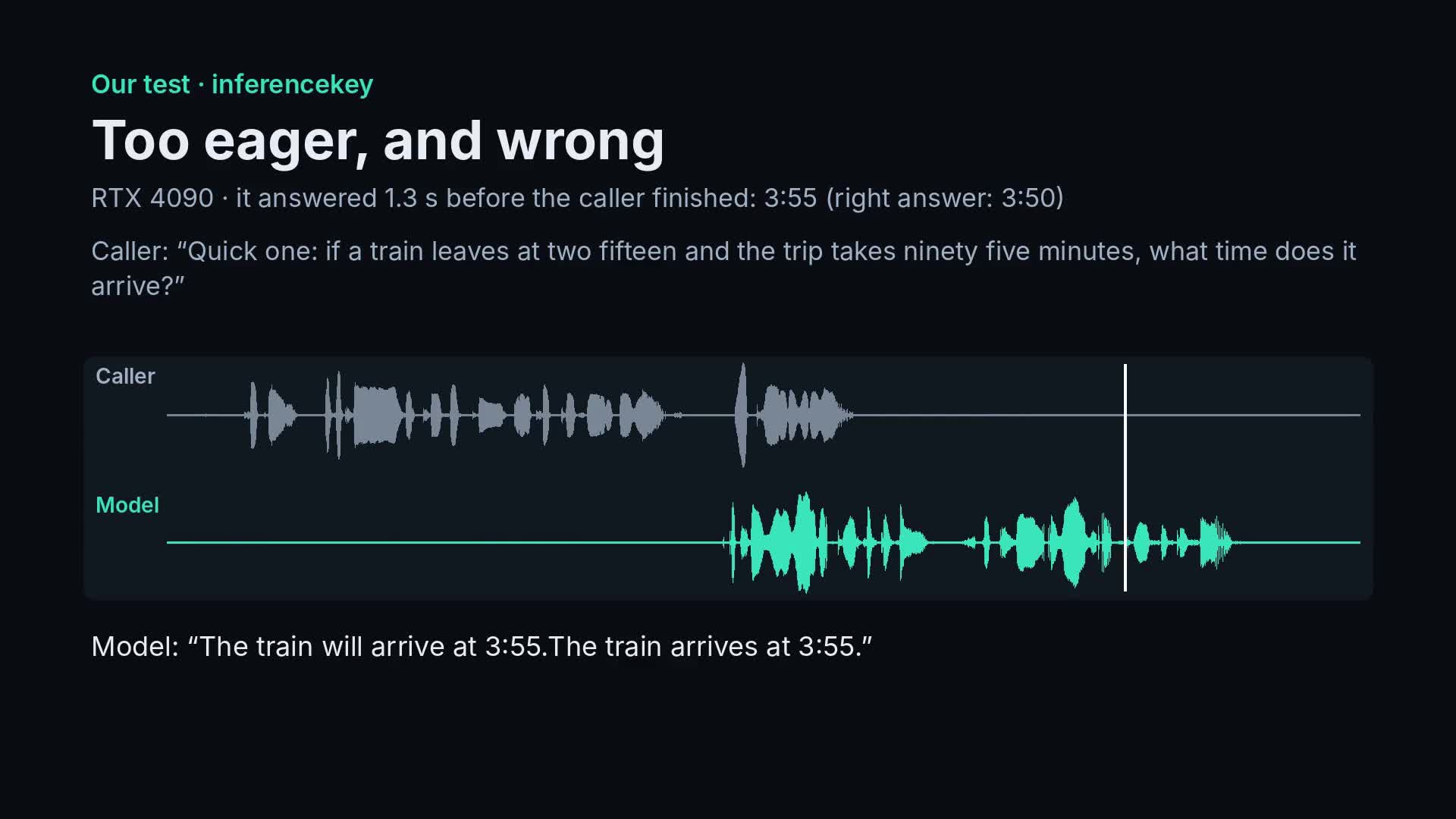
The 192-second demo shows the authors' own demo conversations with credit (32B build), their benchmark figures labelled "Reported by the authors, not reproduced by us", our dashboard with the workload on one RTX 4090, our conversations, and the latency and GPU memory inserts.
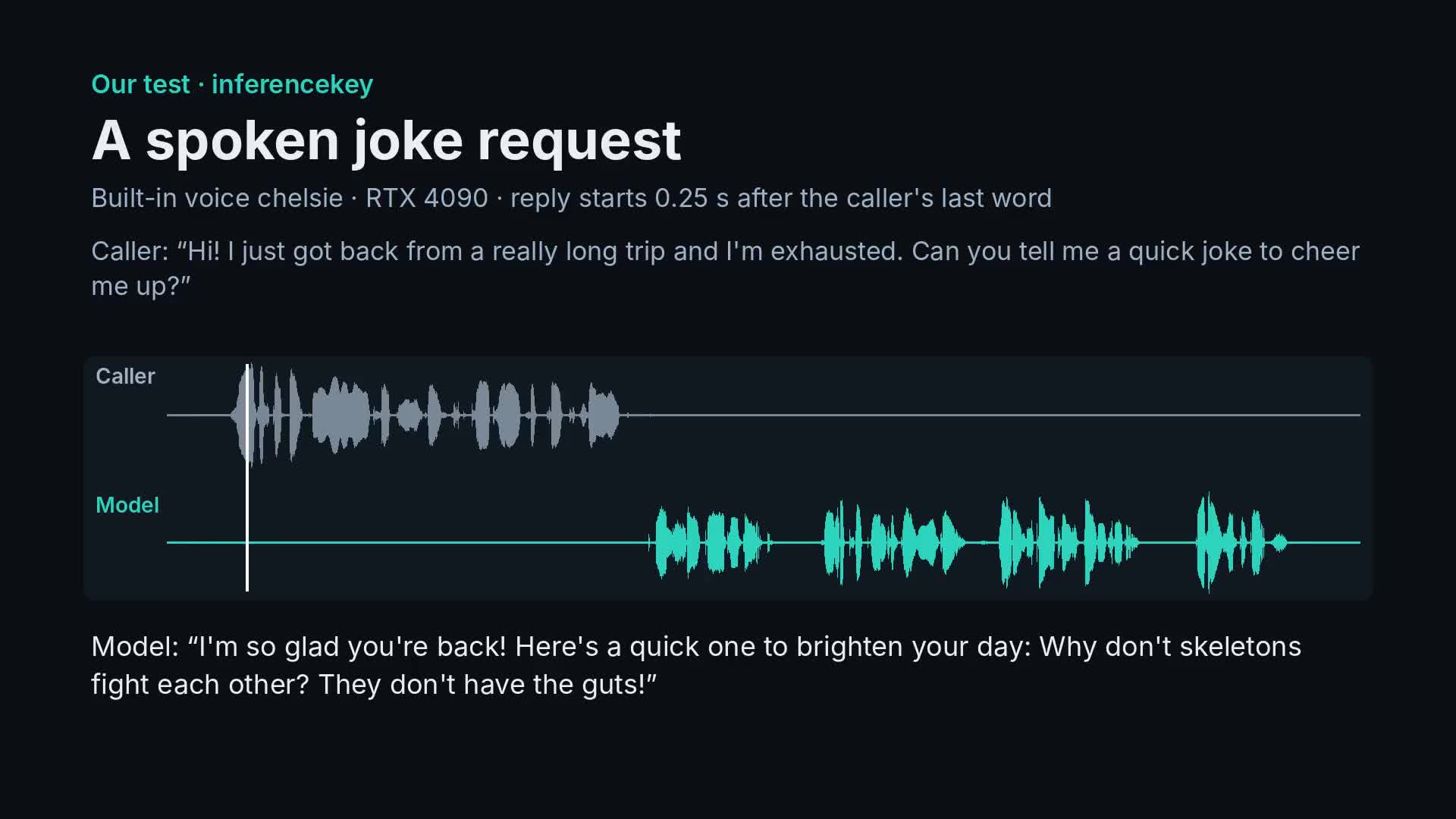
A 61-second clip of four conversations on the 4090: the joke, the cloned narrator voice, the mid-sentence pause and the early cut-in with the wrong sum.
- Capital of Australia on the real RTX 5080 16 GB with the fp8 brain
- The joke in chat mode on the RTX 4090, reply only, with a performed laugh
- The 6.7 s synthetic narrator clip used as the clone reference
Sources
- Sophon-Realtime repository, README ("4B builds (new in 1.4)", "How it works", News), CHANGELOG 1.4.0 and NOTICE files at commit
2c48aa54: https://github.com/adventists-ai/sophon-realtime - Model cards: Sophon-Realtime-4B-Flash, Sophon-Realtime-4B-E2E, Sophon-Realtime-32B-Flash
- Haru: model card and repository
- Where we spotted it: AI Search news video, 15 November 2026
- Our SDK example: https://github.com/inferencekey/inferencekey-sdk/tree/main/examples/sophon-realtime-4b-flash-vllm-omni-custom-backend-private-nvidia