ZONOS3-Mini starts talking in 50 ms on a 24 GB card, and Whisper heard 3 of 6 numbers wrong
ZONOS3-Mini on SGLang-Omni: first audio in 50 ms on an RTX 4090, 70 ms on an L4, every word right in 4 languages, 3 of 6 numbers heard wrong.
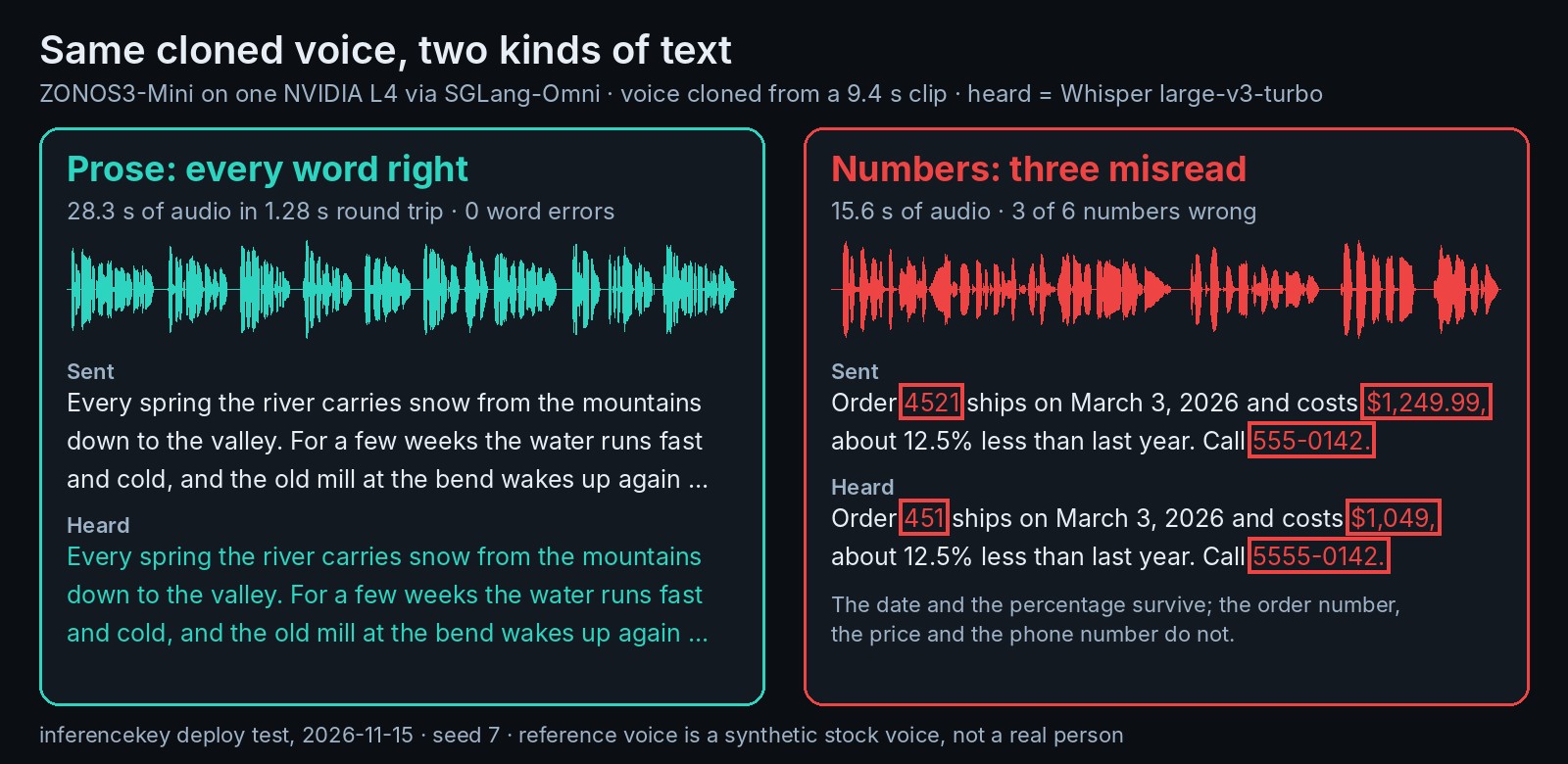
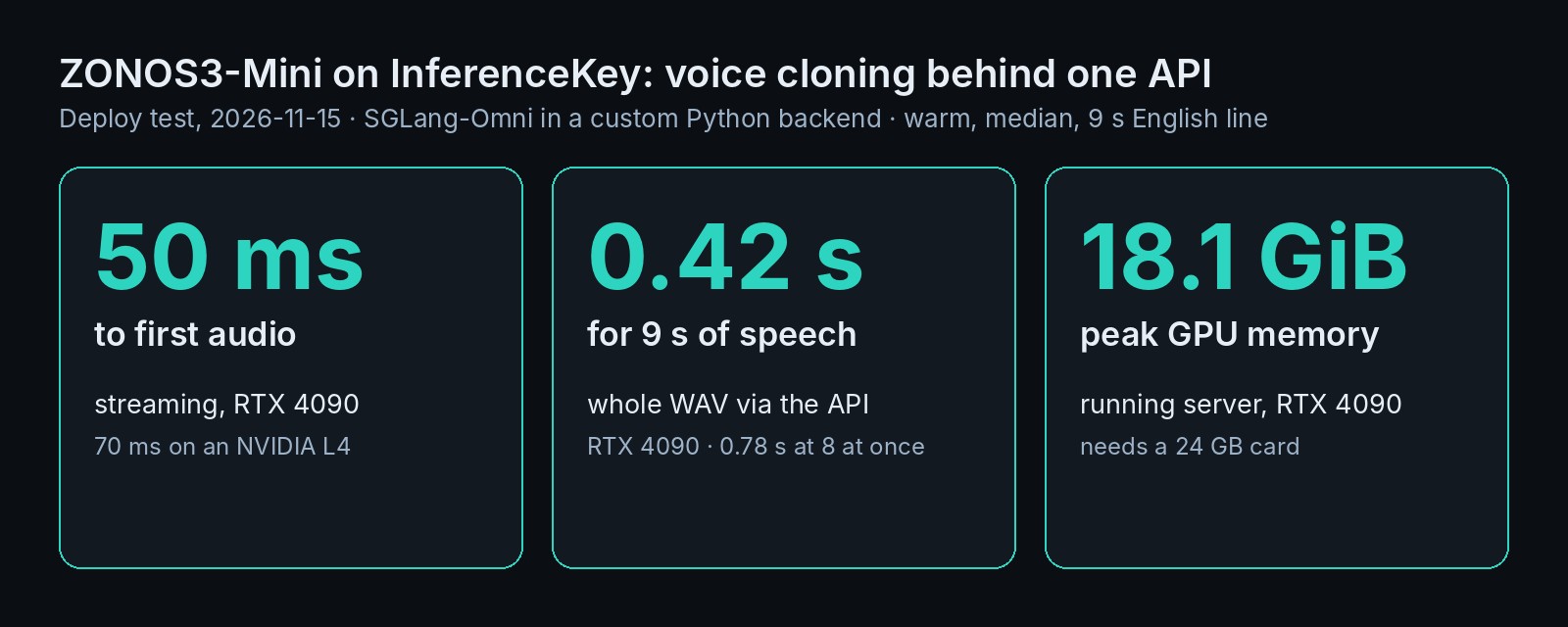
How long does an open speech model take to start talking? ZONOS3-Mini, Zyphra's new one, made its first sound in 50 milliseconds on an RTX 4090 and 70 on an NVIDIA L4, both 24 GB cards on our cloud. With a cloned voice, 55 and 99 ms. We gave it 9 seconds of a voice and no transcript, and it spoke English, Spanish, German and French in that voice, every word right. We cloned a clean synthetic voice from one English clip. A real, noisy recording is untested. On the 4090 it made 9 seconds of speech in about a fifth of a second. Our API does not stream yet: it returns the whole file in 0.42 s. The weights allow commercial use. The catch is in the text: in our test line, Whisper heard three of six numbers wrong, a price among them. Spell numbers out before you send them. Our SDK example deploys the whole thing on a 24 GB card.
| ZONOS3-Mini, 9-second English line, warm | RTX 4090 24 GB | NVIDIA L4 24 GB |
|---|---|---|
| First sound, one request | 50 ms | 70 ms |
| First sound, cloned voice, 8 requests at once | 102 ms | 193 ms |
| Peak GPU memory | 18.1 GiB | 17.6 GiB |
| Words heard right (prose) | all, English and Spanish | all, 4 languages |
A voice cloned from a bare clip, no transcript needed
ZONOS3-Mini turns text into speech in 43 languages. Give it a clip of a voice, from half a second up to a minute, and it speaks in that voice. It does not need to know what the clip says. That is what "no transcript" means: you upload the clip, nothing else. A separate decoder turns its output into CD-quality audio, and that decoder is what fills the GPU.
The work belongs to Gabriel Clark, Sofian Mejjoute, George Close and Beren Millidge at Zyphra. They published the blog post on 9 November 2026 and the technical report on 12 November. The weights are under Apache-2.0, an open license that allows commercial use. They released the inference and training code too, plus versions that run on laptops, Apple chips and in the browser. Their blog says they trained it in 2.5 days on 112 H100 datacenter cards.
The SGLang-Omni team added ZONOS3 to their open server. One command starts it, and code written for OpenAI's speech API works against it. We spotted the model in the AI Search news video of 15 November. Our part: wrapping that server so InferenceKey can deploy it, running it on two cards, and measuring speed, memory and accuracy.
Over 1,000 requests, no crash: the test on two cards
Across speed runs, memory tests and sample clips, the server answered over 1,000 requests with no crash, no error and no empty file. It ran on two real cards on our cloud. The NVIDIA L4 is a small, low-power datacenter card with 24 GB of memory. The RTX 4090 is a 24 GB gaming card. Both ran the same server version with the same settings.
The speed tests read one 9-second English line about a parcel, with 1, 4 and 8 streams at once. The clone came from a 9.4-second clip of a synthetic stock voice from our own tools, not a real person. We checked every output by machine. Whisper, OpenAI's speech recognizer, wrote down what it heard, and a speaker model from Microsoft scored how close each voice was to the reference, from 0 to 1. Nobody judged naturalness by ear, so read the quality results as "right words, right voice", not "sounds human".
First sound in 50 to 70 ms, and 9 seconds of speech in a fifth of a second
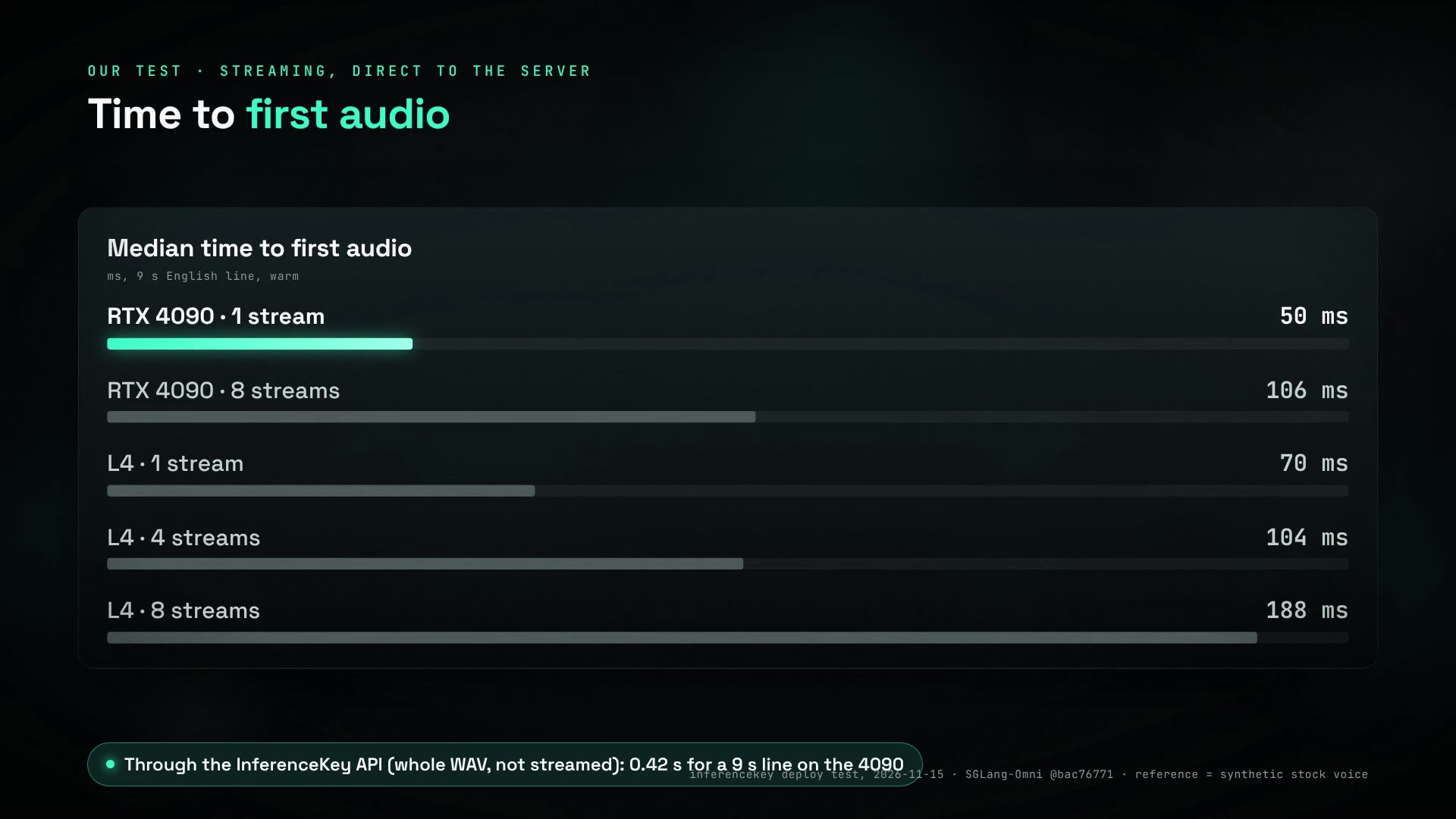
The 4090 started speaking 50 ms after the request, the L4 70 ms. Both were measured on the GPU machine itself, streaming audio as it was made.
With 8 streams at once, both stayed under a fifth of a second: 106 ms on the 4090, 188 ms on the L4. Cloning costs little: 55 ms for one stream on the 4090, 99 ms on the L4. The first time a card serves 4 streams at once it is slow: on the L4, about a second (1.03 s). After that, 104 ms.
The other number is how fast the whole sentence gets made. The 4090 produced the 9-second line in about 0.21 seconds, about 43 times faster than it plays. The L4 was about 32 times faster. Add streams and the card does more at once. With 8 streams, the 4090 made up to 176 seconds of audio every second, nearly three minutes of speech per tick of the clock. The L4 made 82 to 89 seconds of audio per second, about a minute and a half per tick.
Zyphra reports its own figures on one 80 GB H100: first sound in 80 ms with 8 requests at once, and 457 seconds of audio per second at peak. We did not reproduce them. The 4090 is close on first sound, 106 ms at 8 streams against their 80. It makes a bit over a third of their peak output: 176 seconds of speech per second against 457. It is not the same setup: they prompt the voice with a compact voice fingerprint, we sent a raw clip or used the default voice.
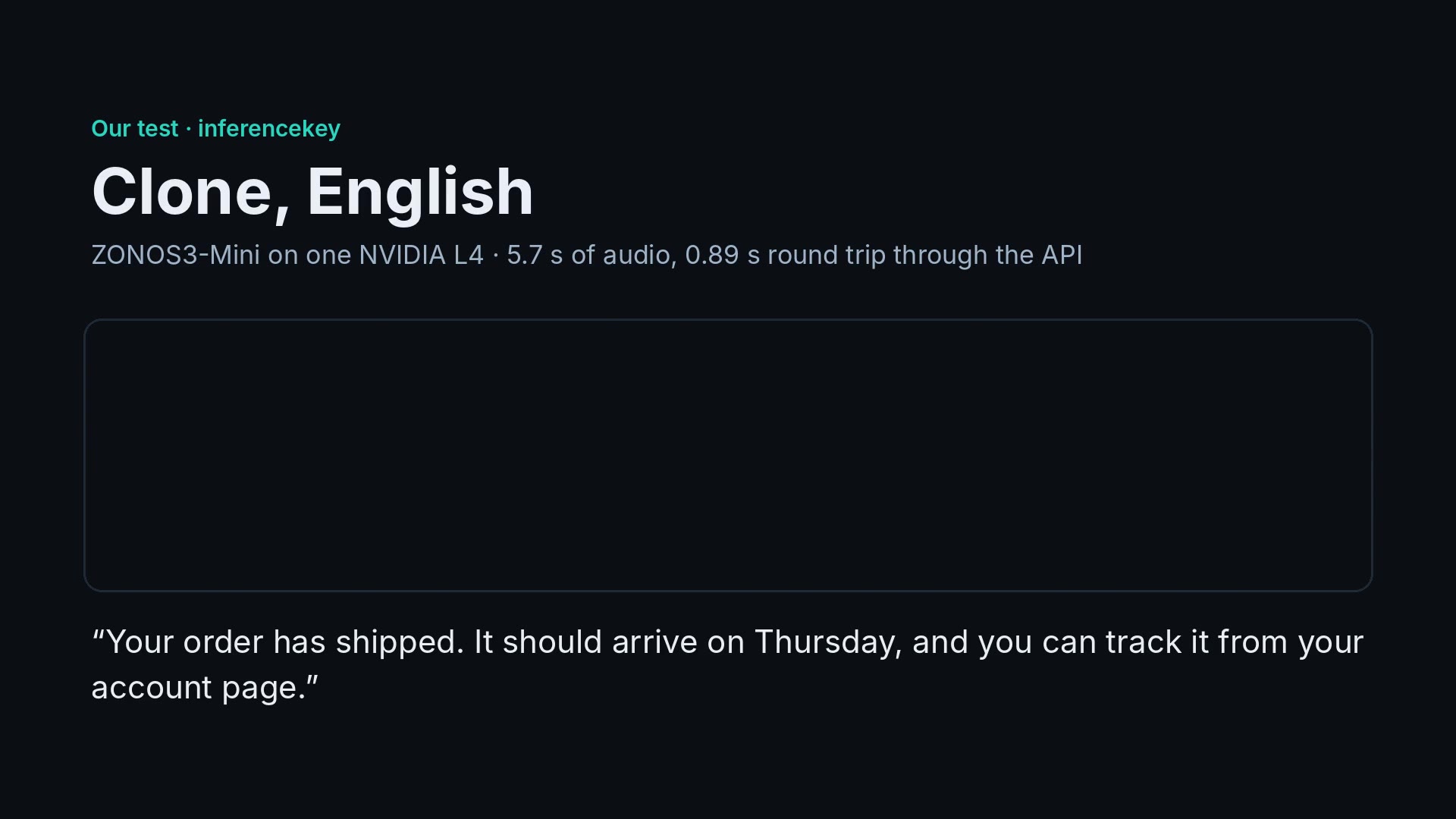
Here is the reference clip, then the clone in English and in Spanish. The reference is English only, so the voice speaks Spanish it never heard.
- Reference voice, synthetic stock voice (9.5 s)
- Clone in English (5.8 s)
- The same clone in Spanish (6.2 s)
Whisper heard every word of both. The clones scored 0.96 in English and 0.90 in Spanish against the reference. A different female preset voice already scores about 0.8, so the clones are clearly closer, not identical. German and French scored 0.94 and 0.91, also word for word. Japanese came back with the same characters and 0.89. A 28-second paragraph of 90 words came out with zero errors, at 0.97, the closest match of the test.
The default voice, when you pass no clip and no preset, is not one fixed voice. It changes from run to run. For a voice that stays the same, use one of the 27 preset voices or a clip.
Pace control works and keeps every word. The same line lasted 5.07 seconds slow, 3.93 at the default and 3.00 fast.
Where it broke in our test: order numbers, prices and phone numbers
Whisper heard every word of the prose clips, but heard three of the six numbers in one cloned line wrong. "Order 4521" became "Order 451". The price "$1,249.99" became "$1,049". The phone number "555-0142" got an extra five. The date and the percentage survived, and the clip itself reads slowly, with three half-second pauses.
- Numbers misread: order number, price and phone number (15.6 s)
This is one line, one run, transcribed by machine. Spell numbers out anyway: in an order confirmation, a wrong number costs money.
Which GPU: a 24 GB card, because the sound decoder outweighs the model
The smallest card that worked was a 24 GB one, and both the gaming RTX 4090 and the L4 passed, so you do not need a datacenter card.
The model file itself is 1.8 GB. But the server also loads the sound decoder and the encoder that listens to your clip, about 14.5 GB of files in all. Zyphra's phone and browser claims are for their own lighter versions, which we did not try.
We then tried to shrink the L4's 17.6 GiB, step by step, on the real card:
| Card and setting (all real cards) | Peak memory | Result |
|---|---|---|
| L4, less of the card reserved for the model's work | 17.3 GiB | works |
| L4, same plus at most 8 requests at once | 16.4 GiB | works, no slowdown for one request |
It still needs 16.4 GiB, a little more than a 16 GB card holds. That is why we expect 16 GB to fail. We could not test it: every 16 GB card we tried to rent on our cloud was out of stock.
On InferenceKey: ready in under four minutes from an empty machine
With our example, deploying took no hand work: from an empty machine, the 4090 was serving 214.7 seconds later. On the L4, with the environment and weights already on disk, it took 98.2 seconds. This ran on a local copy of our stack, not on the hosted service.
Nothing built into InferenceKey runs SGLang-Omni, so we wrote a custom backend. That is a small Python file that tells the platform how to install a server, start it and pass requests to it. Our deploy step lets the model take 1 request at a time. The example raises it to 16 by hand. Without that, requests wait in line: 8 at once took 2.66 s instead of 1.12 on the L4. Status: open.
The problem you will hit on any 24 GB card is memory. SGLang-Omni's default for ZONOS3 gives the model's working memory 30% of the card. That suits an 80 GB H100. On a 24 GB card, 30% is less than the audio codec already holds before the model starts, so the server refuses to start. Raising it to 55% fixed it, and our example sets it for you. Status: worked around.
For live speech you want the 50 ms stream, and our platform does not pass streaming through for custom backends yet. Status: open.
Should you use it? Yes for fast cloned speech, with numbers spelled out
- A live voice agent or phone line: stream from the server directly until our platform passes streaming through.
- Narration, prompts and short replies in a known voice: clone from about 10 seconds of audio, in your language or another one. Use a voice you have permission to clone.
- Anything with prices, order numbers or phone numbers: write them out as words first.
- Your own card or a hosted voice API: we did not compare prices, so this test does not pick a winner. Your own card means someone keeps a server running.
- Accents, ages, whispers and emotions: Zyphra's blog shows them, but only Zyphra's own apps offer them, not this server.
To hear a voice of your choice cloned in English and Spanish on your own GPU, run python main.py my-voice.wav from the ZONOS3-Mini SDK example. It needs a 24 GB NVIDIA card with a recent driver (580 or newer) and 30 GB of local disk, and writes four WAV files to outputs/.
For engineers
Credits
- Gabriel Clark, Sofian Mejjoute, George Close and Beren Millidge (Zyphra): ZONOS3-Mini, the blog post (9 November 2026), the ZONOS3-Mini Technical Report (arXiv 2611.16525, v1 12 Nov 2026), the weights (Apache-2.0, last updated 14 November 2026) and the code and runtimes (CUDA server, MLX, ggml, WebGPU).
- The SGLang-Omni team (sgl-project): SGLang-Omni and its ZONOS3 pipeline (preprocessing, TTS engine, vocoder). The integration landed in PR #3738 by Chenyang Zhao, with the ZONOS3 cookbook and docs by Chenye Charlie Zhu and Xiaohu Feng, and sampling parity following Gabriel Clark's port review.
- OpenAI (Whisper large-v3-turbo) and Microsoft (WavLM-base-plus-sv): the machine checks of words and speaker similarity.
- AI Search: the news video of 15 November (ZONOS3-Mini at 23:35 to 25:33) where we spotted it. Nothing in that segment is used as a source.
- Our part: the custom backend
zonos3-mini-sglang-omni0.1.3, the SDK example, the runs on two cards, the memory ladder and the quality checks.
The model, as published
From the model card's architecture table: 11 layers, model dimension 1,024; latent mixture of experts, 64 experts, top-2 routing from layer 1; layer pattern gdn3_global1, 9 Gated DeltaNet layers plus 2 global attention layers (16 heads x 32 dims, 4 KV heads) with attention residuals; 32,768 positions of context; SuperBPE tokenizer with 8,192 tokens and NeMo text normalization. Codec: ZAC-1, 15 Hz, 44.1 kHz, dual codec with 10 x 4,096 codebooks (1 semantic, 9 acoustic), hop 2,940 samples, up to 10 minutes per generation. Speaker prompt: a raw clip up to 60 s or a 192-dimension MECT-B2 embedding. Conditions: loudness (10 buckets), bandwidth f_max (10), speaking rate in UTF-8 bytes per second (30). Decoder: causal multi-resolution iSTFT head, full_mr by default or keep2_plain (pruned, about 3x faster decode). bf16 weights, fp32 decoder heads.
Parameter count: blog and card say 800M total and about 100M active; the arXiv abstract page says 886M total and 100M active. The arXiv abstract reports 6.71% macro-average WER over 55 language sets of ZTTS2-Eval (35 clean, 20 in the wild).
Languages (43): en, fr, es, de, it, pt, nl, pl, ru, sv, tr, uk, cs, da, fi, el, hu, no, ro, sk, bg, zh, ja, ko, ar, he, vi, id, th, tl, ms, ka, hi, bn, ta, te, mr, gu, kn, ml, pa, or, ur.
Authors' figures we did not reproduce: one H100 80 GB, 80 ms median time to first audio at 8 concurrent requests and 457 s of audio per second at peak (ZTTS2-Eval quality versus speed chart, with the speaker-embedding prompt). Blog: under 570 ms first audio in the browser on a Pixel 9, under 150 ms on an M3 MacBook Air; first among open models on Zyphra's TTS Capability Index v1, followed by Fish S2 Pro and MOSS TTS v1.5. SGLang-Omni cookbook (SeedTTS EN cloning, 1,088 samples, one H100, concurrency 16, Qwen3-ASR-1.7B): non-streaming WER 3.03%, SIM 50.8, RTF 0.060, 55.67 qps; streaming WER 3.13%, RTF 0.070, 48.03 qps, first audio 0.14 s; streaming first audio 0.057 s at concurrency 1, 0.078 at 4, 0.221 at 32, 0.264 at 64.
Setup
| Item | Value |
|---|---|
| Model | Zyphra/ZONOS3-Mini, revision d2d142a86b1e6aeb4252679673c86ecd86177bf8 |
| Server | SGLang-Omni at GitHub commit bac76771a0aa0a8fe849dc158836c22dca542f81 (PyPI 0.2.0 has only zonos2). Pins torch 2.14.1, SGLang 0.5.23, flash-attn-4 4.0.0b39, CUDA 13 wheels; needs --prerelease=allow and a protobuf override |
| Backend | custom Python backend zonos3-mini-sglang-omni 0.1.3: setup() builds a separate py3.12 venv, downloads the 14.5 GB subset SGLang-Omni reads plus the 27 preset voices, starts sgl-omni serve on loopback and waits for /health; process() forwards to /v1/audio/speech, streaming PCM internally to time first audio |
| Files read by the server | lm/zonos3_mini/model.pth 1,772,391,535 B; autoencoder/generator.pt 7,960,647,220 B; autoencoder/heads/full_mr/step_0050000.pt 4,012,134,189 B; autoencoder/teacher/model.safetensors 774,162,368 B |
| Cards | NVIDIA L4 24 GB (23,034 MiB visible), RTX 4090 24 GB (24,564 MiB), driver 595.91.07 |
| Engine memory share | --tts_engine.gpu_memory_fraction 0.55 (env ZONOS3_ENGINE_GPU_MEMORY_FRACTION) |
| Platform | local InferenceKey manager and worker built from main, never production; API round trips measured from a dev VM through a tunnel |
| Reference voice | 9.44 s, 24 kHz clip of a synthetic local stock voice ("anna"), not a real person |
| Checks | Whisper turbo (large-v3-turbo, language forced) and microsoft/wavlm-base-plus-sv cosine to the reference, run on the GPU machine |
Step by step with the SDK example
The example (commit e6046865) holds backend.py, publish.py, main.py, requirements.txt, .env.example and a README. You need an SDK token (ik_sdk_, with assignment:write), an API key (ik_live_), the project slug and a registered NVIDIA worker (IK_WORKER_ID) with a 24 GB card, a driver for CUDA 13.0 or newer (580+) and about 30 GB of free local disk. Keep the cache on local disk, not on a network volume. For publish.py you also need your tenant id and a dashboard session token (INFERENCEKEY_TENANT_ID, INFERENCEKEY_USER_TOKEN); without them, upload dist/*.tar.gz from Dashboard -> Custom backends. INFERENCEKEY_BASE_URL is optional in .env.example: main.py defaults to the public API, https://cloud.inferencekey.com.
cp .env.example .env        # fill in real values
python -m venv .venv && . .venv/bin/activate
pip install maturin requests
( cd ../../bindings/python && maturin develop --release )
python publish.py           # once: packages backend.py and uploads it
python main.py my-voice.wav # ensure -> wait until ready -> 4 WAV files in ./outputs
main.py calls ensure() (policy fixed, task text2audio, ready_timeout_secs 2400, memory share 0.55), waits until ready, raises the worker assignment to max_in_flight 16, then makes four calls: the default voice in English, the preset Ximena_es_F_1 in Spanish, and a clone of your clip in English and Spanish. Only clone voices you have permission to use.
A request on its own (set INFERENCEKEY_BASE_URL first, for example to https://cloud.inferencekey.com, or the URL is empty):
curl -s "$INFERENCEKEY_BASE_URL/endpoint/$INFERENCEKEY_PROJECT/zonos3-mini/v1/audio/speech" \
  -H "Authorization: Bearer $INFERENCEKEY_API_KEY" -H "Content-Type: application/json" \
  -d '{"model": "default", "input": "Your order has shipped.", "voice": "Imogen_en-British_F_1", "seed": 7}' \
  -o speech.wav
Fields: input (up to 3,000 characters), voice (default or one of 27 presets), ref_audio (base64 or data URI, WAV, MP3, FLAC or OGG, no transcript), condition_values (speaking_rate, loudness, fmax), and the sampling fields seed, temperature, top_k, top_p, repetition_penalty, max_new_tokens. The answer is a WAV, 44.1 kHz, 16-bit mono.
Without InferenceKey, the model card's path is sgl-omni serve --model-path Zyphra/ZONOS3-Mini --port 8000, then POST /v1/audio/speech with {"input": ...}, plus "references": [{"audio_path": ...}] to clone or "stream": true, "response_format": "pcm" to stream. On a 24 GB card add --tts_engine.gpu_memory_fraction 0.55. SGLang-Omni's defaults at bac76771: share 0.3, max_running_requests 64, CUDA graph max batch 64, vocoder max_step_streams 4, reference up to 60 s; sampling max_new_tokens 2048, temperature 0.75, top_k 80, top_p 0.69, repetition_penalty 2.4.
Time to ready
| Run | Ready after ensure() | Breakdown |
|---|---|---|
| RTX 4090, empty caches, backend 0.1.3 | 214.7 s | venv 53.9 s, weights 12.7 s, then server start (CUDA graph capture of 43 prefill shapes and 12 batch sizes) and warm-up |
| L4, venv and weights cached, 0.1.2 | 98.2 s | server start 86.0 s, warm-up 10.9 s |
| L4, empty caches, 0.1.1 | failed after 250 s | venv 177.3 s, weights 71.6 s, then the memory-share error |
Direct sgl-omni serve restarts on the L4, all cached | healthy in 42 to 44 s |
Direct streaming on the GPU host
Same 9 s English line, seeds fixed, 3 rounds at 1 stream and 2 at 4 and 8; clone uses the 9.4 s reference. Second passes.
| Card | Streams | First audio median (max) | RTF median | Audio s per s |
|---|---|---|---|---|
| L4 | 1 | 70 ms (73) | 0.031 | 32.5 |
| L4 | 4 | 104 ms (106) | 0.054 | 68.8 |
| L4 | 8 | 188 ms (347) | 0.079 | 82.2 |
| L4 | 1, clone | 99 ms (126) | 0.034 | 28.0 |
| L4 | 8, clone | 193 ms (222) | 0.074 | 89.0 |
| RTX 4090 | 1 | 50 ms (50) | 0.023 | 42.4 |
| RTX 4090 | 4 | 96 ms (97) | 0.032 | 108.9 |
| RTX 4090 | 8 | 106 ms (137) | 0.049 | 146.5 |
| RTX 4090 | 1, clone | 55 ms (57) | 0.024 | 41.7 |
| RTX 4090 | 8, clone | 102 ms (103) | 0.044 | 171.9 |
First passes: the first use of a batch size is slow (L4 first 4-stream round 1.03 s median first audio and 34.9 s/s). 4090 pass 1: 53 / 61 / 81 ms and 43 / 127 / 176 s/s at 1 / 4 / 8.
Through the InferenceKey API
POST /endpoint/<project>/zonos3-mini/v1/audio/speech, whole WAV, round trip from the dev VM through a tunnel to a local manager. Production latency may differ.
| Card | max_in_flight | 1 | 4 at once | 8 at once | Audio s per s at 8 | Clone 1 / 8 |
|---|---|---|---|---|---|---|
| L4 | 1 (set by ensure()) | 0.53 s | 1.58 s | 2.66 s | 17.1 | 0.64 / 3.01 s |
| L4 | 16 | 0.41 s | 0.70 s | 1.12 s | 59.2 | 0.48 / 1.28 s |
| RTX 4090 | 16, pass 2 | 0.42 s | 0.57 s | 0.78 s | 62.7 | 0.47 / 0.91 s |
4090 pass 1: 0.47 / 1.65 (first 4-batch) / 0.75 s, 80.3 s/s at 8.
GPU memory and the ladder
Card peak from nvidia-smi.
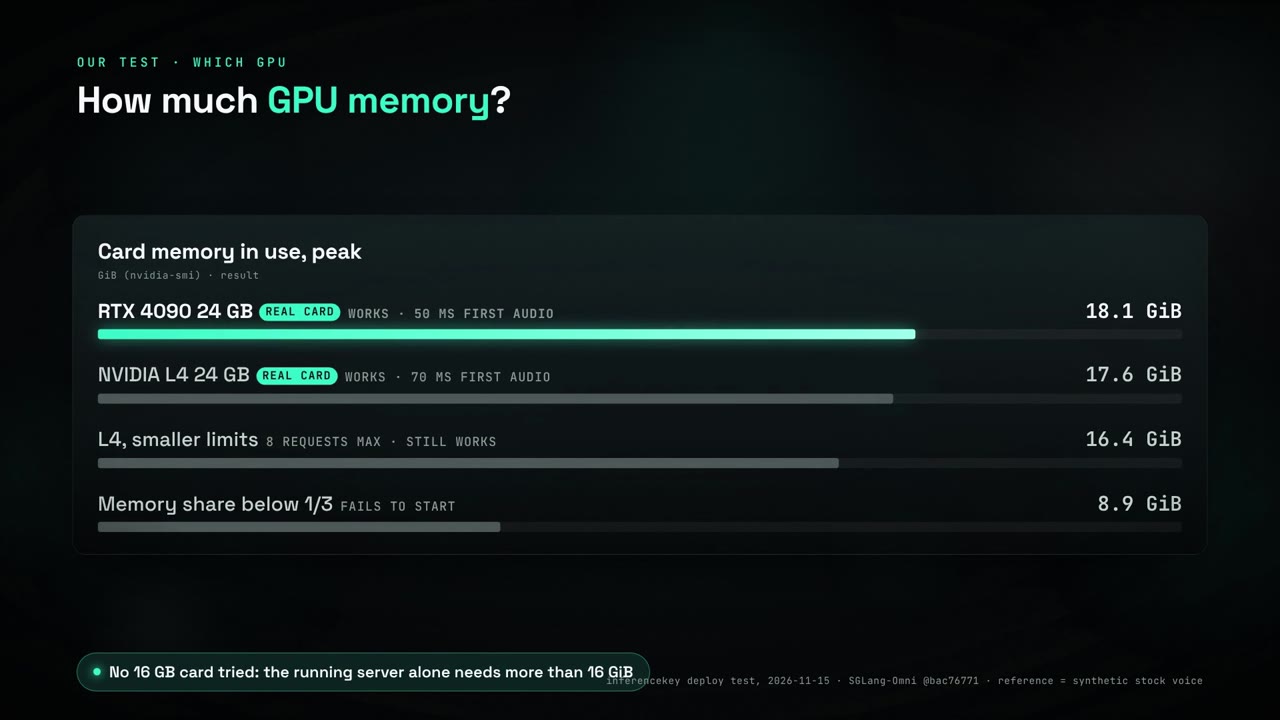
Every rung ran on a real card; none used an emulated allocator cap, since a multi-process server cannot be capped that way. The settings rungs ran sgl-omni serve directly on the L4.
| Card or setting | Configuration | Peak card memory | Speed | Output OK |
|---|---|---|---|---|
| RTX 4090 24 GB | bf16, share 0.55, through the platform | 18,500 MiB | 50 ms, RTF 0.023 | yes |
| NVIDIA L4 24 GB | bf16, share 0.55, through the platform | 18,053 MiB | 70 ms, RTF 0.031 | yes |
| L4 | share 0.40, direct | 17,672 MiB | 69 ms, RTF 0.030 | yes |
| L4 | share 0.36, direct | 17,674 MiB | 71 ms, RTF 0.030 | yes |
| L4 | share 0.36, max_running_requests 8, cuda_graph_max_bs 8, vocoder max_step_streams 2 | 16,808 MiB | 71 ms, RTF 0.030; 8 streams 179 ms | yes |
| L4 | share 0.33, direct | 9,098 MiB before failing | - | no: state=0.15GiB, budget=0.10GiB |
| L4 | default share 0.30 | - | - | no: total=22.49GiB, fraction=0.300, budget=6.75GiB, process_used=7.32GiB |
On the L4 at 0.55: 16,625 MiB right after start. A start traced at 200 ms: 5.5 GB as preprocessing loads the codec encoder, about 8.8 GB after the language model, a jump to 13.6 to 16.6 GB as the vocoder stage starts, 17.5 GB under load. The share only sizes the language model's state pools; most of the footprint is the codec and vocoder.
Not tried: a real 16 GB card (RTX 4080, RTX 4000 Ada and RTX A4000 all out of stock), Zyphra's own CUDA, ggml or WebGPU runtimes (which load the GGUF files, backbone-ptq.gguf is 663 MB), vLLM, fp8, CPU offload, splitting stages across GPUs.
Quality
| Clip | Heard | WER | Similarity to reference |
|---|---|---|---|
| L4 default voice, en | exact | 0 | 0.54 |
| L4 preset Ximena, es | exact | 0 | 0.79 |
| L4 clone, en | exact | 0 | 0.96 |
| L4 clone, es (cross-lingual) | exact | 0 | 0.90 |
| L4 bench, default voice, 1 and 8 streams | exact | 0 | 0.44 / 0.46 |
| L4 bench, clone, 1 and 8 streams | exact | 0 | 0.93 / 0.94 |
| L4 clone, 28.3 s paragraph, 90 words | exact | 0 | 0.97 |
| L4 clone, de / fr | exact | 0 | 0.94 / 0.91 |
| L4 clone, ja | same characters, no punctuation (WER 1.0 is a tokenizer artefact) | - | 0.89 |
| L4 preset Ananya, hi | one vowel sign and one nasal mark differ | 0.05 | 0.78 |
| L4 preset Imogen, en | "ten" heard as "10" | 0.09 | 0.83 |
| L4 clone, numbers line | "451", "$1,049", "5555-0142" | 0.18 | 0.96 |
L4 clone, speaking_rate 9 / default / 22 | exact | 0 | 0.94 / 0.94 / 0.92 |
| 4090, 4 main and 4 bench clips | all exact | 0 | clones 0.89 to 0.96, default 0.52 to 0.71 |
WavLM-base-plus-sv separates female voices less well (presets Ximena 0.79 and Imogen 0.83 against the female reference); the clones still stand clearly above them. No human listening test.
Problems and their status
- SGLang-Omni's default memory share fails on 24 GB cards with
RuntimeError: Colocated GPU memory budget leaves no KV-cache headroom. Worked around: the example setsZONOS3_ENGINE_GPU_MEMORY_FRACTION=0.55.--mem-fraction-staticdoes not change it;--tts_engine.gpu_memory_fractiondoes (0.36 works, 0.33 fails). ensure()created the assignment withmax_in_flight = 1, so concurrent requests queued (flat 17 s of audio per second from 1 to 8 clients). Open, worked around: the example sendsPATCH /api/projects/<p>/assignments/<workload>/<worker> {"max_in_flight":16}(204). The SDK'sWorkloadSpechas no field for it yet.- Backend 0.1.2 left
sgl-omni serverunning after the workload was deleted (17.86 GiB on the card). Fixed in 0.1.3 with a parent-death signal and a SIGTERM/atexit group stop; verified on the 4090, server gone in about 1 s, GPU back to 1 MiB. - No streaming through the platform for custom backends:
stream: trueon/v1/audio/speechreturns 400. Open. The 50 ms figure is measured on the GPU host. - Packaging upstream: PyPI 0.2.0 predates ZONOS3; the cookbook points at a gated
Zyphra-staging/Zonos3-Mini-Staging-ReleasewhileZyphra/ZONOS3-Miniworks;sgl-omni serve --model-path Zyphra/ZONOS3-Minisnapshots the whole repo including GGUF and WebGPU shards, so the backend downloads only the 14.5 GB subset. - Voice design is not in the SGLang-Omni path. Accents, ages, whispering on a span and emotions are in Zyphra's own runtimes and studio. SGLang-Omni gives cloning, the 27 presets (fed as reference clips) and three conditions (speaking rate, loudness, bandwidth).
- First use of a batch size is slow: 1.03 s first audio on the L4's first 4-stream round, 1.65 s round trip for the 4090's first 4-batch through the API; warm, 104 ms and 0.57 s.
- Harmless log noise:
Failed to import nixl,Using default MoE kernel config,torch.jit.script is deprecated.
Limits
Two cards, both 24 GB. A local copy of our platform, not the hosted service. One 9-second line for the speed tests. Quality by machine only (Whisper and WavLM; German, French and Japanese checked on the L4 only), so Whisper may share the blame for some number errors. A synthetic reference voice. The authors' H100, phone and laptop figures are theirs, unreproduced.
Samples
- Clone in German (3.9 s)
- Clone in French (3.7 s)
- Clone in Japanese (6.0 s)
- Clone, 90-word English paragraph, 0 word errors (28.4 s)
- Pace slow, speaking_rate 9 (5.1 s)
- Pace default (4.0 s)
- Pace fast, speaking_rate 22 (3.0 s)
- Preset voice Imogen, British English (3.7 s)
- Preset voice Ximena, Spanish (5.2 s)
- Default voice, changes with the seed (5.4 s)
The reference, the English clone and the Spanish clone in one clip, with waveforms and text (click to play):
The demo video (3 min 26 s): the authors' examples with their audio, then our deployment on the L4, the time-to-first-audio and memory results (click to play):
Summary of the three key numbers:
Sources
- Model card and weights: huggingface.co/Zyphra/ZONOS3-Mini
- Code and runtimes: github.com/Zyphra/ZONOS3-Mini
- Blog: zyphra.com/our-work/zonos3-mini
- Paper: arXiv 2611.16525
- Serving: SGLang-Omni ZONOS3 cookbook
- Where we spotted it: AI Search, 15 November 2026
- Our example: inferencekey-sdk, zonos3-mini-tts-sglang-omni-custom-backend-private-nvidia