PAN 2 films an agent's plan on one 96 GB card, and squeezes into an 80 GB budget
PAN 2 turned a written plan into a 3 s clip in 109 s on one 96 GB card, and still ran under an emulated 80 GB cap, 40 s slower.
An agent can now watch its plan before it acts on it. PAN 2, an open world model, takes a timed list of actions and camera moves and renders what would happen as video. We ran it on one 96 GB RTX PRO 6000 on our cloud. A 3-second walk through a house took 109 seconds and followed the plan.
That matters if you deploy models, because only one part of the job needs the big card. A language model writes the plan, and it can be one you already call. The 29-billion-parameter renderer is the part you host. Under an emulated 80 GB budget it still worked, 40 seconds slower, once the helper that reads the plan moved to the CPU.
What you can do with it: render candidate plans for agent or robotics research, or previews from a script, on one card rented by the hour. Do not use it for anything live.
A script writer and a band, in two downloads
PAN 2 is not another text-to-video model that takes a sentence and hopes. It splits the work. A language model first rewrites your request as a structured description of the next moment: what is in the scene, what each thing does, at which second, and where the camera goes. Then the video model renders that description.
Think of a songwriter handing a session band a chart with every change marked by the bar. When a take goes wrong, you read the chart first.
What you download has two parts. The renderer is a 29.2-billion-parameter video model the authors trained from scratch. The reader is Qwen3.5-9B from the Qwen team, used as is: it does not write the plan, it turns it into numbers the renderer can use. The planner is not in the download. The authors list the models they tried for that role and ship written instructions for it. In our test, Claude Opus 5.5, a hosted API, wrote the plans. We have not run a self-hosted planner.
PAN 2 comes from the Institute of Foundation Models at MBZUAI, with code and weights open, commercial use included. The model card cites a paper by Eric Xing, Mingkai Deng and Jinyu Hou, "Critique of World Model". We ran it through the Hugging Face Diffusers pipeline. Our part was the backend that turns it into an API, the plans, the measurements and an SDK example.
About 36 seconds of GPU work for each second of video
PAN 2 is not a live simulator. Three seconds of video took 109.3 seconds on the card and 113 seconds through our API. A 2-second clip of a hand tipping a glass took 71. Longer clips cost more per second: 10 seconds took 490, about 49 seconds of work per second of video.
So an agent comparing three 3-second plans waits about five and a half minutes on one card, plus the planner's time. For offline planning research, robot data or story previews, that pace works. For anything that reacts to a person in real time, it does not.
Part of the cost is how the model is told to follow instructions closely. At every step it runs twice, once with the plan and once with a fixed list of defects to avoid. Twenty steps become 40 passes through 29 billion parameters.
The pictures were good, with one plain miss. In the house clip the camera walks in and turns left into the living room, as planned, and the walls and stairs stay put. In the glass clip the water spreads and drips off the counter edge. But we asked for a flick, and the hand grips the glass and pushes it. That matches the authors' own warning that "about two in three simulated plans contain at least one step that is not carried out". Treat it as a first draft of the outcome, not a referee.
Which card: 96 GB runs everything, 80 GB needs one trick
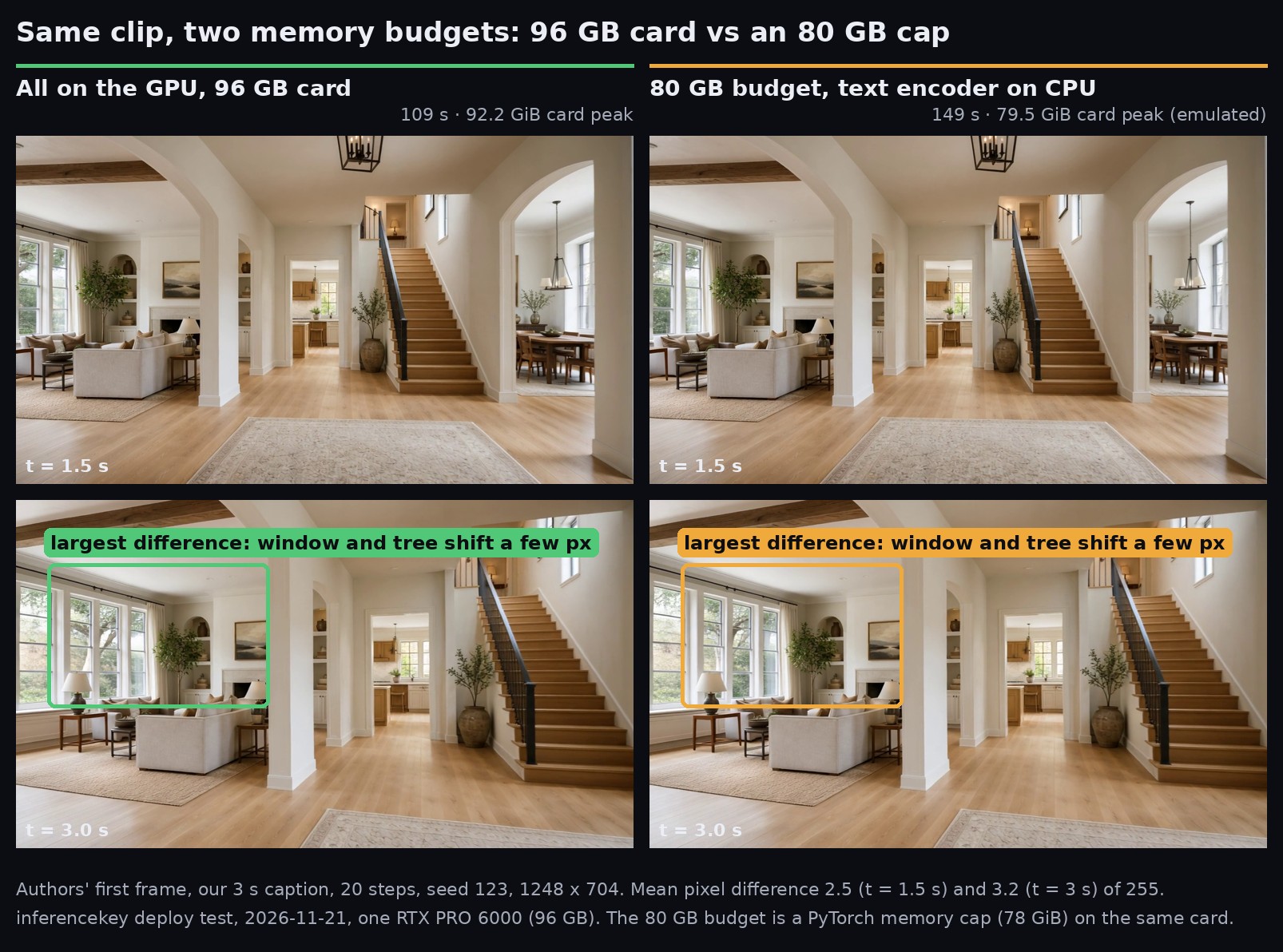
On the 96 GB card PAN 2 used about 96% of the memory, almost full. To test a smaller budget we capped the software at 78 GiB on the same card, about what an 80 GB card gives you.
| Memory budget | How | Result |
|---|---|---|
| 96 GB, real card | everything on the GPU | works, 109 s |
| 80 GB, emulated | reader moved to the GPU only while it reads | out of memory after 4.9 s |
| 80 GB, emulated | reader stays on the CPU | works, 149 s, just fits |
| 48 GB or less | not tried | the renderer alone is about 63 GiB |
Reading the plan on the CPU took 40 seconds instead of half a second, while rendering time did not change. The frames came out practically the same: a window and a tree sit a few pixels off.
On InferenceKey, PAN 2 runs as your own API through a custom backend, a small Python file you upload that the platform runs on your GPU machine. The model was ready 47 seconds after our first call. One open rough edge: one machine renders one clip at a time and there is no cancel, so a wrong plan runs to the end. Status: open on the platform.
Who should care
- Agent and robotics researchers: worth trying, with a planner model budgeted next to it.
- Teams making previews from a script: yes.
- Anyone needing real-time simulation or exact physical actions: not yet.
- Teams sizing hardware: one 96 GB card runs everything; an 80 GB budget needs the reader on the CPU.
The honest limit: we ran one clip per case at 20 steps instead of the authors' 50, emulated the 80 GB budget instead of using a real 80 GB card, and did not test plan quality, physical accuracy, the safety filter or any benchmark.
For the full timings, the memory ladder and the steps to run it on your own card, read the full PAN 2 test in the Research post.