Idol makes a 3D object from one photo on an 8 GB gaming card, and Turbo does it in 3.5 s
Idol turned one photo into 3D in 40.7 s on an RTX 3090, 3.5 s with Turbo, and ran on a real 8 GB RTX 3070 with defaults.
A gaming graphics card can now turn one product photo into a 3D object. We ran Idol, an open model from Speridlabs, on one RTX 3090 on our cloud. A picture of a backpack became a 3D object in 40.7 seconds at full quality, and in 3.5 seconds with the faster Idol Turbo. A real 8 GB RTX 3070 ran it too, on default settings, in 67 seconds an object.
That matters if you deploy models, because the card you already own is probably enough. Idol peaked at 7,308 MiB of graphics memory on the 3090, about the same whatever we asked of it, so a bigger card buys speed, not the ability to run it. On a 3090 rented by the hour, a thousand objects cost about 5.70 dollars of GPU time at full quality.
What you can do with it: turn a catalogue of solid products into 3D files on your own card. Read one helper model's license first.
A cloud of coloured dots instead of triangles
Idol does not build a game-style mesh. It writes a Gaussian splat: a quarter of a million soft, coloured blobs in space that blend into the object from any angle. Think of a pointillist painting you can walk around. The result is a standard .ply file that splat viewers open.
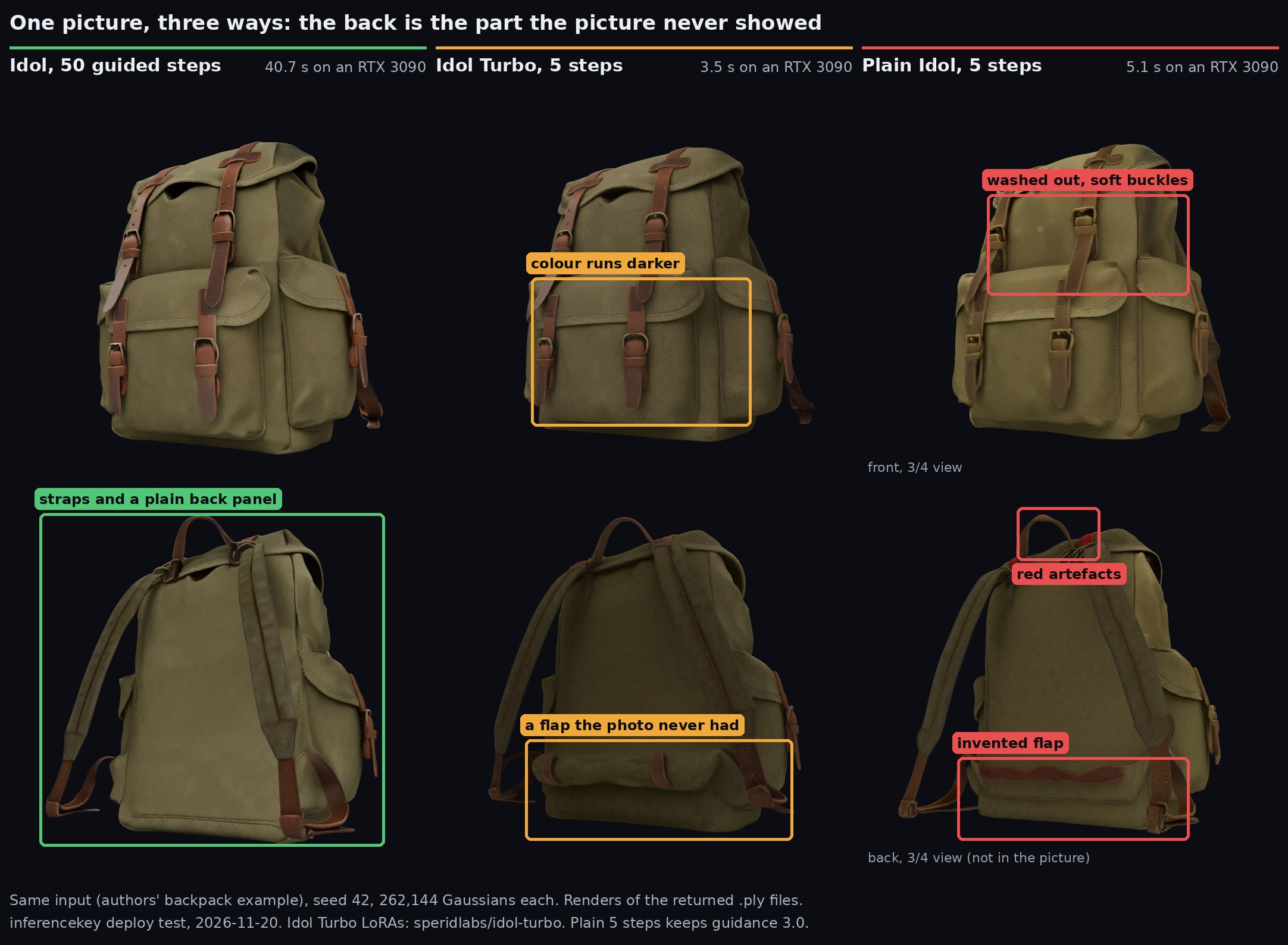
The key idea for the rest of this post is simple. Whatever the photo shows, Idol can copy. Whatever it does not show, such as the back of a backpack, it has to guess. The two modes differ mostly in how well they guess.
Alejandro Canada (project lead) and Chema Garabito built Idol at Speridlabs and published the weights and code under Apache-2.0 on 28 October. An outside developer, akhaliq, built Idol Turbo, which now lives in the Speridlabs account. Idol refines the object in 50 passes, called steps. Turbo, a trained shortcut, needs 5. Our part was wrapping the authors' pipeline as an API on InferenceKey, measuring it, and writing an SDK example.
Turbo is 11 times faster and guesses worse at the back
| Mode on the RTX 3090 | Seconds per object | Back of the backpack (never in the photo) |
|---|---|---|
| Idol, 50 steps | 40.7 | straps and a plain back panel |
| Idol Turbo, 5 steps | 3.5 | invents a flap at the bottom |
| Plain Idol, 5 steps | 5.1 | red artefacts, invented flap |
The third row answers the obvious shortcut: running the normal model with fewer steps is slower than Turbo and clearly worse. Turbo's training is what makes five steps usable.
Results also repeat. The same picture and seed gave an identical file six times on the 3090.
On real photos, a flamingo-shaped terracotta planter got a plausible far side. A gecko came out lumpy and squashed from a new angle. A glass ball became a flat disc. Treat that as a warning for transparent objects.
Who should care
- Teams with a catalogue of solid products (pots, bags): full quality at 50 steps, about 41 seconds an object on a 3090.
- Teams making quick previews or many drafts: Turbo, as long as a person checks the back.
- Teams with a small card: a real 8 GB RTX 3070 worked with the defaults, at 67 seconds an object, or 5.6 seconds with Turbo.
- Anyone shipping a commercial product: read the DINOv3 License first.
Idol, Turbo and the picture compressor it uses are Apache-2.0. One helper model inside, Meta's DINOv3, comes with Meta's own license. Our reading, not legal advice: it grants a worldwide, royalty-free right to use and distribute with no ban on commercial use. It forbids uses that break trade-control rules, including military ones, and Meta may change the terms. Downloading a repackaged copy skips Meta's access form, not those terms.
On a 3090 rented at about 0.50 dollars an hour, a thousand objects cost about 5.70 dollars at full quality, or 49 cents with Turbo. An RTX 3070 at 0.13 dollars an hour brings that to about 2.40 dollars, or 20 cents with Turbo. Those figures assume a busy card, with idle time and your own work not counted.
On InferenceKey, one loaded copy of Idol served both modes. A fresh 3090 was ready 117 seconds after we asked for the model, about 5 GB of downloads included, and a cached restart took 28 seconds. Like a soundcheck before the gig, our wrapper runs one short object in each mode before it reports ready, so your first real request does not wait.
The honest limit
Each case ran with one seed, and we tested no real card below 8 GB, no RTX 4090 and no datacenter card.
One platform rough edge is open: a 17.8 MB result file is larger than the 8 MB one result can carry, so the backend returns it in 2 MB parts. That works with one copy of the model, not yet with several sharing the load, and the fix is to return large outputs through file storage.
For the full timings, the memory ladder, the license details and the steps to run it on your own card, read the full Idol test in the Research post.