MiniMax-H3-Image drew the same 16 MP picture under an 8 GB memory cap. The license is the harder limit
A 29 GB copy of MiniMax-H3-Image drew 4096x4096 in 45 s on one A40 and in 48.9 s under an 8 GB cap. The license excludes the US, EU, UK and Korea.
Which graphics card does a 135 GB image model need? For MiniMax-H3-Image, our test says the card matters less than you would expect. A 29 GB compressed copy drew a 4096 x 4096 image in about 45 seconds on one 48 GB NVIDIA A40. With the model's GPU memory capped at 8 GB, the same image came back in 48.9 seconds, and the returned JPEG was identical.
That matters when you deploy models, because the usual first question is how much GPU memory to rent. Here the limits sit elsewhere: the wait per image, the computer's own memory, and above all the license. It does not cover the US, the EU, the UK or Korea without asking MiniMax. Elsewhere, serving people outside your company needs its written permission first.
What you can do with it: read the license, and if it covers you, deploy the same setup on your own card with our SDK example.
One model that draws and edits at 16 megapixels
MiniMax describes H3-Image as one open model for two jobs: drawing from a text prompt, and editing with up to 16 reference pictures. It works directly at about 16 megapixels, with no enlarging pass afterwards.
The price of that resolution is size. The part that draws weighs about 66 GB, and the part that reads your prompt weighs another 66.7 GB. That is too big to load whole on a 24 or 48 GB card.
We did not shrink it ourselves. Comfy-Org, the makers of ComfyUI, published compressed copies in ComfyUI's format. Their smallest set is 29.4 GB to download, and that is what we ran. Our part was a small Python file that starts ComfyUI without its window, so other programs can call the model as an API. The official routes, by SGLang and vLLM-Omni, run the original on datacenter hardware, and we did not test them.
The memory cap cost about 4 seconds, not the picture
We ran the model on the A40 with no limit first, then set memory caps that stand for cards of 24, 16, 12 and 8 GB. Every cap returned the same JPEG as the uncapped run.
| Cap set for a card of | Peak GPU memory | 4096 x 4096 |
|---|---|---|
| None (the full 48 GB card) | 30.9 GB | 44.6 to 44.7 s |
| 24 GB | 24.1 GB | 46.8 s |
| 16 GB | 15.8 GB | 49.3 s |
| 8 GB | 7.7 GB | 48.9 s |
The trick belongs to ComfyUI. It keeps the whole model in the computer's own memory and hands the card only the piece it needs next. Picture a band on a stage too small for all its guitars: the ones not being played wait on a rack at the side, and a tech hands over the next one between songs. The show is the same and each change costs a moment.
The rack has to be big enough, though. Our machine had 48 GB of system memory, and ComfyUI reserved 31 GB of it for the model.
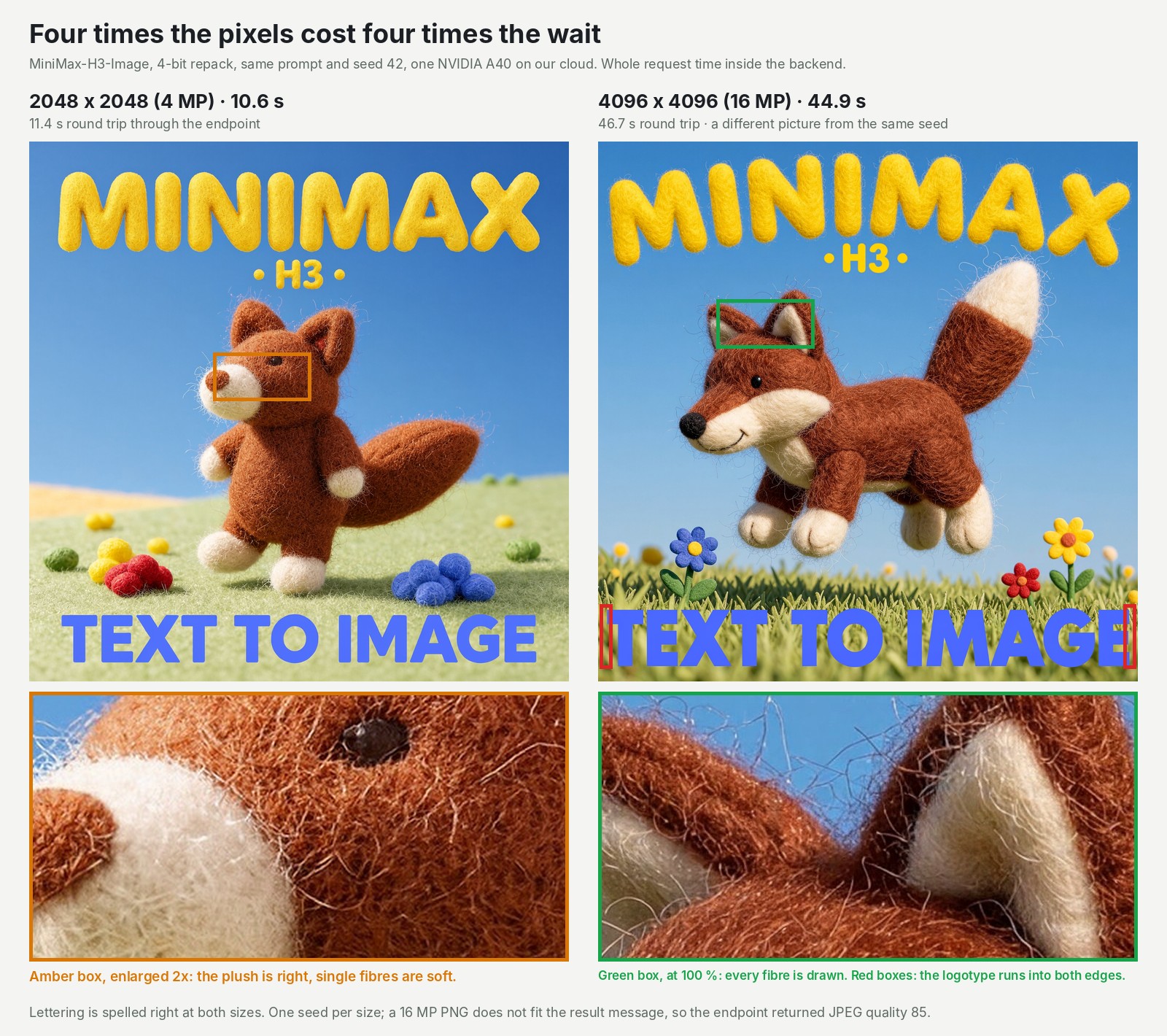
For pace, 2048 x 2048 takes about 10 seconds on the A40, a working speed for drafts. The full 16 megapixels is a final render, a bit more than one image a minute. The same prompt and seed gave a standing fox at 2048 and a leaping fox at 4096, so a small draft is not a preview of the large image.
Who should care, and who should wait
- Teams that need text in images (posters, menus, signs): the lettering was spelled right in every sample we made. Check the framing at 16 megapixels, where one logotype ran into both edges.
- Teams that need large final images for internal work: yes once the license covers you, at about 45 seconds each on an A40.
- Teams that combine several pictures in one edit: not on our evidence. One reference mostly worked, and our one try with two references returned no fox.
- Anyone building a hosted image feature: the license comes first. Section IV.1 asks for "a separate, prior written authorization from MiniMax" if you provide hosted services to third parties, or if annual revenue passes 1 million USD. The compressed copies do not escape it.
The territory rule includes us. Our run was a short private evaluation by a company based in the EU, nobody outside it called the model, and we have not asked MiniMax for a license. Treat it as a measurement, not as a precedent. We are engineers, not lawyers, so read the text yourself.
The honest limit
The caps were set on the A40, not measured on smaller cards, and we never ran the 135 GB original, so we cannot tell you what the compression costs in image quality.
A smaller card is usually also a slower chip, so expect longer times than the table. We did not test a machine with 16 or 32 GB of system memory either.
For the full timings, the editing samples, the license clauses and the steps to reproduce it, read the full MiniMax-H3-Image test in the Research post.