Maxwell-V1.0-Flash keeps its writing speed on a 125K-token contract, on one 48 GB card
On one 48 GB L40S, Maxwell-V1.0-Flash wrote at 107 tok/s with a 125K-token contract bundle vs 118 at 4K, and found 3 of 3 clauses.
Long prompts usually make a model slow down, and Maxwell-V1.0-Flash mostly does not. We fed this new open model a 125,000-token bundle of US copyright law with a fictional supplier agreement hidden inside. It ran on one 48 GB NVIDIA L40S on our cloud. It wrote its answer at 107 tokens a second, against 118 on a 4,000-token prompt, and found all three clauses we asked about, with the right values, in three runs out of three.
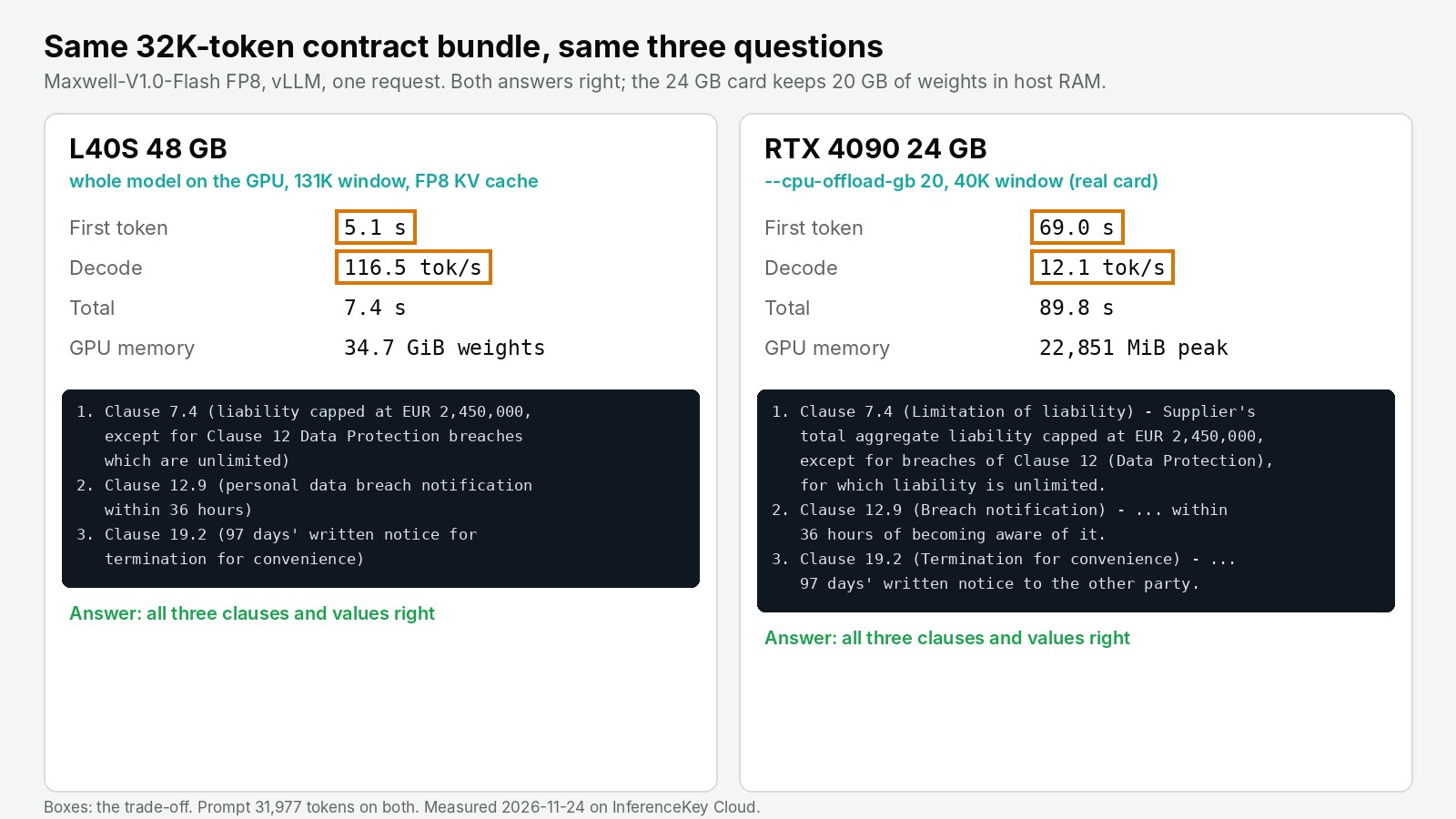
That matters if you deploy models for contracts, policies or any long file that should not leave your machine. A long document does not have to slow the writing on a card you rent by the hour. You can try it on your own GPU with our SDK example, and a 24 GB RTX 4090 also works, about ten times slower.
A 35B model that reads like a lawyer with a binder
Maxwell is a new base model with its own design and its own word list, not someone else's model retrained. The Maxwell Team pretrained it on about 26 trillion tokens and released it under the Apache 2.0 license. It has 35 billion parameters, of which about 3 billion work on each word. That is how a model this size writes at a hundred tokens a second on one card.
The interesting part is how it reads. Most models look back at every word of the document each time they write a new one, so long prompts drag. Maxwell looks at the first pages, the last pages and up to 16 passages that a small learned index flags as relevant. That caps the looking back at about 4,096 tokens, however thick the binder gets. The authors credit MiniMax's sparse attention work as the inspiration for how those passages are picked.
Writing speed held as the prompt grew 31 times
A model first reads your prompt, then writes its answer word by word. Reading grows with the prompt. Writing speed is what the design promises to protect, and it held:
| Prompt | Reading (time to first word) | Writing speed | Answer |
|---|---|---|---|
| about 4,000 tokens | 0.9 s | 118 tok/s | right in 2 of 3 runs |
| about 32,000 tokens | 5.1 s | 116 tok/s | right |
| about 125,000 tokens | 19.3 s | 107 to 108 tok/s | right in 3 of 3 runs |
From 4,000 to 125,000 tokens, writing slowed by about a tenth. The reading cost is real, about 19 seconds for the big bundle, but you pay it once. A second question on the same bundle got its first word after 1.5 seconds, because the card kept what it had already read. It works like a soundcheck: one long wait at the start, then the set moves fast.
The 4K miss was a format slip, not a wrong fact. In one run the model listed the right clause numbers and left the values in its private thinking. It never got a value wrong.
Who should care
Teams that review contracts, policies or other long files, and want that text on a card they control. The full 131,072-token window fits on one 48 GB card, though only just: the serving software needed 96.5% of the card's memory. On a 24 GB RTX 4090, with 20 GB of the model kept in the computer's main memory, the same 32,000-token bundle came back right, at 12.1 tokens a second against 116 on the L40S. That suits batch reviews up to about 40,000 tokens, not chat.
One catch you will hit first: the authors' ready-made server package is not built for the L40S or the 4090. We ran the public build it starts from, with their 31 changed files on top, and the prepare_worker.sh script in our SDK example sets that up once per machine. You also cannot turn the model's thinking off through our endpoint yet, so a one-line question took 15.9 seconds.
The sparse design saves work, not memory: every token you feed it still takes room on the card. And the honest limit: this was one request at a time, a find-three-facts test, with no other model run on the same card for comparison.
Read the full test, with the memory ladder, the rough edges and the setup, in the Maxwell-V1.0-Flash Research post.