Haru-4B holds a Spanish phone call on a 16 GB card, but do not ask it for facts
Open voice model Haru-4B needed 57 ms of a 133 ms beat on a 70 W RTX 2000 Ada, and peaked at 10.7 GiB. It still said Sydney.
Fifty-seven milliseconds. That is how long a 70-watt RTX 2000 Ada with 16 GB, on our cloud, needed for each 133-millisecond beat of a Spanish phone call with Haru-4B. Haru is an open voice model from higurashi that listens and talks at the same time. The card finished each beat with more than half of it to spare, and it never fell behind in 41 calls across two cards.
For a team that deploys models, that moves the hardware question. A natural-sounding voice for one conversation does not need a 24 GB gaming card. Haru peaked at 10.7 GiB on the small card, and it is Apache-2.0.
What you can do with it today: run recorded calls through your own API on a 16 GB card, for practice partners, games, characters or research on how machines take turns. What you should not do is trust what it says.
One beat, one step, no second model
A live voice model works like a drummer: every hit has to land on the beat. Haru's beat is 133 milliseconds. In each one it hears a slice of your voice and produces a slice of its own. If the card needs longer than that, the conversation drags and never catches up.
Haru keeps each beat cheap by design, with no second model behind it. It adds what it heard, what it said and the text it is writing into one input, and a small add-on draws the next slice of voice in one go.
The work is higurashi's, built on Alibaba's Qwen language model and Microsoft's VibeVoice. Their technical blog, by Rikuto Kotoge, says they trained it on over 40 million hours of speech in more than 160 languages, with a focus on nine. The model card calls it "a pretrained base model, released for research". Our part was a custom backend around the authors' package, two real cards, a memory ladder and a fix for long calls.
Under half the beat on the small card
We played recorded calls from synthetic callers to the model, one beat at a time, and let it decide from the audio alone when to speak.
| Card | Typical work per 133 ms beat | Faster than real time |
|---|---|---|
| RTX 4090, 24 GB | 44 to 48 ms | 2.8 to 3.1x |
| RTX 2000 Ada, 16 GB, 70 W | 57 ms | 2.3x |
No slow beats hide behind the typical figure. The slowest single beat across 41 calls took 74.6 milliseconds. In the calls paced like a real line, not one beat arrived late on either card.
Answering speed is a separate question. Haru started talking 0.12 to 1.13 seconds after the caller's last word following a greeting or question. After a 16-second story it was slower, 1.8 to 4.9 seconds, and then said little.
A friend on the phone, a poor source of facts
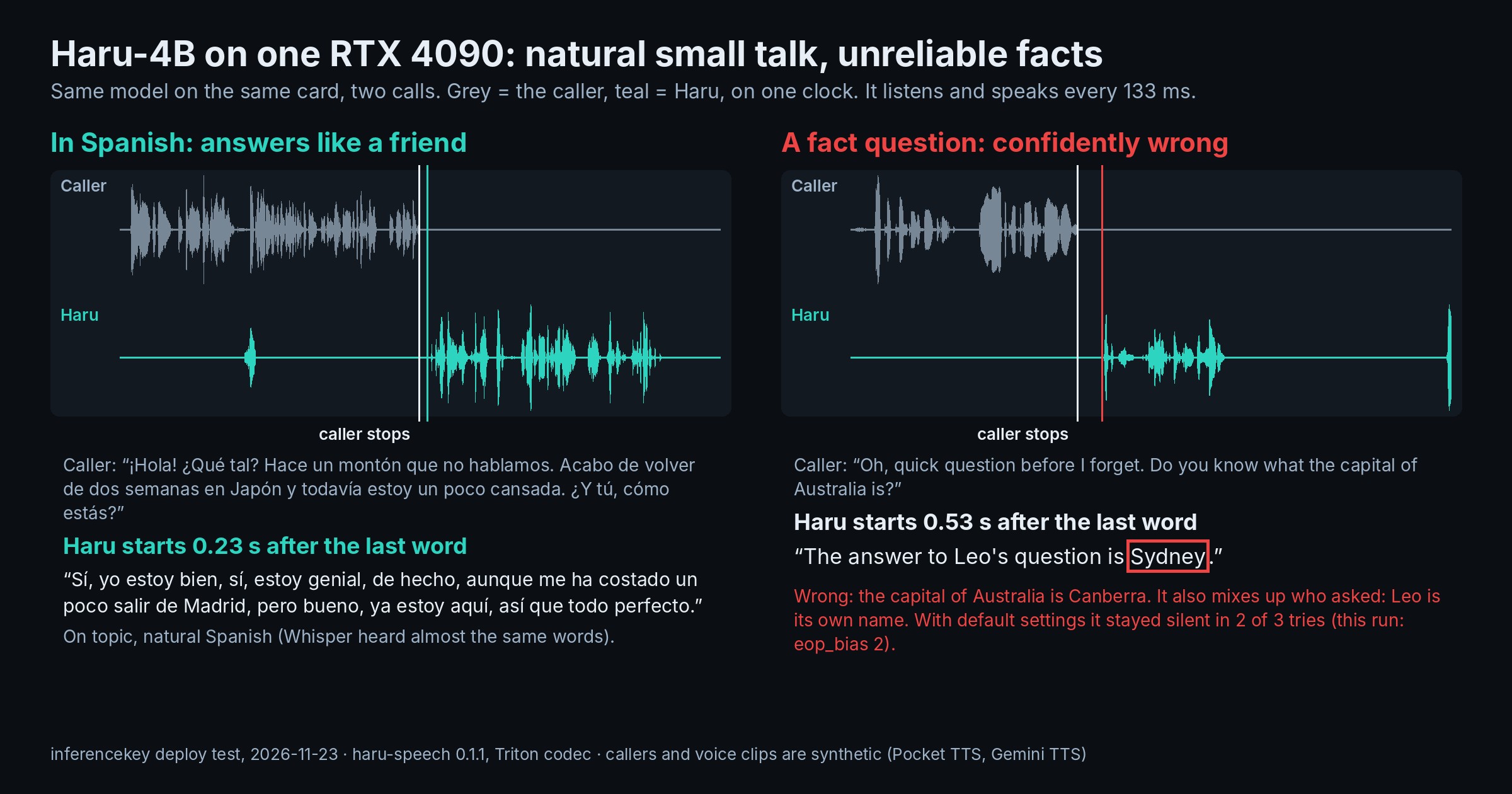
Every Spanish call got an on-topic Spanish reply, with the small words people use: "pues", "bueno", "ay". Asked by a friend back from Japan how he was, Haru, playing Marcos from Madrid, said he was fine, great in fact, although getting out of Madrid had been a bit of a struggle. It sounds like a person.
Then we asked for the capital of Australia. With default settings it stayed silent in two of three runs. Other times it introduced itself, or said Sydney. Once, in a longer call, it said "is it Canberra?", the right city as a guess. In one Sydney answer it also said "The answer to Leo's question is Sydney", when Leo was its own name.
None of this contradicts the authors. The card says Haru "is not a reliable source of facts and does not follow instructions the way an assistant does". It can also imitate a voice from a short clip, so we used only synthetic voices, as the authors ask.
16 GB proven, 12 GB likely
The model alone needs 9.92 GiB before it hears a word. Under an 11 GiB cap, standing in for a 12 GB card, Haru said the same words at the same speed on both cards. That cap is emulated: we could not rent a real 12 GB card. A 9 GiB cap ran out of memory while loading, so nothing smaller works without compressing the model.
On InferenceKey, a custom backend (a short Python file that tells our software on the GPU machine how to load a model and answer a request) installs higurashi's own package unchanged. From an empty machine to ready took 84.7 seconds on the small card. Long calls used to come back as a timeout: a 38-second call finished on the GPU in 20 seconds, but its reply exceeded the platform's 8 MB message limit. The backend in our SDK example now compresses the audio, and the same call came back in 20.7 seconds. The platform still reports a dropped result as a silent timeout, and that part is open.
Who should care
- Researchers studying turn-taking: yes. It is open, and our backend returns the beat-by-beat timing with every call.
- Teams building practice partners, games or characters: yes for recorded turns on a 16 GB card. Not yet for a live line through our API, which takes a whole recorded call and returns the whole reply.
- Anyone who needs correct answers or instructions followed: no. The authors say so, and our capital question agrees.
The honest limit: one run per setting with synthetic voices, one conversation at a time, and a caller who never interrupts, so how Haru handles being talked over is untested.
Read the full Haru-4B test in the Research post for every call, the memory ladder and the steps to run it on your own card.