Haru-4B keeps up with a recorded Spanish call on a 70 W card, and still gets facts wrong
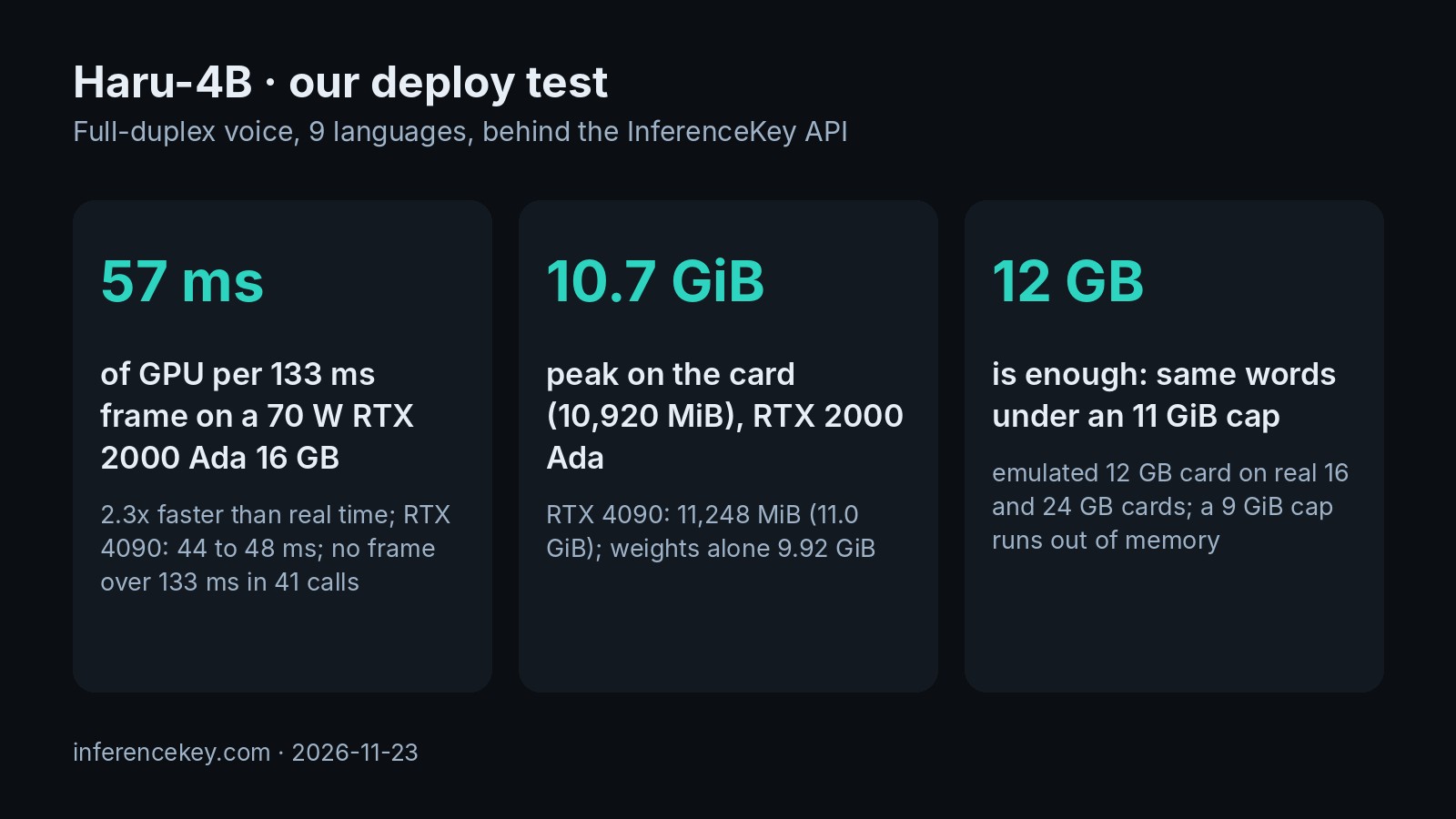
Open full-duplex voice model Haru-4B used 57 ms of GPU per 133 ms frame on a 16 GB RTX 2000 Ada, and worked under an emulated 12 GB cap.
We wanted to know whether a voice that listens and talks at the same time could hold a Spanish phone call on a small graphics card. We played a recorded Spanish call from a synthetic caller to Haru-4B, an open model from higurashi. On a 70-watt RTX 2000 Ada with 16 GB on our cloud, it kept up. The model works in beats of 133 milliseconds. Each beat cost that card 57 milliseconds of work, more than half of every beat to spare. In the scripted Spanish calls it started answering about 0.23 to 1.05 seconds after the caller stopped. Asked for the capital of Australia, it often stayed silent. When it spoke, it changed the subject, said Sydney or once guessed Canberra. Haru is good company for small talk and a poor source of facts.
A 133-millisecond beat, and one step per beat by design
The authors designed Haru to draw each slice of its voice in a single step, with no second model behind it.
A drummer has to land every hit on the beat. If getting ready for a hit takes longer than the beat itself, the song drags, and no talent fixes it afterwards. A voice model on a live line has the same problem. Haru's beat is 133 milliseconds: in each one it hears a slice of your voice and produces a slice of its own. If the graphics card needs more than 133 milliseconds to do that, the conversation falls behind and never catches up.
Haru listens and speaks at the same time, like a phone call rather than a walkie-talkie, as Sophon-Realtime does. What is different is how little Haru does per beat.
Many voice models turn sound into a stream of codes from a fixed dictionary of sounds, like spelling speech with a huge alphabet. Some then run a second model just to write those codes. Haru does neither. In every beat it adds up three things into one input of its language model: what it heard, what it said and the text it is writing. A small add-on then draws the next slice of its voice in one go.
The work is higurashi's, built on Alibaba's Qwen language model and Microsoft's VibeVoice, with credits to others in the appendix. Their technical blog, by Rikuto Kotoge, says they trained it on over 40 million hours of speech in more than 160 languages, with a focus on nine. The Hugging Face repo went up on 12 November and the code and blog on 13 November, under Apache-2.0. The model card calls it "a pretrained base model, released for research". Both statements hold at once: the licence lets you build on it, and the authors tell you it is not an assistant.
We spotted it in the AI Search news video of 15 November (chapter at 20:10). Our part: a custom backend around the authors' package, a memory ladder on two cards, and a fix for long calls that timed out.
The test: a recorded call, played to the model one beat at a time
Each request carried a recorded caller clip, and our code fed it to the model one 133-millisecond slice at a time. Most calls ran as fast as the GPU allowed. A few were paced like a real line, one slice every 133 milliseconds. After the clip, it kept the line open with eight seconds of silence. Nobody told the model when to talk: it decided from the audio alone. The clips never interrupt or talk over the model, so the test measures turn-taking after the caller stops. How it handles being interrupted stays untested.
The callers were synthetic voices. The English caller, a woman's voice, talked about a trip to Japan, told a 16-second story about the wrong train in Tokyo and asked for the capital of Australia. In Spanish, two Google synthetic clips did a catch-up call and a short story. Haru ships without voices, so we gave it one from a clip of 6 to 7 seconds, also synthetic, plus a short character card. In English it played Leo, a travel writer in Lisbon. In Spanish it played Marcos, from Madrid.
We ran it on two real cards: an RTX 4090 with 24 GB and an RTX 2000 Ada with 16 GB. The second is a 70-watt card. A speech-to-text program transcribed 33 replies to check what the model actually said. One run per setting, synthetic voices and one conversation at a time: those are the limits, and the rest of the numbers sit inside them.
Under half the beat on a 70 W card, and no beat over 133 ms in 41 calls
The small card did each beat's work in 57 milliseconds. That leaves 76 milliseconds of every beat idle, so the card runs 2.3 times faster than the conversation needs. The RTX 4090 took 44 to 48 milliseconds per beat, about three times faster than real time.
| Card | Typical work per 133 ms beat | Faster than real time |
|---|---|---|
| RTX 4090, 24 GB | 44 to 48 ms | 2.8 to 3.1x |
| RTX 2000 Ada, 16 GB, 70 W | 57 ms | 2.3x |
No slow beats hide behind that typical figure. Across 41 calls on both cards, the slowest single beat took 74.6 milliseconds, well inside 133. In the calls paced like a real line, not one beat arrived late on either card.
How fast it answers is a separate question from how fast it computes. In the returned recording, Haru started talking 0.12 to 1.13 seconds after the caller's last word following a greeting or question. Our API takes the whole recorded call and returns the whole reply: 7.3 seconds for the Spanish catch-up call. After the 16-second story it was slower: it waited 1.8 to 4.9 seconds and then said little.
In Spanish it chats like a friend, but asked a fact it guesses
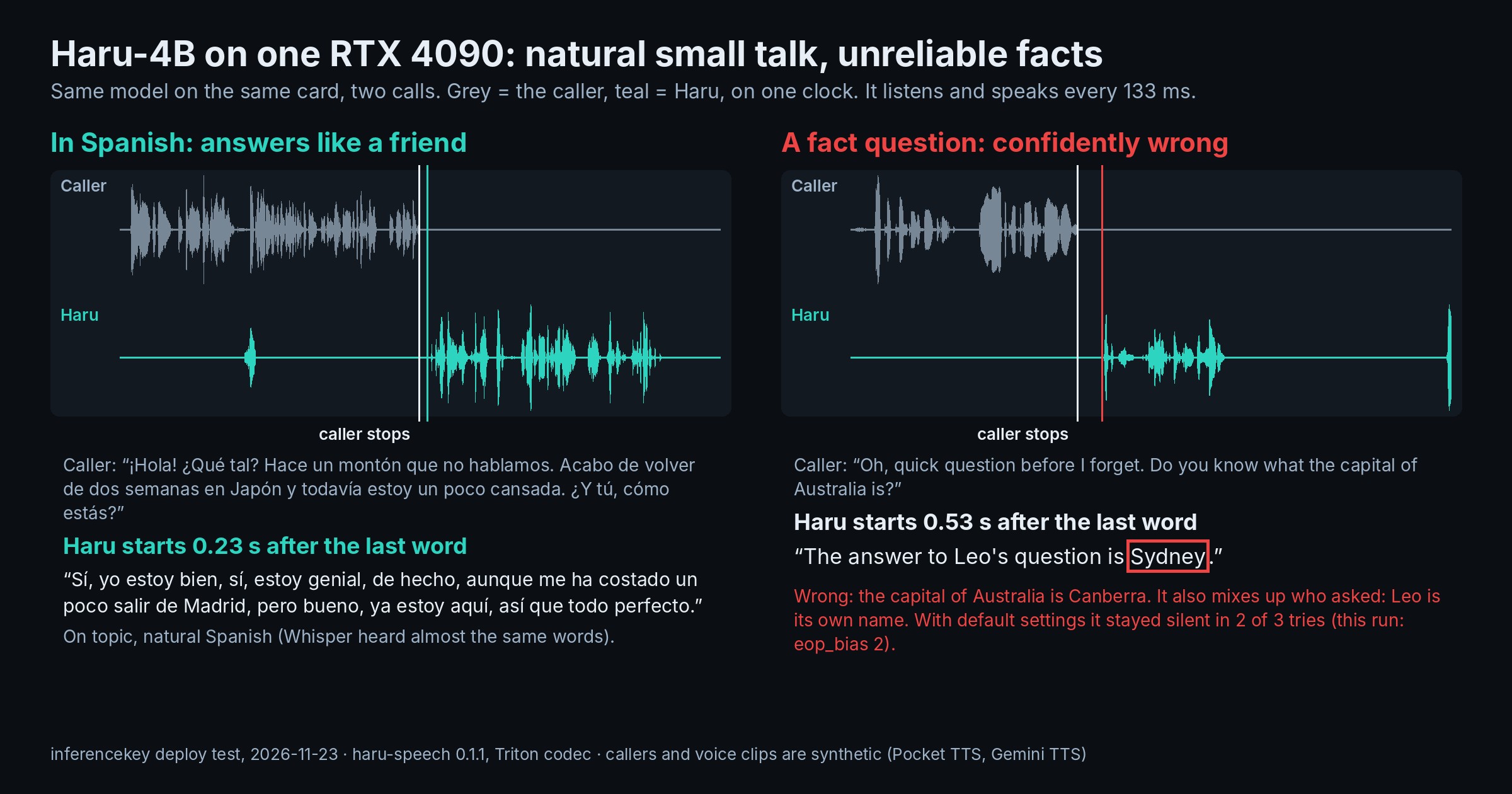
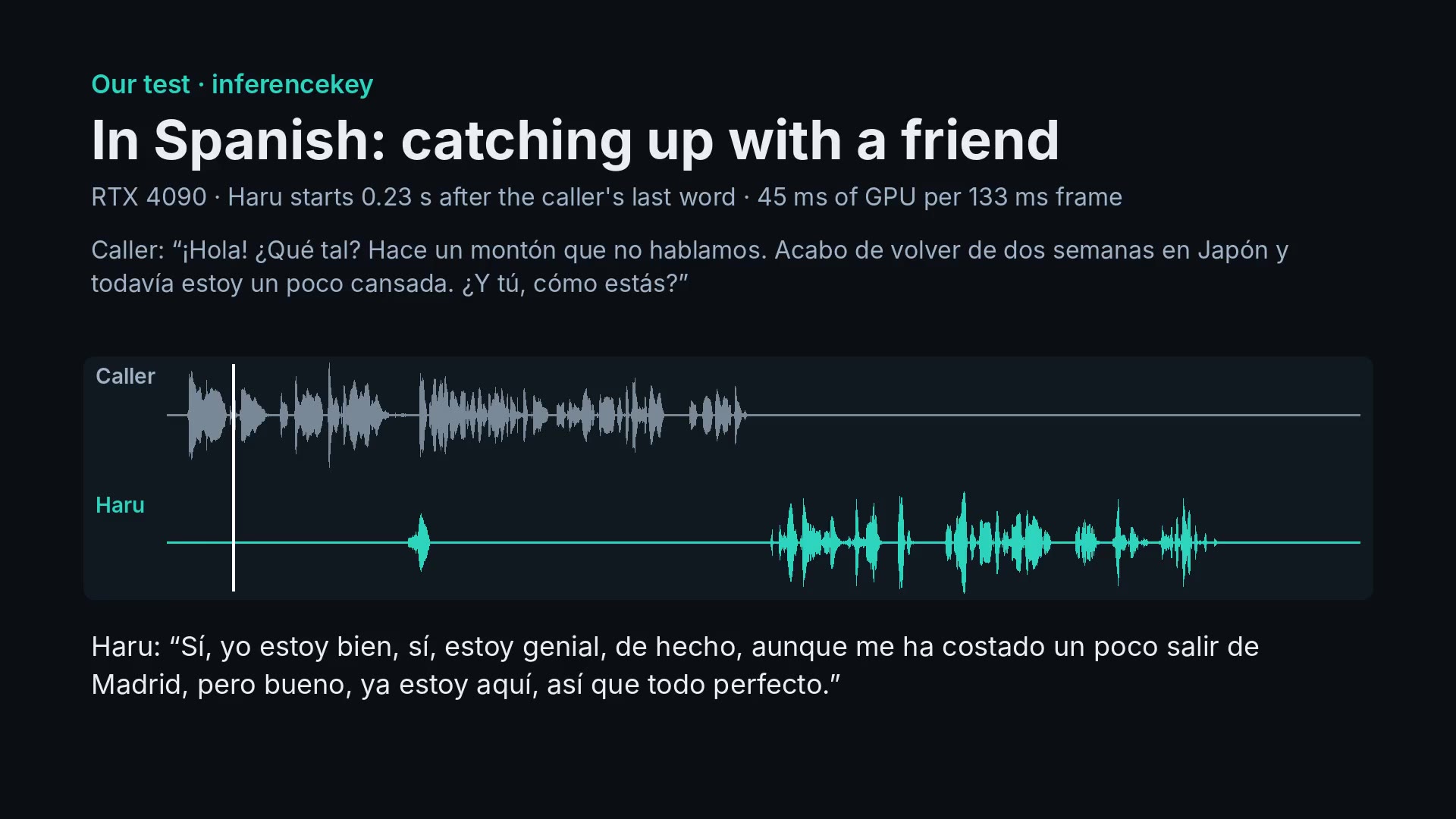
Every Spanish call got an on-topic Spanish reply with the small words people use: "pues", "bueno", "ay". We did not score them. Asked how he was by a friend back from Japan, Marcos said he was fine, great in fact, although getting out of Madrid had been a bit of a struggle. It sounds like a person on the phone.
Spanish catch-up call on the RTX 4090: the caller is back from two weeks in Japan, Haru (as Marcos) answers in Spanish 0.23 s after she stops
English small talk on the RTX 4090: Anna is back from Japan, Haru (as Leo, a travel writer in Lisbon) answers about life in Lisbon
Facts are another story, and the authors warned us. Asked for the capital of Australia, it stayed silent in two of three runs with default settings. In others it introduced itself instead of answering, or said Sydney. Once, in a longer call, it said "is it Canberra?", the right city phrased as a guess. In one Sydney answer it also mixed up who was talking: "The answer to Leo's question is Sydney", when Leo is its own name. It called the Algarve a coastal town near Lisbon. And sometimes it slurs: in two replies on the small card, its voice did not match the words it meant to say.
The capital question on the RTX 4090: Haru answers "The answer to Leo's question is Sydney", which is wrong, 0.53 s after the caller stops
None of this contradicts the card, which says Haru "is not a reliable source of facts and does not follow instructions the way an assistant does". It is a base model: it learned how conversations sound, not what is true. It can also imitate a voice from a short clip, and the authors ask you to use only voices you have the right to use. We followed that with synthetic voices only.
Which GPU: a real 16 GB card works, 12 GB likely but not proven
The smallest real card that worked was the 16 GB RTX 2000 Ada, so the 4090 is not a requirement for one conversation.
As shipped, Haru peaked under 12 GB of the card's memory. It has about 5 billion parameters, stored as one 10.5 GB file. The model alone needs 9.92 GiB before it hears a word, and the small card peaked at 10.7 GiB. Sophon-Realtime, tested last week, peaked at 19.5 GiB on an RTX 4090 with its authors' 24 GB configuration. That is a different setup, so it is not a fair ranking.
To stand in for a 12 GB card, we let the model use only 11 GiB, leaving room for what else runs on the card. Under that cap, Haru said the same words as without it, at the same speed, on both cards. This is an emulated cap, not a real 12 GB card, which would have about 1 GB to spare over what we measured. We could not rent one: the RTX 3060 is not in our cloud's catalogue, and the 12 GB RTX 3080 Ti and 4070 Ti were out of stock.
With a 9 GiB cap, standing in for a 10 GB card, it ran out of memory while loading. The weights alone do not fit, so there is no point trying anything smaller without compressing the model. The authors offer a compressed version only for Macs, and we did not test it.
On InferenceKey: the authors' package unchanged, ready in 85 seconds on the small card
The card is yours by the hour, and the authors' own package ran on it unchanged. We wrote a custom backend, a short Python file that tells our software on the GPU machine how to load a model and answer a request. It installs higurashi's haru-speech package, downloads the weights at a fixed version and feeds each recorded call to their own conversation loop.
From an empty machine to ready took 76.2 seconds on the RTX 4090 and 84.7 seconds on the RTX 2000 Ada. Downloading the 10.5 GB of weights took 7 to 10 seconds. The largest single part was a one-time warm-up on the card of about 28 seconds. Restarted with files already there, it took 12 to 13 seconds.
Long calls used to come back as a timeout. Our SDK example fixes it. A 38-second call finished on the GPU in 20 seconds, but its 11.3 MB reply exceeded the platform's 8 MB message limit, so the client got a timeout. The backend in our SDK example now compresses the audio when the reply would not fit, and names the error if it still does not. The same call then came back in 20.7 seconds. The platform still turns a dropped result into a silent timeout instead of naming the cause: that part is open.
Should you use it? For natural small talk and turn-taking research, not for answers
- You are researching how machines take turns in a conversation: yes. It is open, Apache-2.0, nine languages per the authors, and our SDK example's backend returns the beat-by-beat timing with every call.
- You want a natural-sounding voice for practice partners, games or characters: yes for recorded turns on a 16 GB card, not yet for a live line through our API. For live today, run the authors' own server on your card, or wait for our streaming. Either way, have a person or a filter check anything it states as fact.
- You need correct answers, booking details or instructions followed: no. The authors say so and our capital question agrees.
Run python main.py caller.wav my-voice.wav --language es from the Haru-4B SDK example. It needs a 16 GB NVIDIA card and 30 GB of disk.
For engineers
Credits
- higurashi (higurashi.ai): Haru-4B, the weights and the code (both Apache-2.0), the training data pipeline (FastDialogueSidon), the
haru-speechpackage, the Triton codec, the MLX app, the vLLM-Omni plugin, the technical blog by Rikuto Kotoge, and three of the four demo videos on the project page, used in our video with a credit band. Their blog thanks GENIAC (METI/NEDO) and a cloud sponsor for support. Release dates: Hugging Face repo created 12 November, code and blog on 13 November. - Sidon (W. Nakata, Y. Saito, Y. Ueda, H. Saruwatari, ICASSP 2026): the open multilingual speech restoration model among the preprocessing models in Haru's data pipeline, which FastDialogueSidon is named after.
- The Qwen team, Alibaba: Qwen3.5-4B, the text backbone Haru starts from.
- Microsoft: VibeVoice, the causal acoustic tokenizer Haru uses as its codec, and the idea of next-latent generation at 7.5 Hz (per the Haru acknowledgments).
- Improved MeanFlow: the one-step generative framework behind the audio head.
- Kyutai: Moshi, the full-duplex pioneer whose web client the Haru demo derives from; and Pocket TTS, whose stock voices
anna(English caller) andalba(English voice reference) we used. - Google: Gemini TTS voices for the Spanish callers and the Spanish voice reference.
- OpenAI: Whisper medium, run with faster-whisper, used to transcribe the replies.
- flash-linear-attention: the kernels we added by hand for one variant.
- AI Search: the news video of 15 November, chapter "Haru 4B" at 20:10, where we spotted the model. Nothing said in it is used as a source.
- Our part: the custom backend
haru-4b-full-duplex(0.1.0 and 0.1.1), the SDK example, the runs on two cards, the memory ladder, the transcripts, the demo video and the samples.
The model, as published
| Part | Details (model card and blog) |
|---|---|
| Weights | higurashi-ai/Haru-4B, sha 8d6e83bcd3701a76fc27a764965665da1df7da78, one model.safetensors of 10,540,113,510 B, BF16, 5,270,000,897 parameters; tokenizer 20 MB; not gated; audio-to-audio |
| Language model | Qwen3.5-4B text backbone, 32 layers, hidden size 2560; 3 of 4 layers are Gated DeltaNet linear attention |
| Audio codec | VibeVoice acoustic tokenizer, causal, 24 kHz, 3200 samples per latent |
| Audio head | 4-layer MLP, MeanFlow, 1 sampling step, guidance scale 1 to 2 (default 1.5); trained with Flow Matching, then MeanFlow distillation |
| Frame rate | 7.5 Hz: per 133 ms frame, user audio, model audio and model text summed into one LM position (element-wise addition instead of interleaving, about a third of the context) |
| Text | chunks followed by padding and a dedicated end-of-padding token that predicts when speech starts |
| Training | over 40M hours of speech, more than 160 languages with a focus on nine (English, Spanish, Portuguese, German, French, Chinese, Japanese, Russian, Korean), over 13M hours of full-duplex dialogue separated into one track per speaker by FastDialogueSidon, samples up to 60 min; no LLM-generated dialogues or TTS speech; 256 B200 for about 8 days on Megatron-LM |
| Authors' latency (not reproduced) | M1 Max, native Swift app, int8: one step 34.2 ± 0.5 ms, total p50 65.2 ± 1.5 ms, excluding up to 133 ms of framing. B300 via vLLM-Omni: encode, one LM step and decode about 15 ms |
| Quality benchmarks | none published |
| Implementations | haru/ (PyTorch and web demo), haru_mlx/ (Apple silicon, native macOS app, optional 8-bit at load), haru_vllm/ (vLLM-Omni plugin, vllm>=0.32, vllm-omni>=0.32, recommended for many concurrent conversations); repo commit 7fe6b766 "Release haru-speech and haru-speech-vllm 0.1.1", 2026-11-13 |
| Future work (blog) | full-duplex models of 100B+ parameters in pretraining, video input, fine-tuning on native two-channel recordings |
Authors' quick start, which our backend follows: pip install -e ./haru then python -m haru.server --hf-repo higurashi-ai/Haru-4B and a web demo on http://localhost:8998 ("With an NVIDIA GPU (about 12 GB of memory)"; Bluetooth adds 100 ms or more). The Python API is DuplexSession(model, system_prompt=card, reference=voice), session.start(), then session.step(user_audio) with 3200 samples at 24 kHz in and out; the model is one frame ahead of the user. The voice clip must be one speaker, 3 s to 3 min, clean speech. The character is a text card with a fixed layout (render_card, per-language templates). Upstream DuplexConfig defaults: codec_backend torch, temperature 0.7, top_k 25, guidance 1.5, eop_bias 0.0 ("> 0 makes the model start speaking sooner"), max_frames 27,000 (60 minutes). The Triton codec takes about 0.7 ms instead of 6 ms to encode or decode a frame.
Setup
| Item | Value |
|---|---|
| Runtime | haru-speech[triton]==0.1.1, torch 2.15.0+cu132, transformers 5.24.0, triton 3.9.0, resolved by the worker's uv into the backend venv |
| Backend | custom Python backend haru-4b-full-duplex 0.1.0, then 0.1.1 (text2audio, chat route). setup(): snapshot_download at the pinned revision to local disk, optional torch.cuda.set_per_process_memory_fraction cap, load_model, warm-up of 30 silent steps (codec auto tries Triton, falls back to torch). process(): caller clip plus voice clip plus per-language card, DuplexSession.start(), one step() per 3200-sample frame over the clip and tail_seconds of silence. One conversation at a time (threading.Lock) |
| Why not the vLLM-Omni plugin | no built-in InferenceKey backend serves Haru; the plugin needs vLLM and vLLM-Omni 0.32+, a much heavier install, and the plain PyTorch path is the authors' quick start. Plugin not tried |
| Cards | RTX 4090 24 GB (24,564 MiB, driver 595.112.07, CUDA 13.2, cc 8.9); RTX 2000 Ada 16 GB (16,380 MiB, 70 W limit, 224 GB/s) |
| Platform | local InferenceKey manager and worker built from main, never production |
| Callers (synthetic) | English Pocket TTS anna: e1-trip 6.99 s, e2-story 15.86 s, e3-fact 5.05 s, e4-long 37.9 s (e1, 5 s, e2, 5 s, e3). Spanish Gemini TTS es-es-commercial-3: s1-viaje 8.84 s, s2-historia 12.12 s |
| Voices given to the model (synthetic) | ref-alba 6.34 s (Pocket alba), ref-es 7.44 s (Gemini es-es-advisor-2) |
| Cards (characters) | EN "Leo", 34, travel writer in Lisbon, caller "Anna"; ES "Marcos", Madrid, caller "Lucía" |
| Checks | faster-whisper medium on CPU, 33 replies; nvidia-smi sampled every second for card peak |
"Starts" below is the first model frame above -45 dBFS at or after the caller's last voiced 20 ms window (-40 dBFS).
Step by step with the SDK example
The example (commit cb36a29b on main) holds backend.py, publish.py, main.py, requirements.txt, README.md, .env.example and .gitignore.
git clone https://github.com/inferencekey/inferencekey-sdk.git && cd inferencekey-sdk
# client: local SDK build (see CONTRIBUTING.md) plus `requests`
cd examples/haru-4b-full-duplex-custom-backend-private-nvidia
cp .env.example .env   # INFERENCEKEY_SDK_TOKEN, INFERENCEKEY_API_KEY, INFERENCEKEY_PROJECT, IK_WORKER_ID;
                       # optional INFERENCEKEY_TENANT_ID and INFERENCEKEY_USER_TOKEN for publish.py and the chat route
python publish.py      # once: uploads backend.py as a custom backend
python main.py caller.wav my-voice.wav                  # English card
python main.py llamada.wav mi-voz.wav --language es     # Spanish card
main.py calls ensure() (fixed policy, text2audio, ready_timeout_secs 2400, HARU_* variables passed through), waits until ready, turns on the chat route, sends one call and writes outputs/call-<lang>.wav (the model, 24 kHz), call-<lang>.conversation.wav (caller left, model right) and a .json with text, per-frame timing and GPU memory. request_timeout_secs is 300. IK_KEEP_ALIVE=1 keeps the workload afterwards.
The request, POST {base}/endpoint/{project}/haru-4b/v1/chat/completions:
{"model": "default",
 "messages": [{"role": "user", "content": [{"type": "input_audio",
   "input_audio": {"data": "<base64 WAV of the caller>", "format": "wav"}}]}],
 "extra_body": {"voice_clip_b64": "<base64 WAV, 3 s to 3 min of one speaker>",
                "voice": "leo", "language": "es",
                "character": {"persona": "...", "name": "Marcos", "gender": "male",
                              "other_name": "Lucía", "relationship": "...", "situation": "..."},
                "tail_seconds": 8, "seed": 7}}
Other options: temperature (0.7), top_k (25), guidance_scale (1 to 2, 1.5), eop_bias, speak_first, pace (offline or realtime), audio_format (wav or flac), tail_seconds 0 to 30. The reply content is a JSON string with audio_b64, conversation_b64, format, text, words, timings (frame_ms_median, frame_ms_p95, frame_ms_max, realtime_factor, frames_over_133ms, model_starts_after_caller_s, model_talks_while_caller_talks_s) and gpu_used_mib_peak.
| Variable | Default | What it does |
|---|---|---|
HARU_CODEC_BACKEND | auto | auto (Triton when usable), triton or torch |
HARU_GPU_MEMORY_GB | 0 (no cap) | caps the GiB PyTorch may allocate, used for the emulated rungs |
HARU_HF_REVISION | 8d6e83bc... | Hugging Face revision of the weights |
HARU_CACHE_DIR | ~/.cache/haru-backend | where the 10.5 GB checkpoint goes; keep it on local disk |
requirements.txt: inferencekey, haru-speech[triton]==0.1.1, huggingface_hub[hf_xet], numpy, scipy, soundfile. flash-linear-attention is not included.
Time to ready
| Run | Ready after ensure() | Backend setup() |
|---|---|---|
| RTX 4090, fresh worker | 76.2 s (venv about 25 s) | 46.2 s: 10.5 GB download 7.1 s, load 4.0 s, warm-up with Triton compile 28.0 s |
| RTX 4090, warm caches | 12.0 to 13.0 s | 9.0 to 10.2 s |
| RTX 2000 Ada, fresh worker | 84.7 s | 49.0 s: download 10.4 s, load 4.3 s, warm-up 27.1 s |
Calls through the API
Seed 1 unless noted, 8 s tail.
| Card | Call | ms per frame median / p95 / max | Starts | Model wrote |
|---|---|---|---|---|
| 4090 | e1-trip | 45.2 / 48.8 / 73.5 | 0.97 s | "Oh, I've been great, just working my little bum off here in Lisbon. Life is good, you know, just staying busy." |
| 4090 | e2-story | 44.2 / 49.7 / 55.5 | 4.89 s | "Yeah, I remember that." |
| 4090 | e2-story seed 2 / 3 | 43.7 / 43.6 | 1.82 s / 4.75 s | "Hi Anna, how are you? I'm catching up. How" / nothing |
| 4090 | e3-fact seed 1 / 3 | 44.1 / 43.6 | none | silent for 8 s |
| 4090 | e3-fact seed 2 | 47.9 | 0.66 s | "I'm Leo. I'm a traveler, and I live in Lisbon. And I have a really good friend, Anna" |
| 4090 | e3-fact, eop_bias 2 | 43.3 | 0.53 s | "The answer to Leo's question is Sydney. I have a" |
| 4090 | s1-viaje (es) | 47.2 / 49.7 / 55.9 | 0.23 s | "Sí, yo estoy bien, sí, estoy genial, de hecho, aunque me ha costado un poco salir de Madrid, pero bueno, ya estoy aquí, así que todo perfecto." |
| 4090 | s2-historia (es) | 44.0 / 50.2 / 58.0 | 0.52 s | "Ay, ay, qué buenísimo, se te ve la cara de felicidad. Pues yo la verdad es que" |
| 4090 | e2-story, pace: realtime | 45.3, 0 late frames | 4.89 s | same as offline, round trip 25.1 s |
| 4090 | four calls during the demo take | 43.4 to 47.5 | 0.23 to 3.69 s | Spanish and English small talk |
| Ada | e1 / e2 / s1 / s2 / e3 eop_bias 2 | 56.9 to 57.0, p95 at most 57.9, max 74.6 | 0.97 / 4.89 / 0.23 / 1.05 / 0.53 s | s2: "Qué bueno, una aventura total."; e3: off-topic self-intro |
| Ada | e2-story, pace: realtime | 57.1, 0 late frames | 4.89 s | "It's a kind of like we university. My name is Leo. I'm thirty-four years" |
| Ada | e4-long 37.9 s plus 8 s (345 frames), backend 0.1.1 | 57.1 / 57.8 / 69.3 | 1.13 s | "... Well, let's see, it would be the capital of Australia. Well, is it Canberra?" (FLAC, round trip 20.7 s) |
| Ada | e4-long seed 2 | 57.6 | 0.60 s | "... I think Sydney. Oh yes, Sydney, it's like. Ah Sydney, yes, Sydney." |
Prompt prefill (character card plus voice clip): 0.11 to 0.20 s. Round trip for a 14 to 24 s call: 5.4 to 11.3 s in offline pace. Round trip for s1-viaje on the 4090: 7.3 s. Worst frame with the plain PyTorch codec: 87.8 ms.
Whisper notes: heard text matches written text in most replies (names aside: "Lisbon" heard "Lesbin", "Anna" heard "Hannah"). Two replies on the RTX 2000 Ada were heard differently from what the model wrote ("It's nice to have a conversation again" heard "It's right as well to I've been great to Monsanto"; "un poco mejor que tú" heard "es indíntuco, mejor que tú"). Whisper prints "Thank you." over the silent replies, an ASR artifact. Overlap with the caller (model_talks_while_caller_talks_s) was 0 to 3.3 s, mostly when the model started a reply early. It sometimes stops mid-sentence when the 8 s tail ends.
Memory ladder
| GPU or setting | Configuration | Card peak | Time per frame (median) | Output OK? | Real or emulated |
|---|---|---|---|---|---|
| RTX 4090 24 GB | as shipped, Triton codec | 11,248 MiB | 44 to 48 ms | yes | real |
| RTX 4090 | plain PyTorch codec, HARU_CODEC_BACKEND=torch | 11,070 MiB | 64 to 68 ms | yes, different words with the same seed | real |
| RTX 4090 | flash-linear-attention 0.6.0 added by hand to the backend venv | 11,677 MiB | 38 to 41 ms | yes, different words | real |
| RTX 2000 Ada 16 GB, 70 W | as shipped, Triton codec | 10,920 MiB | 57 ms | yes | real |
| 12 GB card on the RTX 4090 | HARU_GPU_MEMORY_GB=11 (PyTorch cap 11.0 GiB) | 11,242 MiB (torch 10,784) | 44 to 46 ms | yes, same words as uncapped | emulated |
| 12 GB card on the RTX 2000 Ada | HARU_GPU_MEMORY_GB=11 | 10,920 MiB | 57 ms | yes, same words as uncapped | emulated |
| 10 GB card on the RTX 4090 | HARU_GPU_MEMORY_GB=9 | n/a | n/a | no: setup() failed: CUDA out of memory. Tried to allocate 46.00 MiB ... 9.00 GiB allowed (weights 9.92 GiB) | emulated |
| RTX 3060 12 GB | not tried | n/a | n/a | not offered on our cloud; RTX 3080 Ti and 4070 Ti 12 GB out of stock | not run |
Other memory figures: 10,970 MiB after setup on the 4090, 10,620 MiB on the Ada; PyTorch peak reserved 10,734 to 10,786 MiB. The cap limits PyTorch's allocator only: a real 12 GB card has 12,288 MiB, and the card peak under the cap was 10,920 to 11,242 MiB. The SDK example's README notes 64 to 67 ms for the PyTorch codec, the report 64 to 68 ms.
Remaining samples and video
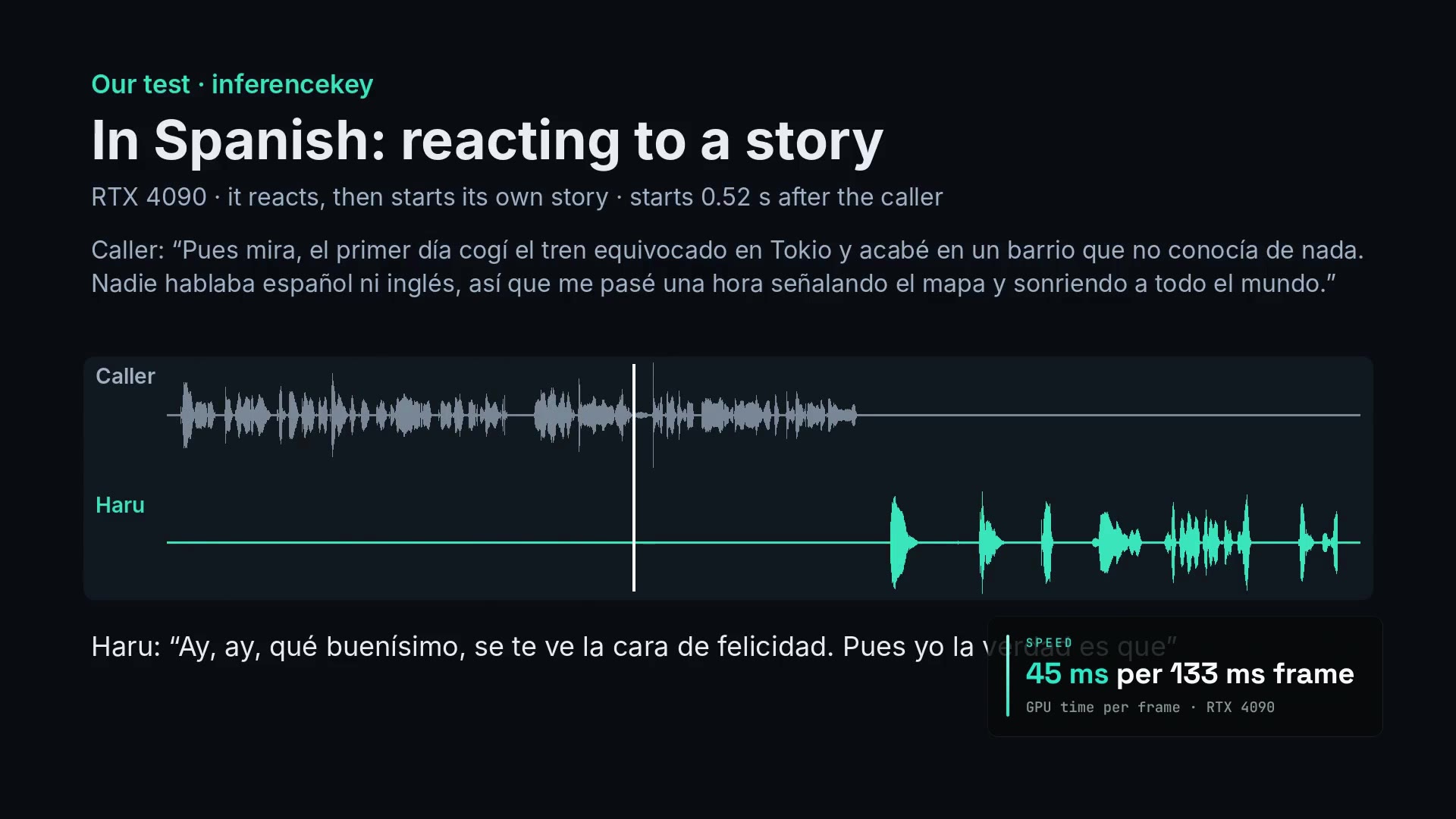
Spanish story on the RTX 4090: the caller tells a short story, Haru answers "Ay, ay, qué buenísimo" 0.52 s after she stops
Long call on the RTX 2000 Ada: 37.9 s of trip, story and the capital question, Haru ends with "Well, is it Canberra?"
English voice reference given to the model (synthetic, 6.34 s)
Spanish voice reference given to the model (synthetic, 7.44 s)
Problems
- Long calls returned 504 (fixed in the backend, platform part open). A 37.9 s clip plus 8 s tail finished on the GPU in 20.1 s, but the client got
504 {"error":{"message":"Inference timed out.","type":"timeout_error","code":"inference_timeout"}}twice. Worker log:job result refused by JetStream for good (code max_payload: max payload size exceeded: Payload size limit of 8388608 exceeded by message size of 11262873). Backend 0.1.1 switches to FLAC above 7 MB, drops the two-channel copy if still too big and errors clearly if the reply alone is too big; the rerun returned FLAC in 20.7 s. The manager still reports a dropped result as a timeout. - Base model, unreliable facts: model limit stated by the authors; see the calls table.
- No live streaming through the platform: no WebSocket passthrough, so a request is a recorded clip fed frame by frame.
- transformers fast paths:
chunk_gated_delta_rule,fused_recurrent_gated_delta_ruleandcausal_conv1d_*fall back to PyTorch withoutflash-linear-attentionandcausal_conv1d. Real time holds anyway; fla 0.6.0 gave about 12 % and 430 MiB more. - No real 12 GB card available on our cloud: the 12 GB rung is emulated.
- One conversation per worker in this backend; concurrency not measured.
Limits
One run per setting at temperature 0.7, so single differences can be chance. Synthetic callers and voice references; Spanish judged on two synthetic caller clips plus the demo-take calls, one run per setting, not a scored evaluation. A request is a recorded call, not a live microphone session; timings are measured by the backend on the GPU host. Our numbers come from a local manager; the hosted service was not called. Not tried: a real 12 GB card, int8 or fp8 weights (the authors' 8-bit option exists only in their Mac (MLX) version), several conversations at once, the vLLM-Omni plugin, the MLX/Mac path. The authors' latency figures were not reproduced.
Sources
- Haru-4B model card and repository (commit
7fe6b766) - higurashi technical blog (2026-11-13) and project page with the four demos
- AI Search news video, chapter at 20:10, where we spotted it
- Our earlier full-duplex test: Sophon-Realtime-4B on a 24 GB card
- SDK example, commit
cb36a29b