Maxwell-V1.0-Flash reads a 125K-token contract on one 48 GB card and writes at 107 tok/s vs 118 at 4K
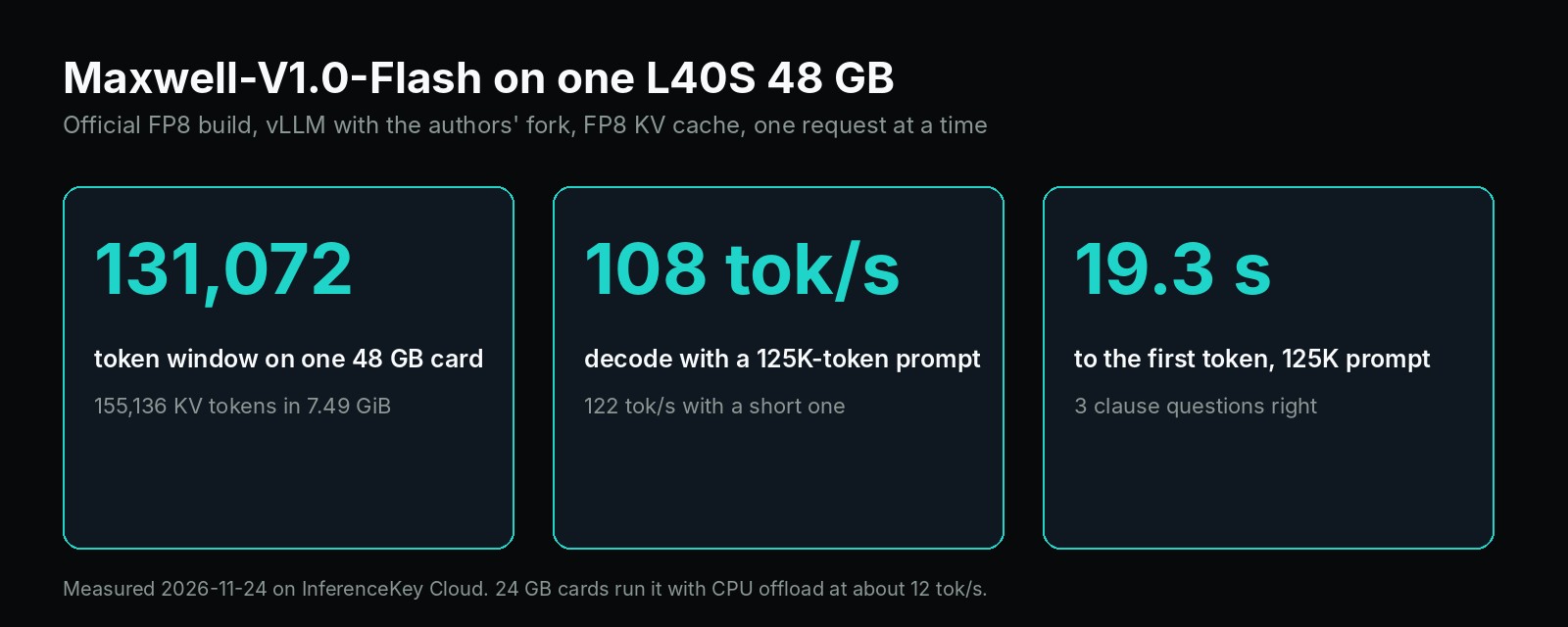
Maxwell-V1.0-Flash on one 48 GB L40S: 131,072-token window, 107 tok/s with a 125K prompt vs 118 at 4K, 3 of 3 clauses found. A 24 GB 4090 works, 10x slower.
Can an open model read a whole contract bundle on one graphics card and still write its answer as fast as it writes one to a short email? We gave Maxwell-V1.0-Flash 125,000 tokens of US copyright law with a fictional supplier agreement hidden inside, on one 48 GB NVIDIA L40S on our cloud. It found all three clauses we asked about, with the right values, in three runs out of three. Reading the bundle took about 19 seconds. Then it wrote the answer in about 3.5 seconds, at 107 tokens a second against 118 on a 4,000-token prompt. Speed held within about a tenth.
Our SDK example puts the same setup on your own GPU machine. A 24 GB RTX 4090 also gave the right answers on a 32K bundle, at a tenth of the speed. One catch: the authors' own server package is not built for these cards, and the example works around it.
A new base model built to skim long documents
Maxwell has its own design and its own word list, so it is not someone else's model retrained. The Maxwell Team pretrained it on about 26 trillion tokens of text and released it under the Apache 2.0 license. It has 35 billion parameters in total, of which about 3 billion work on each word. Think of a large team of specialists where each word only bothers a dozen of them. That is why a 35B model can write at a hundred tokens a second on one card.
The part worth testing is how it reads. Most models, when they write the next word, look back at every word of the document. The longer the document, the more looking back, so long prompts slow everything down. Maxwell reads like a lawyer with a thick binder. For each new word it looks at the first pages, the last pages, and up to 16 passages that a small learned index points to as relevant. The authors call this block-sparse attention, and they credit MiniMax's sparse attention work as the inspiration for how those passages are picked. It caps the looking back at about 4,096 tokens, however long the binder gets.
The model card says this looking-back step runs 6.7 times faster than the usual way at 256,000 tokens. The technical report is careful: the number measures that one step alone, not the whole model. What we could check is the claim an engineer cares about before swapping models: does the writing speed hold as the prompt grows?
The authors also publish a comparison against Qwen3.6-35B-A3B, a model of the same size. On their numbers, Maxwell scores 75.6 against 71.7 on a long-document reasoning test. It scores 65.4 against 63.4 on fixing real code bugs with Claude Code. Qwen still leads on the long-document retrieval test closest to ours, 97.1 against 95.8, and on two instruction-following tests by about a point.
Our test: one 48 GB card, one request at a time
We served the authors' own compressed copy: the same model at half the size, 38.6 GB instead of about 74 GB. It ran on one L40S with 48 GB of memory, through the InferenceKey API, with open-source serving software plus the authors' changes for this model. The window, the most text the model takes at once, was set to 131,072 tokens. It only just fits: the software needed 96.5% of the card's memory, and refused at 95%.
The task was a contract review a legal team might hand to a model. We took Title 17 of the US Code, public domain text, and planted a fictional supplier agreement in it. Three clauses sat at 10%, 50% and 90% of the depth: a liability cap of EUR 2,450,000, a breach notice within 36 hours, and 97 days' notice to terminate. The model had to find all three and give the values. We cut the bundle to about 4,000, 32,000 and 125,000 tokens and timed each size.
The limits, said once: one request at a time, three runs at the largest size, and no test of many users at once. This is a find-three-facts test, not a test of reasoning across the whole document. We did not reproduce the 6.7x. We ran no other model on this card, Qwen included, so every Qwen number here is the authors'. Nothing ran on a real 32 GB card or below 24 GB, and the 24 GB card never saw the 125K bundle.
Writing speed held: 107 tokens a second at 125K against 118 at 4K
The answer to the flat-speed question is mostly yes. A model first reads your prompt, then writes its answer word by word. Reading grows with the prompt. Writing speed is what we checked.
| Prompt | Reading (time to first word) | Writing speed | Answer |
|---|---|---|---|
| short (24 tokens) | 0.3 s | 122 tok/s | speed test only |
| about 4,000 tokens | 0.9 s | 118 tok/s | right in 2 of 3 runs |
| about 32,000 tokens | 5.1 s | 116 tok/s | right |
| about 125,000 tokens | 19.3 s | 107 to 108 tok/s | right in 3 of 3 runs |
From 4,000 to 125,000 tokens, the prompt grew about 31 times and the writing slowed by about a tenth. Below 16,000 tokens Maxwell still looks back at every word, so the binder trick only runs at the 32K and 125K points. Speed held at both. Without a dense or Qwen run on this card, we cannot say how much of that comes from the sparse design.
Reading is where long context costs, and you pay it once per bundle. A second question on the same bundle got its first word after 1.5 seconds, because the bundle was already read and kept on the card. The card keeps about 155,000 read tokens, so one 125K bundle fits at a time. It works like a soundcheck: one long wait at the start, then the set moves fast.
In one of the three 4K runs on the full-memory L40S, the model listed the right clause numbers but left the values in its private thinking. It never got a value wrong. Our prompt asked for three lines, "each with the clause number", and its thinking read that as only the clause number. Its instruction-following score in the authors' table, 64.8 of 100, trails Gemma-4-26B-A4B (79.1) and Muse Glimmer-30B (83.2), which matches this slip.
Good for precise lookups in long files, memory still grows
In our test it found precise facts in a long bundle, which is the shape of a contract or policy lookup. It also made one tool call, right the first time: it asked for a contract by its id in 1.3 seconds, then read our reply and answered in 1.0.
It does not make long context free in memory. The sparse design saves work, not space: every token you feed it still takes room on the card.
Which GPU: a real 24 GB RTX 4090 passed, about ten times slower
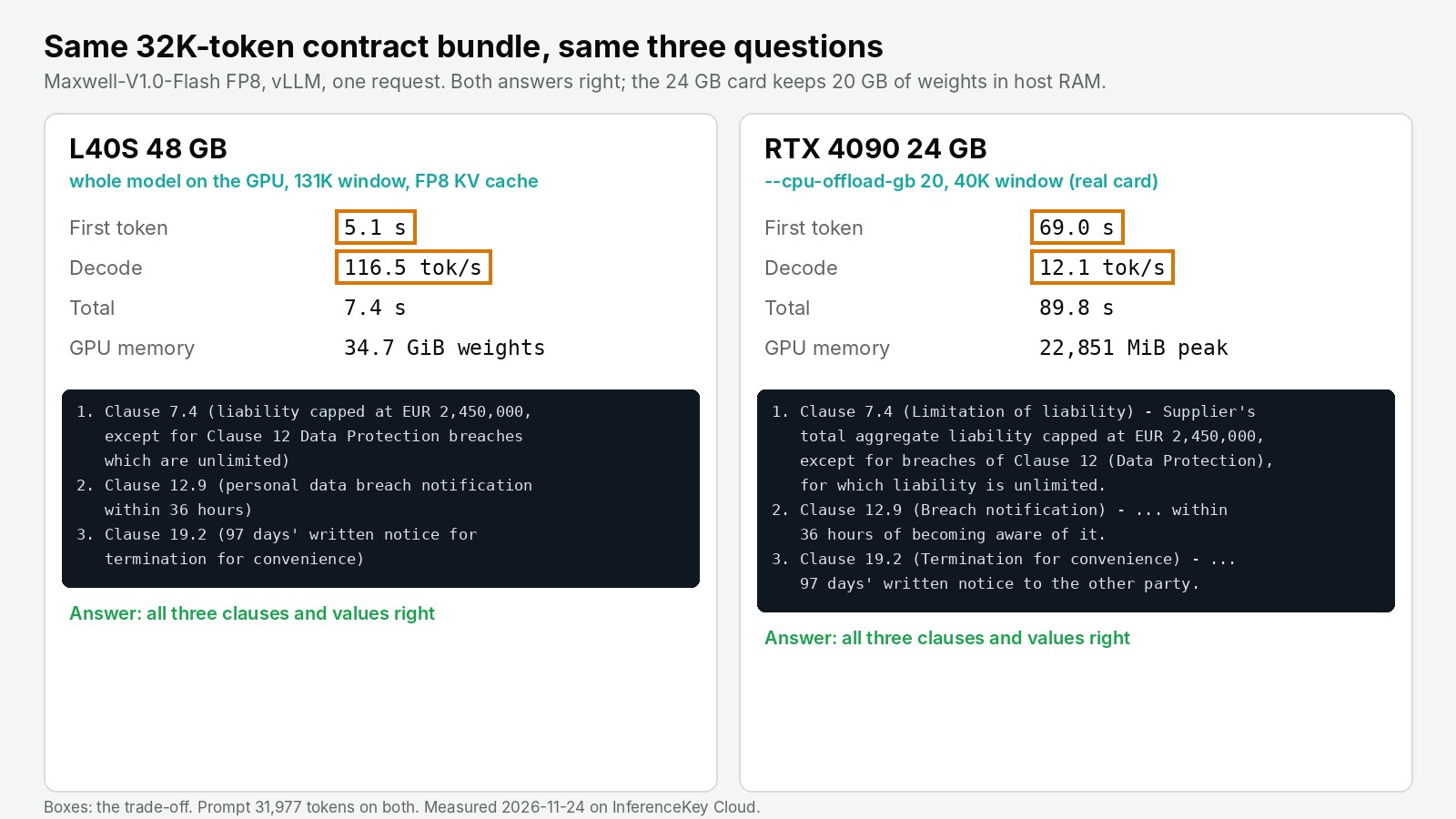
The smallest card that gave the right answers was a real RTX 4090 with 24 GB. It needs a trick: 20 GB of the model stays in the computer's main memory and is fetched as needed. On the same 32,000-token bundle it wrote at 12.1 tokens a second against 116 on the L40S, and the first word took 69 seconds against 5.1. All three answers were right, with values. The 4090 ran with a 40,960-token window.
So 48 GB is not a requirement. It is the price of full speed and the 131,072-token window. The model alone takes about 37 GB of the card, and the full window needs almost 7 GB more.
We also capped the L40S to act like a 32 GB and a 24 GB card. The two capped runs wrote 18.7 and 12.9 tokens a second, with the same format slip. The appendix has the full list.
On InferenceKey: serving in 170 seconds, once we swapped the authors' server package
It ran on our standard serving software, after one setup step per machine that the SDK example automates. From asking for the deployment to the model being ready took 169.9 seconds on a restart, with the files already on the machine. On a fresh machine, the 38.6 GB of weights downloaded in 25 seconds and the software environment built in about a minute.
The problem you will hit first is the server software. The authors' ready-made package does not suit the L40S or the 4090: its compiled code, which we inspected but did not run, only targets Hopper and Blackwell cards such as the H100 and B300. So we ran the public build it starts from with their 31 changed files on top.
Our part of that problem: our workers, the machines that run the model, install serving software only from public releases. Their modified version has to be put on the worker ahead of time. The prepare_worker.sh script in the SDK example does that once per machine. Status: the example handles it. Support for custom builds in the platform is still open. The other rough edges, including one bug of ours where an error was swallowed and the caller waited 180 seconds for nothing, are in the appendix with their status.
Swap it in for long documents on a 48 GB card, check strict formats first
For long documents, Maxwell is worth a trial against Qwen3.6-35B-A3B, and on a card you run yourself. Contract and policy text should not leave your machine. On your own GPU you rent the card by the hour, not by the token, though a 125K read holds it about 20 times longer than a 4K one.
- Long documents on your own card: try it, on a 48 GB card for the full 131,072-token window at full speed.
- Strict output formats: check them, and word the format plainly, before you rely on them.
- Many users at once: untested by us. Measure it on your own traffic before you size a server.
- A 24 GB card: use it for batch reviews up to about 40,000 tokens, not for chat.
- Quick answers per request: we found no way to turn thinking off through our endpoint yet, and a one-line question about the model took 15.9 s with it.
To run the same contract review on your own NVIDIA worker, run prepare_worker.sh once and then python main.py from the Maxwell-V1.0-Flash SDK example. It needs a 48 GB card with a CUDA 13 driver, an SDK token and an API key, and it deletes the deployment when it finishes.
For engineers
Credits
- The Maxwell Team trained and released Maxwell-V1.0-Flash and its FP8 build under Apache 2.0, wrote the technical report, the vLLM fork (
maxwell-model/vllm, commit4fb7bcae) with the Triton and TileLang paths we ran on Ada, and the MBSA kernel library. - MiniMax published MiniMax Sparse Attention (MSA). The report says Maxwell's per-KV-group remote-block selection "was inspired by" it, and the MBSA MegaKernel follows "the block-granular execution strategy of MSA".
- DeepSeek-AI and Xu et al. are credited by the report for manifold-constrained hyper-connections (mHC), the four residual streams; Jordan et al. and Liu et al. for the Muon optimizer used in pretraining.
- The vLLM project publishes nightly wheels; the one for
a9eafde5(the fork's base) carries kernels for sm_75 to sm_120, which is what made Ada possible. - AtomicChat published GGUF files and a llama.cpp port patch (not used here).
- AI Search covered the model in its 2026-11-22 video (chapter at 29:57), where we spotted it.
- Our part: running it on cards the authors do not list, through the stock InferenceKey
vllmbackend, measuring it, and packaging the SDK example.
The model, from the authors' card
- A mixture of experts with its own architecture and tokenizer (not a Qwen derivative going by mHC, the 200,704 vocab and BSA). 35B total, 3B active per token (both excluding embeddings), context up to 256K, about 26T pretraining tokens with Muon. Training starts dense; block-sparse attention enters at 128K mid-training once the indexer is warmed up against dense attention.
- 45 layers (3 dense FFN, 42 MoE), hidden 2,048, 32 query / 4 KV heads, head dim 128, 256 routed experts with 12 active plus 2 shared per layer, expert intermediate size 512, 4 mHC residual streams, 1 MTP layer, vocab 200,704, configured sequence length 262,144, RoPE base 10,000,000.
- MBSA: each KV group keeps 8 prefix and 8 local 128-token blocks plus up to 16 remote blocks picked by a learned indexer, capping main attention at 4,096 tokens per KV group. The full-history KV cache stays. Dense GQA for the first 16K query positions, BSA beyond.
- The 6.7x is an attention-kernel speedup "under matched tensor shapes" (report Figure 14), not end to end. Figure 14 also shows 10.8x at 1M; the report says lengths beyond 256K are kernel references only. MBSA requires SM90, SM100 or SM103.
- FP8 repo
maxwell-model/Maxwell-V1-Flash-FP8, sha6f91969d, created 2026-11-18, last modified 2026-11-24T04:34Z: onemodel.safetensorsof 38,588,885,068 B, fine-grained FP8 with 128x128 blocks. BF16 repo: 34 shards, 73,643,612,777 B.
Authors' numbers (not reproduced by us)
Post-training table, Qwen3.6-35B-A3B vs Maxwell:
| Benchmark | Qwen3.6-35B-A3B | Maxwell |
|---|---|---|
| AA-LCR | 71.70 | 75.60 |
| LongBench V2 | 58.80 | 59.40 |
| RULER | 97.08 | 95.81 |
| GPQA-Diamond | 86.00 | 86.52 |
| LiveCodeBench v6 pass@1 | 85.32 | 85.66 |
| Terminal-Bench 2.1 (mean@5) | 47.42 | 58.65 |
| SWE-Bench-Verified (Claude Code harness) | 63.40 | 65.40 |
| BrowseComp | 47.00 | 76.30 (82.20 with context management) |
| IFBench | 59.60 | 64.80 |
| IFEval | 93.80 | 93.00 |
| AdvancedIF | 72.50 | 71.30 |
Gemma-4-26B-A4B scores 79.10 on IFBench; Muse Glimmer-30B 79.60 on AA-LCR and 83.20 on IFBench. SWE-Bench Verified ran with Claude Code 2.1.212, a 256K window, at most 240 turns and 4 hours; Terminal-Bench 2.1 in Harbor with Terminus-2, 256K window, temperature 1.0. Base model RULER: 94.57 vs 88.39 (Qwen3.5-w35a3-base) at 128K, 93.35 vs 85.75 at 256K. For frontier context, BenchLM GPQA Diamond (updated 2026-11-23) lists GPT-6.2 Astra at 97.0 (OpenAI-reported) and Kimi K3.1 Pro at 94.2.
Tech report Table 1 is an exploratory mid-training comparison, dense GQA vs BSA:
| 32K | 64K | 128K | 256K | |
|---|---|---|---|---|
| RULER, dense / BSA | 91.07 / 88.31 | 83.34 / 82.11 | ||
| HELMET, dense / BSA | 50.17 / 49.72 | 46.44 / 45.22 | ||
| TTFT s, concurrency 1, dense / BSA | 0.837 / 0.501 | 2.217 / 0.908 | 6.368 / 1.882 | 10.570 / 2.792 |
| Aggregate TPS, concurrency 32, FP8 KV, dense / BSA | 711.70 / 739.23 | 397.94 / 448.21 | 172.85 / 250.51 | 88.46 / 176.81 |
Figure 3 (end-to-end output throughput, concurrency not stated): Maxwell approaches Qwen3.5-35B-A3B at 96K and passes it and Gemma-4-26B-A4B at 128K, 192K and 256K. It compares against Qwen3.5, not Qwen3.6. The serving hardware for Table 1 and Figure 3 is not stated in the text we extracted, so do not compare these TTFTs with ours.
GPU and backend choice
- Why not the authors' image.
maxwellmodel/vllm-openai:v0.30.0hastorch_cuda_arch_list=9.0 10.3a+PTX.cuobjdumpon its vLLM wheel layer showedreshape_and_cache,rms_norm,silu_and_mul, per-token-group quant,topk,moe_alignandmoe_sumonly for sm_90/sm_100, with 0 functions for sm_80/sm_89. Decided from the binaries; not run on a GPU. - What ran. The fork
maxwell-model/vllm4fb7bcaeis one commit ("feat: add maxwell_v1_flash model support") on upstreama9eafde5. We used the upstream nightly wheelvllm-0.30.1rc1.dev219+ga9eafde59(torch 2.13.0+cu130, transformers 5.24.0, tilelang 0.1.12) with the fork's 31 Python files copied over it. On sm_89 the fork uses Triton block-sparse prefill and split-K decode, a Triton index scorer and TileLang mHC. - Card. L40S 48 GB (Ada, sm_89, 46,068 MiB, driver 595.112.07, CUDA 13.2). The authors validated H100 and B300 and require driver >= 580 (CUDA 13.0) or
VLLM_ENABLE_CUDA_COMPATIBILITY=1. An A40 was rejected: Ampere has no FP8 compute and the fork's Triton FP8 KV path needs sm_89+, so 128K would not fit with bf16 KV. - Backend. The stock InferenceKey
vllmbackend withvllm_version="0.30.1rc1.dev219+ga9eafde59",ExecutionPolicy.FIXED.
Step by step
- Register a private NVIDIA worker (48 GB, CUDA 13 driver, Python 3.12) and copy its id.
- On the worker host, as the worker's user, run
prepare_worker.shfrom the SDK example. It installs the upstream wheel and ninja into the venv path the worker derives fromvllm_version(/opt/inferencekey/venvs/vllm-26a731c5684ad61c), overlays the 31 fork files at4fb7bcaeand checks the version. The worker then finds vLLM "already importable" and skips its pip install. - On your machine:
cp .env.example .env    # INFERENCEKEY_SDK_TOKEN (ik_sdk_, workload:read/write),
                        # INFERENCEKEY_API_KEY (ik_live_, allows the workload),
                        # INFERENCEKEY_PROJECT, IK_WORKER_ID
pip install -r requirements.txt
python main.py
main.py ensures a fixed vllm workload with this command (the worker adds host and port), waits until ready, asks the card's question, optionally reads MAXWELL_DOCUMENT, runs a get_contract tool call with the reasoning passed back as the card asks, and deletes the workload unless IK_KEEP_ALIVE=1:
vllm serve maxwell-model/Maxwell-V1-Flash-FP8 --revision 6f91969de0d39c9fdbb98306e8826ba4f661125b \
  --trust-remote-code --block-size 128 --max-model-len 131072 --kv-cache-dtype fp8 \
  --gpu-memory-utilization 0.965 --max-num-seqs 4 \
  --reasoning-parser qwen3 --enable-auto-tool-choice --tool-call-parser qwen3_coder
For a 24 GB card set MAXWELL_GPU_UTIL=0.92, MAXWELL_CONTEXT=40960 and MAXWELL_EXTRA_ARGS=--cpu-offload-gb 20, with about 20 GB of free host RAM.
Time to ready (L40S)
- Fresh machine to worker online: 50 s. Weights (38.6 GB) in 25 s, venv in 66 s, in parallel.
- First start (failed on KV at util 0.95): load 20.7 s (weights 13.5 s, 34.68 GiB), torch.compile 13.3 s, warm-up 19.4 s.
- Second start:
ensure()to ready 169.9 s (engine init 111.25 s incl. profile, KV and warm-up; CUDA graphs 3 s). A fully cold worker adds about 30 s of compile.
Full timings (L40S, 131,072 window, FP8 KV, streaming, temperature 0.6, top_p 0.95)
| Test | Prompt tokens | Completion | First token s | Decode tok/s | Result |
|---|---|---|---|---|---|
| short, ignore_eos x2 | 24 | 512 | 0.29 / 0.58 | 122.0 / 122.0 | speed only |
| review 4K x3 | 3,977 | 227 / 232 / 1,206 | 0.86 / 0.91 / 0.64 | 118.8 / 118.3 / 118.2 | run 1 clause numbers only, runs 2-3 right |
| speed 4K | 3,990 | 512 | 0.64 | 118.1 | |
| review 32K | 31,977 | 270 | 5.07 (cold) | 116.5 | right |
| speed 32K | 31,990 | 512 | 1.57 (cached prefix) | 115.8 | |
| speed 125K | 124,990 | 512 | 19.05 (cold) | 106.8 | |
| review 125K | 124,977 | 270 | 1.5 (cached) | 108.4 | right |
| review 125K, fresh prefix | 124,985 | 390 | 19.31 | 107.7 | right |
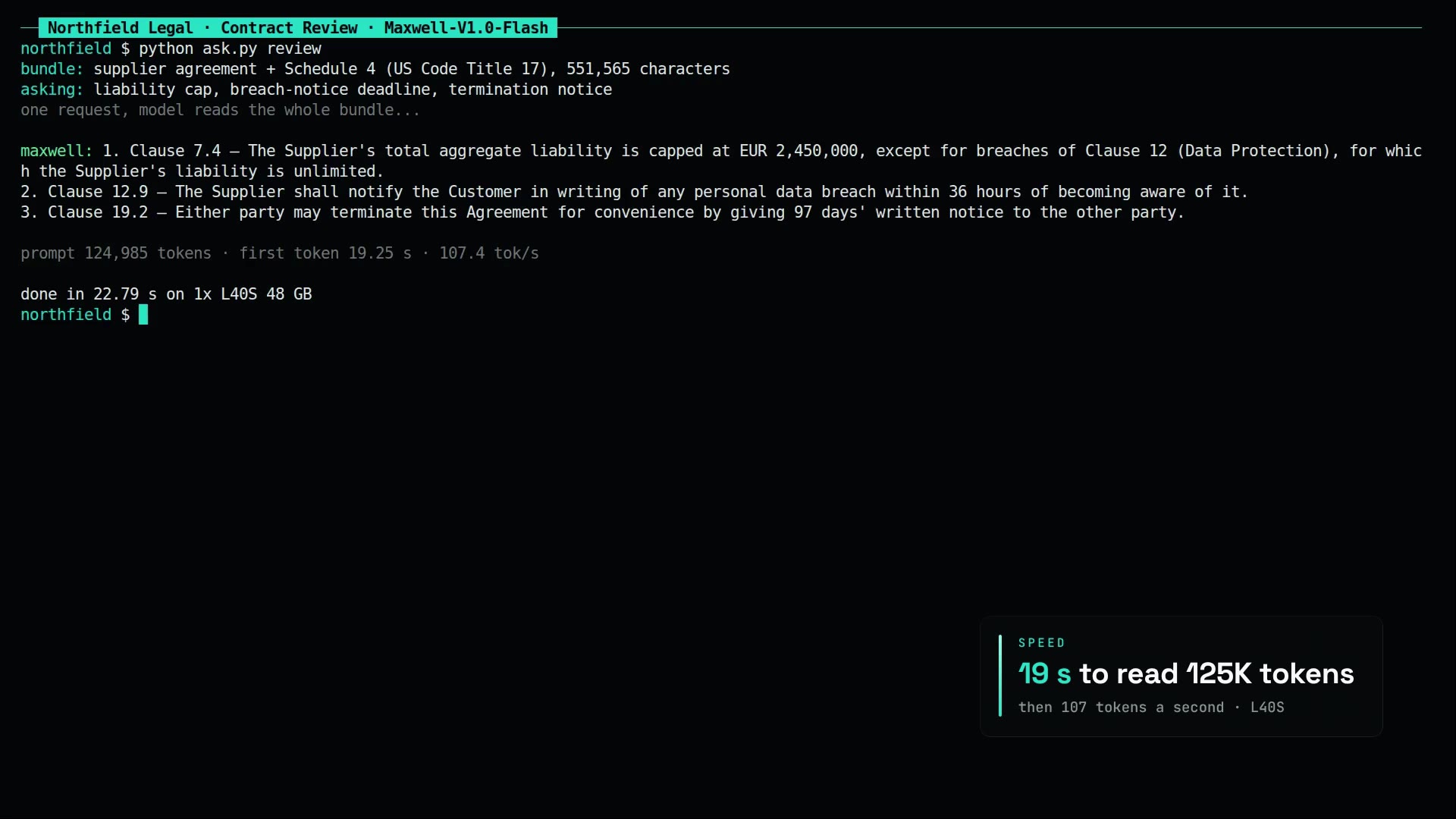
| review 125K, fresh prefix, recorded take | 124,985 | 19.25 | 107.4 | right, 22.79 s total | |
| card question (SDK) | right, 15.9 s with thinking | ||||
| tool call + answer | 1.3 s + 1.0 s, correct |
KV: 155,136 tokens in 7.49 GiB at util 0.965 (about 50.6 KiB per token with FP8 KV and the indexer keys). At 0.95 vLLM refused: 6.33 GiB KV cache is needed, which is larger than the available KV cache memory (6.25 GiB) ... estimated maximum model length is 129408. Card peak 44,874 MiB of 46,068. Cold prefill at 125K ran at about 6,500 prompt tokens per second. Answers to the review: Clause 7.4 liability cap EUR 2,450,000; Clause 12.9 breach notice within 36 hours; Clause 19.2 97 days' notice.
Memory ladder
Direct vllm serve on the worker machine with the same venv, --block-size 128 --max-num-seqs 4 --kv-cache-dtype fp8, no reasoning parser. Tests: the card question, 256 tokens with ignore_eos, the 32K review with max_tokens 4,000.
| GPU or cap | Configuration | Peak VRAM | Decode | 32K first token | Output | Real or emulated |
|---|---|---|---|---|---|---|
| L40S 48 GB | all on GPU, util 0.965, 131,072 window, via the endpoint | 44,874 MiB | 116 to 122 tok/s (107 at 125K) | 5.07 s | right | real |
| 32 GB cap, rung a | util 0.69, --cpu-offload-gb 12, 32,768 window | 31,307 MiB | 18.7 | not run | card question right | emulated |
| 32 GB cap, rung b | util 0.69, offload 12, 40,960 window | 31,546 MiB | 18.7 / 18.6 | 43.02 s | clause numbers only, values in the thinking | emulated |
| 24 GB cap | util 0.52, offload 20, 40,960 window | 23,625 MiB | 12.9 / 12.8 | 64.11 s | same text as rung b | emulated |
| RTX 4090 24 GB | util 0.92, offload 20, 40,960 window, KV 6.47 GiB = 134,016 tokens | 22,851 MiB | 12.1 | 68.97 s (89.8 s total) | right with values | real |
Rung a never ran the 32K review: our prompt plus max_tokens 6,000 exceeded the 32,768 window (a 400, operator error). The format slip on rungs b and 24 GB came with the same seed and identical text, so it is not an offload effect. The prompt asked for three lines "each with the clause number", and in the failing 4K run the thinking read that literally ("So just numbers"). We attribute it to weak format following (the authors' IFBench is 64.8). Not tried: 16 or 12 GB caps, a real 32 GB card such as an RTX 5090 (none available), Ampere cards (the FP8 KV path needs sm_89 or newer), GGUF.
Demo video
The 218-second narrated montage shows the panel workload on the L40S worker and a terminal 125K review (first token 19.25 s, 107.4 tok/s, all three right).
Remaining problems
- The authors' image is Hopper/Blackwell only. Worked around with the upstream wheel plus the fork overlay. Status: documented in the SDK example; an authors' packaging matter.
- The worker installs vLLM only by PyPI version. First attempt:
No matching distribution found for vllm==0.30.1rc1.dev219+ga9eafde59. A fork must be pre-built at the venv path the worker derives fromvllm_version. Status: handled byprepare_worker.sh; a wheel URL or overlay option in the workload config is open. - A vLLM 400 on a streaming request was swallowed (ours). The worker logged
Job c09adc5a failed: vllm_error - 400 Bad Request ... maximum context length is 131072 tokens ... 6144 output tokens and ... 124929 input tokens, but the client got no error event and the stream closed empty after 180.0 s. Status: open; streaming jobs that fail should emit an error chunk or a non-200. Leave room for the output in the window: prompt plusmax_tokensmust stay at or under 131,072. chat_template_kwargsis not forwarded. The endpoint's request type deserializes model, messages, temperature, max_tokens, top_p, stop, presence and frequency penalties, seed, stream, stream_options, modalities, speaker, extra_body, tools and tool_choice.enable_thinking: falsehas no effect, andtop_k(the card recommends 20) is not a top-level field. Whetherextra_body.chat_template_kwargsreaches vLLM was not tested. Status: open.- Disk size setting ignored. Machines came up with 100 GB instead of the 150 GB requested; 100 GB was enough (38.6 GB weights plus 8 GB venv). Status: open.
- ninja missing for direct vLLM runs (
FileNotFoundError: ... 'ninja'at warm-up on the 4090). Status: fixed inprepare_worker.sh. - One card type never exposed SSH (an RTX 6000 Ada); the manager terminated it after 180 s. The montage crashed once because
/tmpon our build VM was 98% full; rerun withTMPDIRelsewhere. - Odd reasoning. For a plain "400-word overview" prompt the reasoning twice referred to instructions not in the prompt ("Constraints:, Plan:, Draft:, Verify:"), with the same server seed. Those runs were speed tests with ignore_eos cut at 256 or 512 tokens, so no final answer was produced or checked.
GGUF route (not tried)
AtomicChat/Maxwell-V1-Flash-GGUF has Q8_0 (38.4 GB) down to AD-Q4_K-IQ4_XS (20.8 GB, suggested for 24 GB GPUs). Their card: "Stock llama.cpp, LM Studio and Ollama do not load these files yet"; it needs their patch on llama.cpp d3c3e242c. IQ4_XS picks the BF16 top token 85.7% of the time (mean KLD 0.1736), and their llama-bench on one H100 gives 173 tok/s at empty context, 150 at 8K and 132 at 32K. Their files attend densely beyond 16K, so they do not reproduce the block-sparse behavior.
Sources
- Model card: maxwell-model/Maxwell-V1-Flash
- FP8 build: maxwell-model/Maxwell-V1-Flash-FP8
- Code and report: github.com/maxwell-model/Maxwell-V1-Flash, technical report (PDF)
- GGUF files: AtomicChat/Maxwell-V1-Flash-GGUF
- Where we spotted it: AI Search, 2026-11-22
- Our SDK example: maxwell-v1-flash-fp8-long-context-vllm-private-nvidia (commit
c11fdf8a)