An open 27B decision model makes the close calls in a Crazy Taxi shift, in 0.76 seconds
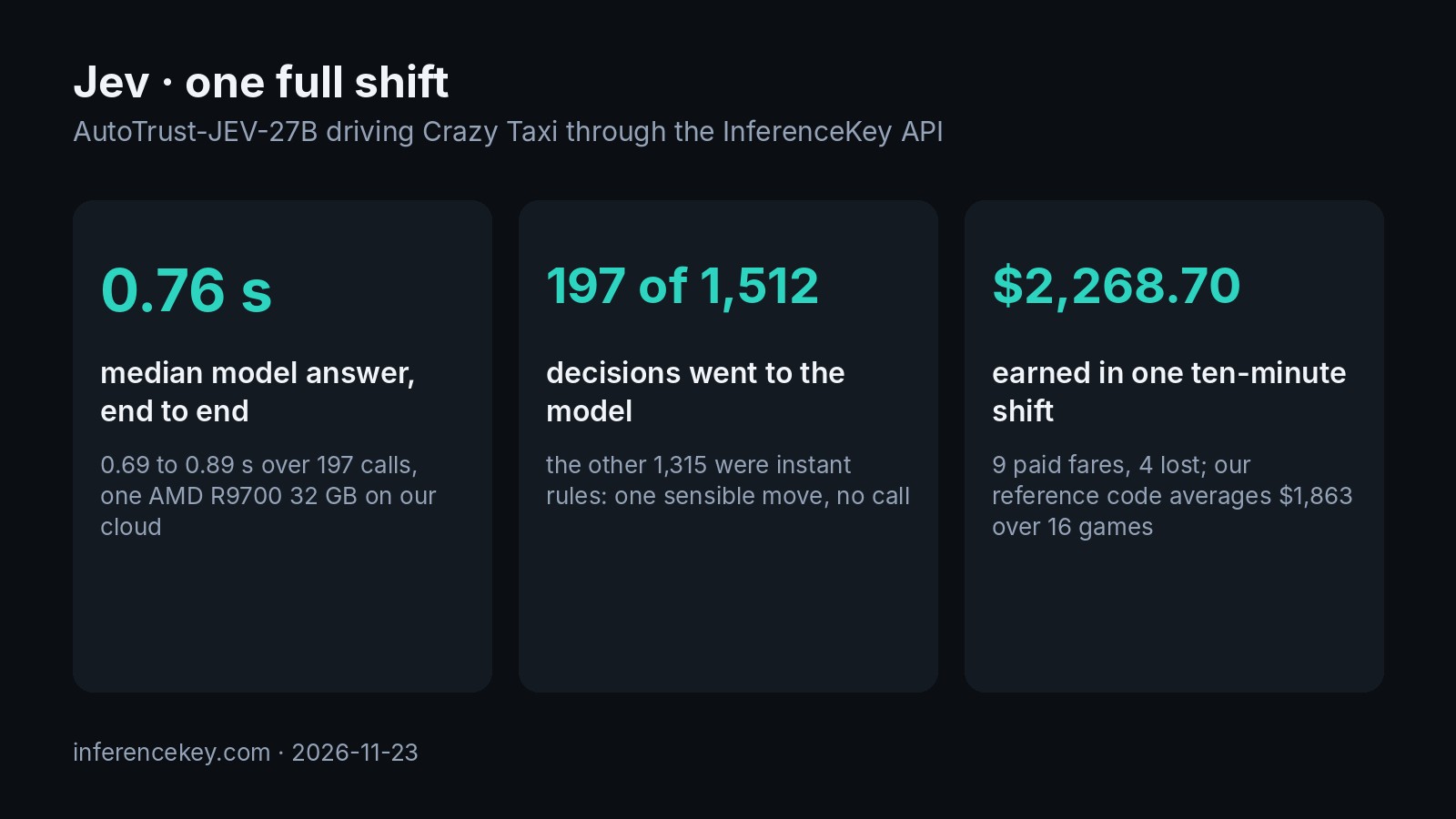
Jev, an open 27B decision model, chose the direction 197 times in a 10-minute Crazy Taxi shift in a median 0.76 s on one AMD R9700. Rules took 1,315.
Most of driving is reflex, and a reflex should never wait for a model. While Jev, an open 27-billion-parameter decision model, picked the next turn, our cab typically covered about 27 yards of road. In a full ten-minute shift of the arcade game Crazy Taxi, Jev chose the direction 197 times. Each answer took a median of 0.76 seconds, through the InferenceKey API on a graphics card in our cloud. Plain rules took the other 1,315 moves at once, from stopping at the customer to reversing off a wall. The shift earned $2,268.70. That is our case: a fast model can decide in a game that never pauses for it, if you only ask it what needs judgment. You can send it one real moment from this game with our SDK example and see the answer and its timing yourself.
A model that answers multiple choice, not essays
Jev does not write. You hand it a situation and a question with a few named options, and it gives back a probability for each option. Think of a multiple-choice exam rather than an essay: the model reads everything once and scores each answer.
The model is the work of AutoTrust AI Lab, published as AutoTrust-JEV-27B v1.1 under the open Apache-2.0 licence. It builds on open work by the vLLM Semantic Router Team, which in turn builds on an open Qwen model. All three are credited below.
Our part was the plumbing and the driving. There was no ready-made compressed copy of v1.1 for the server we use, so we made one. We put it behind a new route in the InferenceKey API, wrote the bot that reads the game and calls the model, and measured every decision. Its authors call it AutoTrust-JEV-27B v1.1. We call it Jev.
Reflexes go to rules, choices go to the model
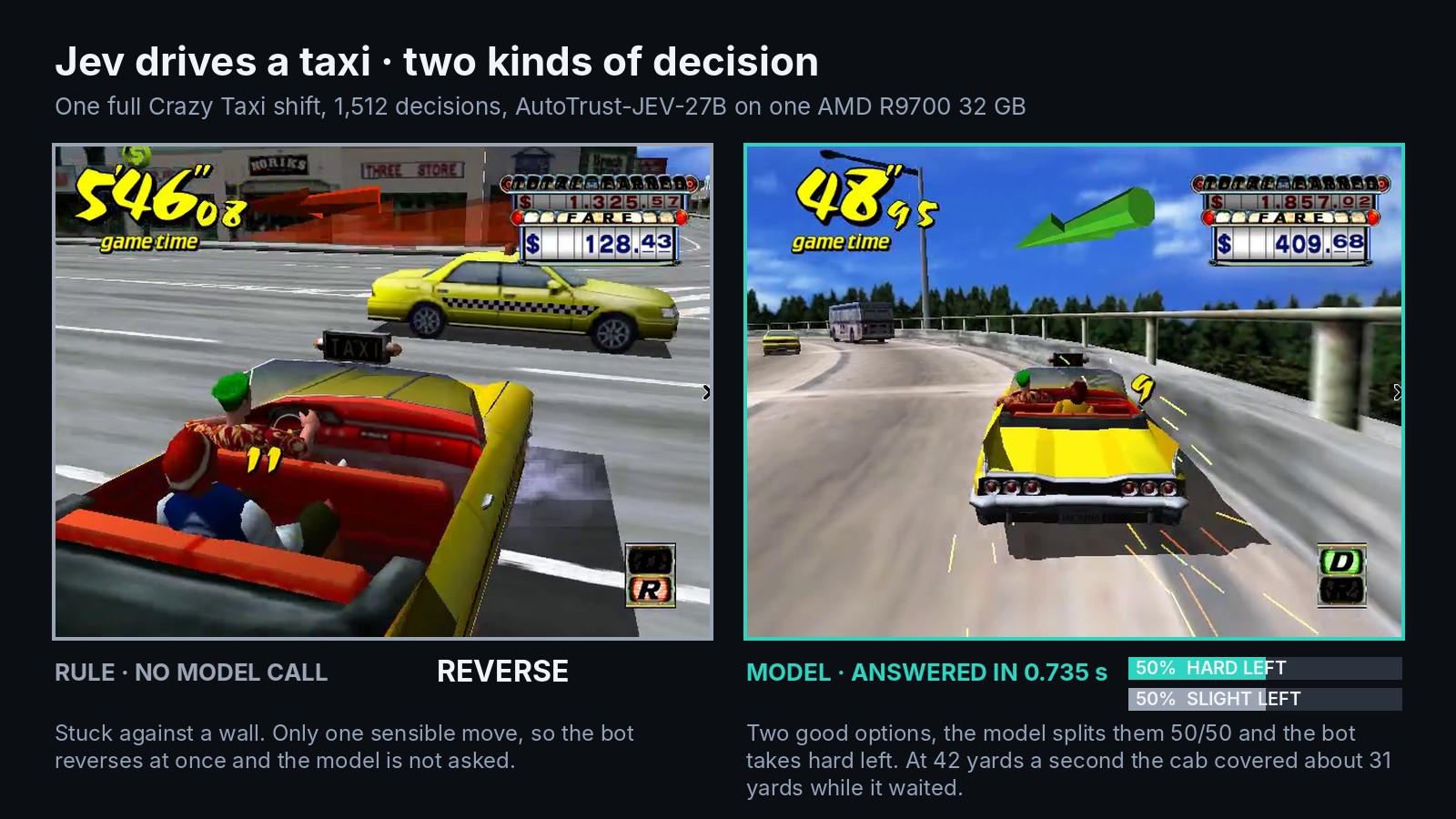
The rules took every decision with one obvious answer. The model only ever chose between two moves that both made sense.
At the moments the model was asked, with a passenger on board, the cab ran at a median of 35 yards a second. While the model thinks for 0.76 seconds, the cab travels about 27 yards, some 25 metres, before anyone has touched the wheel. You cannot spend that on a wall that is already in front of you. On stage you don't think about the chord changes you have played a hundred times. You only think about where the solo goes.
So the bot carries a short list of rules, written in plain code. At the customer or the destination, it stops. Stuck, it reverses. Just hit a wall, it turns hard toward where it needs to go. With a passenger aboard, it never brakes, because the clock costs more than a bump. The size of a turn follows the angle to the target: up to 25 degrees, straight on. Past 75 degrees, a full turn. In between, the rules leave two candidates, for example a gentle right or a full right, and the model picks.
Of the 1,512 decisions in the shift, the rules settled 1,315 on their own, 87%. Most were plain "keep going straight" (394) or turns the angle made obvious. Then came slowing near a stop, 17 stops and 12 reverses. The model was asked the other 197 times, 13%. Every one of those questions had exactly two options.
One real game, every answer timed end to end through the public API
Every model answer below is timed by the bot, from sending the request to getting the answer, so it includes the network trip to our cloud. The game was one ten-minute shift of Crazy Taxi, the 1999 arcade game, in its Dreamcast version from our own copy. It ran in an emulator on one of our servers. The bot reads the game's memory for what a driver would know, such as speed, position and the clock. It also reads the game's green guide arrow off the screen, with a small model we taught from pictures of that arrow.
Every decision, the bot builds a short description of the moment: passenger or not, speed, which way the arrow points, how far the destination is, what it did last. If the rules leave more than one option, it sends that description and the options to the InferenceKey API. The model, on one graphics card in our cloud, returns the probabilities. The bot presses the buttons.
The shift ran on 2026-11-23, about ten and a half minutes from the first decision to the last. The bot decided about every third of a second. The bot ran on a server of ours outside the GPU machine and reached the model over the internet. In an early test, calling the model directly on the GPU machine took about 0.51 seconds, against about 0.6 through the public endpoint.
Under 0.9 seconds, every time it was asked
The model answered all 197 questions in a median of 0.76 seconds. The fastest answer took 0.686 seconds and the slowest 0.888. Nine answers in ten came back in under 0.84 seconds. Not one request timed out, so the bot never had to drive on a guess.
The spread is the useful part. The fastest and slowest answers were two tenths of a second apart. For a game on a clock, a steady answer beats a fast average with rare slow ones. You can plan around 0.8 seconds. You cannot plan around an answer that now and then runs into the bot's 3-second limit.
After the shift, our SDK example sent one early moment of the game five more times: passenger aboard, 37 yards a second, the arrow 27 degrees right. Each time it got 88% gentle right and 12% straight on, the same as in the game. Nothing in the answer is random, so the same moment gets the same answer. Those five calls took 0.72 to 0.81 seconds.
Even its coin tosses were safe: the rules allowed both moves
Usually the model was sure: its pick got a median of 84%. When it was not, both moves were allowed by the rules, so a near tie was safe. About one answer in ten (20 of 197) was closer than 55 to 45.
The closest call came 576.6 seconds in, with the cab on an elevated road at 42 yards a second. The model answered in 0.735 seconds: 50.006% for a hard left, 49.994% for a gentle left. The bot took the hard left. During that answer the cab covered about 31 yards.
What it picked: when going straight was on offer, it turned instead 101 times out of 103. For that pair, a one-line rule that always turns would have made almost the same choices with no wait. So the model's real work was mostly the 94 calls between a full turn and a slight one, where it split about evenly, 49 slight against 45 full.
$2,268.70 in one shift, above our average, below our best
The shift earned $2,268.70 from nine customers, as the game's result screen shows. The cash in the game's memory went up nine times, and those nine fares add up to exactly that figure.
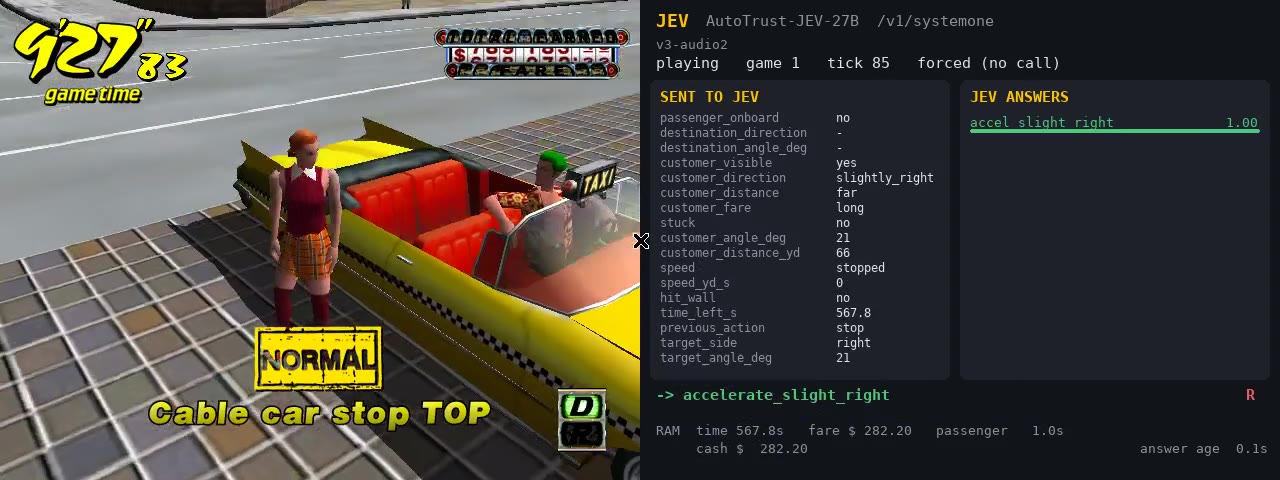
The first fare went to the top cable car stop for $282.20, 39.4 seconds into the game.
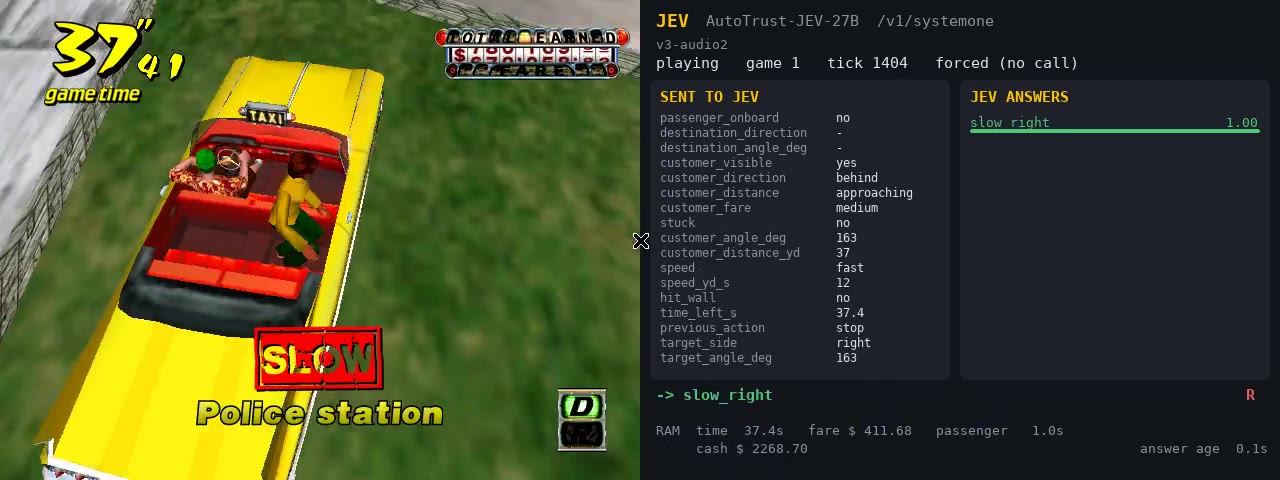
The best fare of the shift was the last one: $411.68 for a drop at the police station, paid with 37.4 seconds left on the game clock.
It was not a tidy drive. The cab hit a wall 55 times and got stuck 12 times, and each time the rules backed it off and sent it on.
Our reference, the same bot with the same model frozen at an earlier version, averaged $1,863 over 16 games, and a typical game lands within about $650 of that. Our best game ever made $2,958.86, so it is not a record either.
The money comes from the whole bot, not from the model alone. One part, a road map learnt from earlier games, changed the route over 16 games but not the money. We kept it on for this shift, and it steered 145 of the 1,512 decisions.
One shift shows a pattern, not a driver
It shows a way to use a model too slow for a reflex in a game that never waits. Let code take every move that has one answer. Let the model choose among moves that are all acceptable.
It does not show that the model can drive. This is a 1999 arcade game, not a car, and not a driving benchmark. The rules are where most of the driving skill lives. We never compared the model's 197 picks with a fixed or random pick between the same two options. So this post shows the model is fast enough to sit in the loop, not that its picks earn more than a coin flip would. It is one game, and the result sits inside the normal spread of our games. We also ran our own compressed copy of the model, and we have not compared its probabilities with the authors' full-precision setup.
On InferenceKey: one route, one 32 GB card, and our own compressed copy
One AMD graphics card in our cloud, a Radeon AI PRO R9700, held the whole model in about 22.4 of its 32 GB.
The authors' setup needs an NVIDIA card, so on AMD we used llama.cpp, an open-source server that supports this kind of model. We added a route to the InferenceKey API that passes these decision requests straight to that server. A client sends a state and a question, and gets back probabilities.
Two rough edges a team will meet. The first start was slow: about 19 minutes from launch to ready on our machine. We have not looked into why, and that is open. And the server answers one request at a time. The model was trained to read each question on its own, so a second caller waits in line. For one cab that is fine. For a fleet, you would need more copies.
Should you use it? For choices inside rules you trust, yes
- You run a bot or an agent that acts on a clock, with a menu of acceptable moves: yes. Keep the reflexes in code and let the model pick among the moves they leave.
- You need a decision every tenth of a second: no. Three quarters of a second is too slow for that. Use rules, and ask the model only when the rules leave a real choice.
- You need the model to explain itself or write text: no. It returns probabilities, not words.
- You will act on the probabilities themselves: test them on your own data first, as the authors ask.
Run python decide.py from the Jev SDK example: it sends one real moment from this shift to the model and prints the choice, the probabilities and the latency.
For engineers
Credits
- AutoTrust AI Lab (Hugging Face org
autotrust): AutoTrust-JEV-27B v1.1, the model card and weights under Apache-2.0, the choice and yes/no question types, and the vLLM serving setup. - StartLux Labs (
StartLuxLabs/StartLux-Decision): the StartLux prefix-bidirectional plugin (startlux-decide,STARTLUX_PREFIX_BIDIR=1) that the authors' serving script turns on. - vLLM Semantic Router Team: d3 (Decision 3.0), the decision model Jev builds on, per the repo's
NOTICE.base. - Qwen/Qwen3.8-27B (Apache-2.0): the base model under d3, per
NOTICE.base. - llama.cpp contributors: the server, the
vllm-d3decision architecture and the native System One API in release b11815 (/v1/systemone, with itsstateandquestionsrequest), which we serve the model with. "System One" is that API's name, not the model card's. - Flycast and RetroArch (libretro): the Dreamcast emulator and the frontend the game ran in.
- Crazy Taxi (USA, Dreamcast): the game, played from our own copy.
- Our part: the Q6_K conversion and the converter module, the
/v1/systemoneroute in InferenceKey, the bot (jevtaxi: RAM reader, arrow classifier, rules, client), the runs and the measurements, the SDK example and the video.
The model, as published
| Part | Details |
|---|---|
| Name and repo | Card heading "AutoTrust-JEV-27B v1.1"; autotrust/AutoTrust-JEV-27B-v1.1 redirects to autotrust/AutoTrust-Decider-Pro-Vision-27B-v1.1, sha ae156900e9f338e423042b89e25d0fd8093064d4 (the revision we converted) |
| What it is | "a text decision model that assigns probabilities to the answer options supplied with each question"; choice and yes/no questions, text-only input |
| Lineage | NOTICE.base: "d3 (Decision 3.0) Copyright 2026 vLLM Semantic Router Team. Built on Qwen/Qwen3.8-27B (Apache-2.0)." The card itself does not name d3 or Qwen |
| Licence | Apache-2.0 (card and GGUF metadata) |
| Authors' serving | vLLM 0.31.0 with the StartLux prefix-bidirectional plugin (startlux-decide from StartLuxLabs/StartLux-Decision), which needs FlashAttention (CUDA) |
| "System One" | not on the card; the name of llama.cpp b11815's native API, which we use |
| Authors' caveat | "Validate the model on representative application data before relying on its probabilities or decisions." |
Setup
| Item | Value |
|---|---|
| Card | one AMD Radeon AI PRO R9700 32 GB on our cloud, ROCm, worker ik-node-1 |
| Server | llama.cpp b11815 (ROCm 10.0 build), native System One API, through InferenceKey's built-in llamacpp backend |
| Weights | our own Q6_K GGUF: 22,082,531,424 bytes, 6.57 bits per weight, qwen35.attention.causal = False, general.license = apache-2.0; made from a Q8_0 conversion with our autotrust_jev.py converter module |
| Flags | -ub 2048, --parallel 1, --ctx-checkpoints 0, --cache-ram 0 (each prompt read whole, alone, in one micro-batch) |
| VRAM | about 22.4 GB for the model |
| Cold start | about 19 minutes to ready |
| Endpoint | https://cloud.inferencekey.com/endpoint/gpu-workloads-dev/autotrust-jev-27b-llamacpp-amd/v1/systemone |
| Game | Crazy Taxi USA (Dreamcast) in Flycast (libretro) inside RetroArch, on a headless Xvfb display of a Linux VM |
| Bot | jevtaxi/play.py and jevtaxi/jev.py; from console RAM: cab position and heading, speed, cash, destination, game clock, wall contact; plus the guide arrow read from the screen by a small CNN |
| Run | runs/v3-audio2, 2026-11-23, one game; obstacle and free-space detectors off (--obstacles and --free-space not set), learnt road map on |
Earlier figures from the project journal, iteration 0 (2026-10-22): about 510 ms per decision with the server called directly on the worker, about 600 ms through the public endpoint, on a manual test.
The rules (jev.allowed_actions, turn_options)
| Situation | Options | Model called? |
|---|---|---|
| At the customer or the destination | stop | no |
| Stuck | reverse (1.5 s; 3.0 s when stuck again at the same place) | no |
| Just hit a wall | full turn toward the target side | no |
| Passenger aboard, near the destination (50 yd) | slow moves toward the drop spot | when more than one fits |
| Steering toward a target, angle up to 25 degrees | straight | no |
| Under 8 yd/s | one gentle turn (full turn past 120 degrees) | no |
| 25 to 45 degrees | slight turn or straight | yes |
| 45 to 75 degrees | full turn or slight turn | yes |
| Over 75 degrees | full turn | no |
| Passenger aboard | no brake options at all |
With one option left, Jev.drive returns {action: 1.0, forced: 1.0} with latency 0 and makes no request.
Step by step with the SDK example
The example (commit f5801e7 on main) holds README.md, publish.py, decide.py, autotrust_jev.py, convert_retry.py, requirements.txt and .env.example. The full how-to, self-hosted or on InferenceKey: How to deploy AutoTrust-JEV-27B.
Before publish.py, follow README steps 1 and 2: make the Q6_K GGUF (about 44 minutes of streamed conversion from Hugging Face, then llama-quantize; about 50 GB of free disk) and copy it to the worker host, with JEV_GGUF set to its path as the worker sees it. The first start then takes about 19 minutes.
git clone https://github.com/inferencekey/inferencekey-sdk.git && cd inferencekey-sdk
cd examples/autotrust-jev-27b-systemone-llamacpp-private-amd
cp .env.example .env   # INFERENCEKEY_API_KEY, INFERENCEKEY_PROJECT, IK_WORKER_ID, INFERENCEKEY_SDK_TOKEN,
                       # JEV_GGUF (path of the Q6_K on the worker host); optional JEV_URL,
                       # JEV_WORKLOAD (default autotrust-jev-27b-llamacpp-amd), INFERENCEKEY_BASE_URL
python -m venv .venv && . .venv/bin/activate
pip install maturin -r requirements.txt
( cd ../../bindings/python && maturin develop --release )   # the local SDK build publish.py imports
python publish.py                 # ensure() the llamacpp workload on your R9700 worker, wait until ready
python decide.py                  # the game's own request: 2 options
python decide.py --options all    # all 5 full-throttle steering options
python decide.py --runs 5         # repeat, then min / median / max latency
publish.py --delete tears the workload down.
Calls through the API
POST {base}/endpoint/{project}/{workload}/v1/systemone, with the API key as a bearer token. The game client sends a single choice question named action. Its criteria map each option name to a one-line description:
{"state": {"passenger_onboard": true, "route_arrow": "slightly_right",
           "route_arrow_angle_deg": 27, "speed_yd_s": 37, "destination_distance_yd": 439,
           "previous_action": "accelerate_straight", "...": "..."},
 "questions": {"action": {"type": "choice",
                          "instructions": "You drive a taxi in Crazy Taxi. Choose the best driving action ...",
                          "criteria": {"accelerate_slight_right": "Full throttle with a gentle correction to the right.",
                                       "accelerate_straight": "Full throttle, wheel centred."}}}}
{"answers": {"action": {"type": "choice", "choice": "accelerate_slight_right",
                        "probabilities": {"accelerate_slight_right": 0.879906667497815,
                                          "accelerate_straight": 0.12009333250218505}}},
 "usage": {"input_tokens": 453, "output_tokens": 0}}
llama.cpp calls this native API System One. The answer has output_tokens: 0: the server reads the prompt in one pass and writes nothing.
The client timeout is 3.0 s. On a request error the bot drives on the rules' first option and logs fallback. This game logged none.
decide.py, 2026-11-23, 5 calls each, state of tick 37:
| Request | Answer | Probabilities | Input tokens | Latency min / median / max |
|---|---|---|---|---|
| game's 2 options | accelerate_slight_right | 0.880 / 0.120 (straight) | 453 | 0.716 / 0.719 / 0.806 s |
| all 5 options | accelerate_slight_right | 0.871, straight 0.092, right 0.033, slight left 0.004, left 0.001 | 495 | 0.732 / 0.766 / 0.855 s |
The game itself logged 0.879906667497815 for tick 37, with a latency of 0.804 s.
Full measurements, runs/v3-audio2
| Measure | Value |
|---|---|
| Decisions | 1,512 (197 model, 1,315 rule, 0 fallback) |
| Wall time first to last decision | 625.8 s; first decision 6.5 s after video start |
| Decision gap | median 0.314 s, 2.42 decisions a second |
| Model latency, end to end on the client | min 0.686, median 0.76, p90 0.838 to 0.839 (by method), max 0.888 s |
| Probability of the chosen option | median 0.843 |
| Option pairs offered | slight right / straight, slight left / straight, right / slight right, left / slight left |
| Model choices | slight right 87, slight left 63, left 31, right 14, straight 2 |
| Choices by pair | with straight on offer, turned 101 of 103; full or slight turn, 49 slight and 45 full |
| Close calls (top two apart) | 20 under 10 points, 17 at 9 points or less; closest 0.50006 / 0.49994 at tick 1375 |
| Rule decisions | straight 394, left 249, right 212, slight right 124, slight left 106, slow straight 101, slow left 51, slow right 49, stop 17, reverse 12 |
| Passenger aboard | 72.4% of decisions |
| Speed with a passenger | median 27 yd/s over all passenger ticks (p90 46), 26 yd/s without the ticks at the destination; 35 yd/s at the moments the model was called |
| Learnt road map | steered 145 decisions |
| Wall hits / stuck onsets | 55 (rising edges of state.hit_wall; 36 of the raw RAM contact flag) / 12 |
| Cash | $2,268.70 from 9 increments: 282.20, 353.34, 344.56, 174.88, 170.59, 196.23, 128.26, 206.96, 411.68 |
Context from the journal: frozen reference $1,863 over 16 games (sd $645); learnt road map $2,136 (sd $383) over its first 8 games and $1,815 (sd $499) over 16; longer reverse $1,856 over 16 games, 4.2 stuck repeats a game against 7.4; best game $2,958.86 (runs/v3-arw2), next $2,786.69 and $2,697.28; first night's record $1,737.25. The arrow classifier is a small CNN first trained on 270 hand-labelled crops (of 1,147 cut): median error 5 degrees held out by run, 94% under 30, against 14 degrees and 36% of readings over 90 degrees off for the old hand-written rules. 230 more crops were labelled later.
The bot's panel in the video lags the decision log by about one second: the frame at 576.6 s still shows tick 1374, a rule decision, not the 50/50 answer.
Problems
- Cold start (open): see the InferenceKey section; not investigated.
- One request at a time (by design):
--parallel 1keeps each prompt alone in its micro-batch, which the bidirectional model needs. - No public GGUF of v1.1 (worked around). We converted it ourselves; the converter module and a retry wrapper for the streamed download are in the SDK example.
- Rules carry most of the skill. The 55 wall hits and 12 stuck onsets come from the bot's perception and rules, not the model's choices.
Limits
The limits are in the narrative above (one game, no fixed or random pick baseline, our Q6_K not compared with the authors' bf16 setup). Latency includes the network from our VM to the public endpoint. The journal has no separate entry for this run: its figures are recomputed from decisions.jsonl and checked against the video frames.
Sources
- AutoTrust-JEV-27B v1.1 model card and
NOTICE.base - SDK example, commit
f5801e7 - How to deploy AutoTrust-JEV-27B
- Our run
runs/v3-audio2(decisions.jsonl,game-1.json,game-1.mkv) and the project journal