LTX-2.5: video with its own soundtrack on a 24 GB card, and a trainer for your own footage
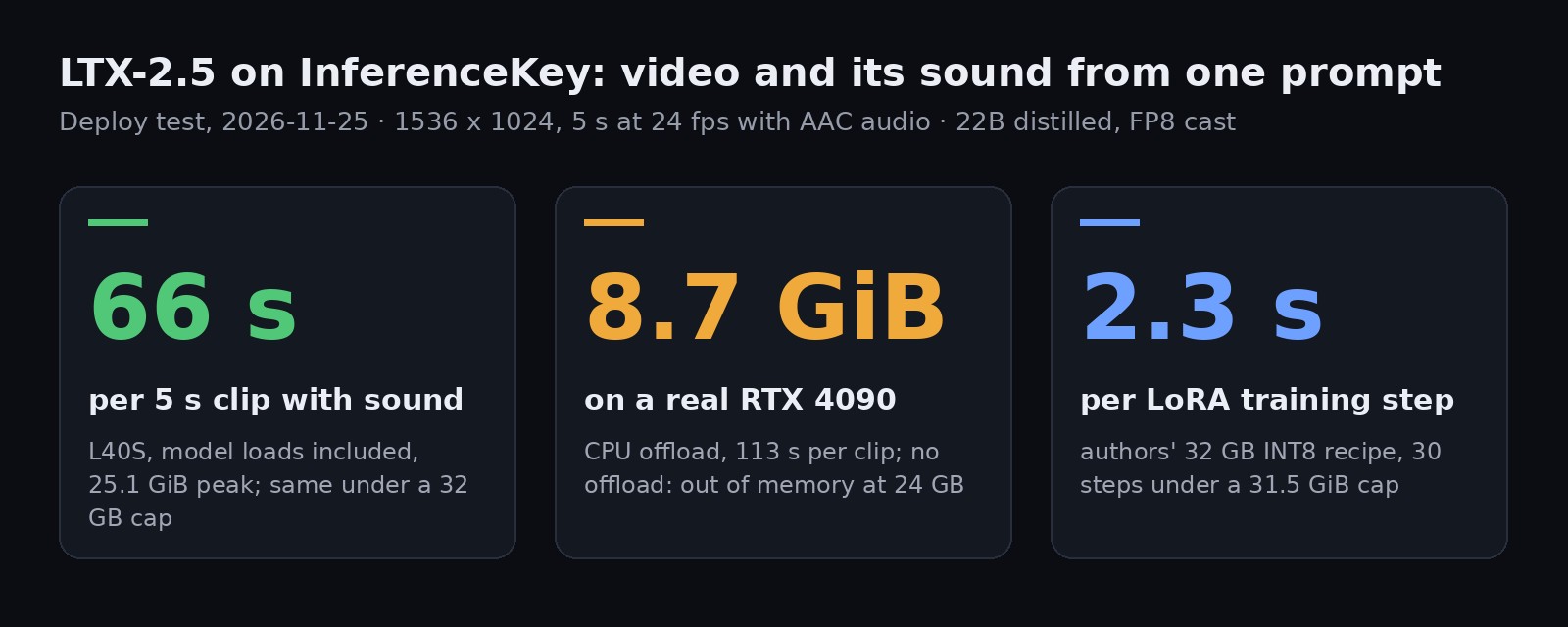
LTX-2.5 made 5 s of 1536x1024 video with sound in 66 s on an L40S and 113 s on a 24 GB RTX 4090. Its trainer started a LoRA run within 32 GB.
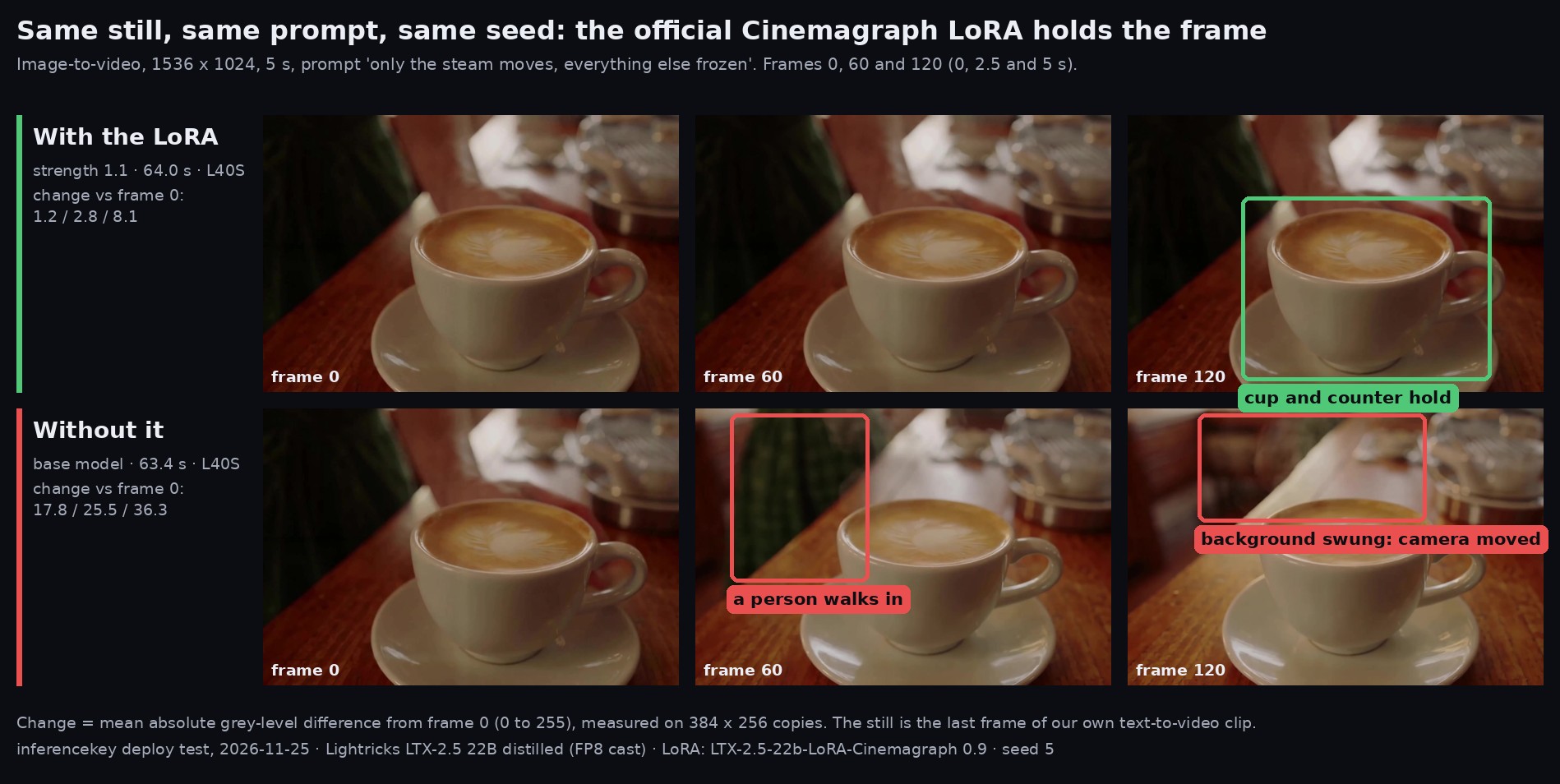
The coffee cup held still. We gave LTX-2.5, Lightricks' open video model, a still of a cappuccino and asked for five seconds in which only the steam moves. With Lightricks' official Cinemagraph add-on loaded, the cup and the counter stayed put to the last frame. Without it, with the same still, prompt and random starting number (the seed), the camera drifted and a stranger walked into the shot. That add-on is a LoRA, a small file that teaches the big model one habit. LTX-2.5 comes with a trainer to make your own from your own footage: your product, your character, your house style.
This matters because one model makes the clip and its soundtrack, on a GPU you control. On an L40S graphics card with 48 GB of memory, on our cloud, a 5-second clip with a spoken line took about 66 seconds. A 24 GB RTX 4090 made it too, in 113 seconds. The trainer started a LoRA run inside a 32 GB memory budget. The model files (its weights) are free for companies under 10 million dollars of yearly revenue, with catches below. Our SDK example deploys the same setup on your own NVIDIA card.
One model for the picture and the soundtrack, plus a trainer for your own look
LTX-2.5 makes a video and its sound in one pass. You give it a prompt, a first image, a piece of audio or another video. Lightricks promises "synchronized, high-fidelity video and audio", built to run on your own machines and to be retrained. The repository went up on Hugging Face in July 2026, and its counter shows about 3.0 million downloads in the last 30 days.
It is not one file but a kit. The core video model alone is 42 GB. A text model reads your prompt: Google's Gemma 4, retrained by Lightricks. Smaller pieces turn the result into pixels and sound, and two more double the resolution or the frame rate. Getting started means downloading about 71 GB of files. The default clip is 1024 x 1536 at 24 frames a second, and a separate high-quality path goes up to 4K.
The part worth a team's attention is the customization. A LoRA works like a guitar pedal: the amplifier stays the same and the pedal changes one thing. Lightricks publishes official ones for LTX-2.5. Cinemagraph keeps a shot still except for one moving detail. Slow-Motion-Control does what its name says. Others learn a change from before-and-after clips, such as Day-To-Night or Colorization, plus eleven more listed in the appendix.
LTX Trainer, in Lightricks' open code repository, fine-tunes the model on your own clips. It trains a LoRA, a before-and-after LoRA, or the whole model. Its recipes for text-to-video and image-to-video train the sound along with the picture. Others teach it to add sound effects to a silent video, extend a clip, or repaint part of the frame. It also ships two helper scripts. One cuts long footage into scenes. The other writes a caption for each scene with a local or a hosted model. A folder of your own product shots becomes a training set without hand labeling.
Our test: two spoken clips, one held shot and a 30-step training run, one request at a time
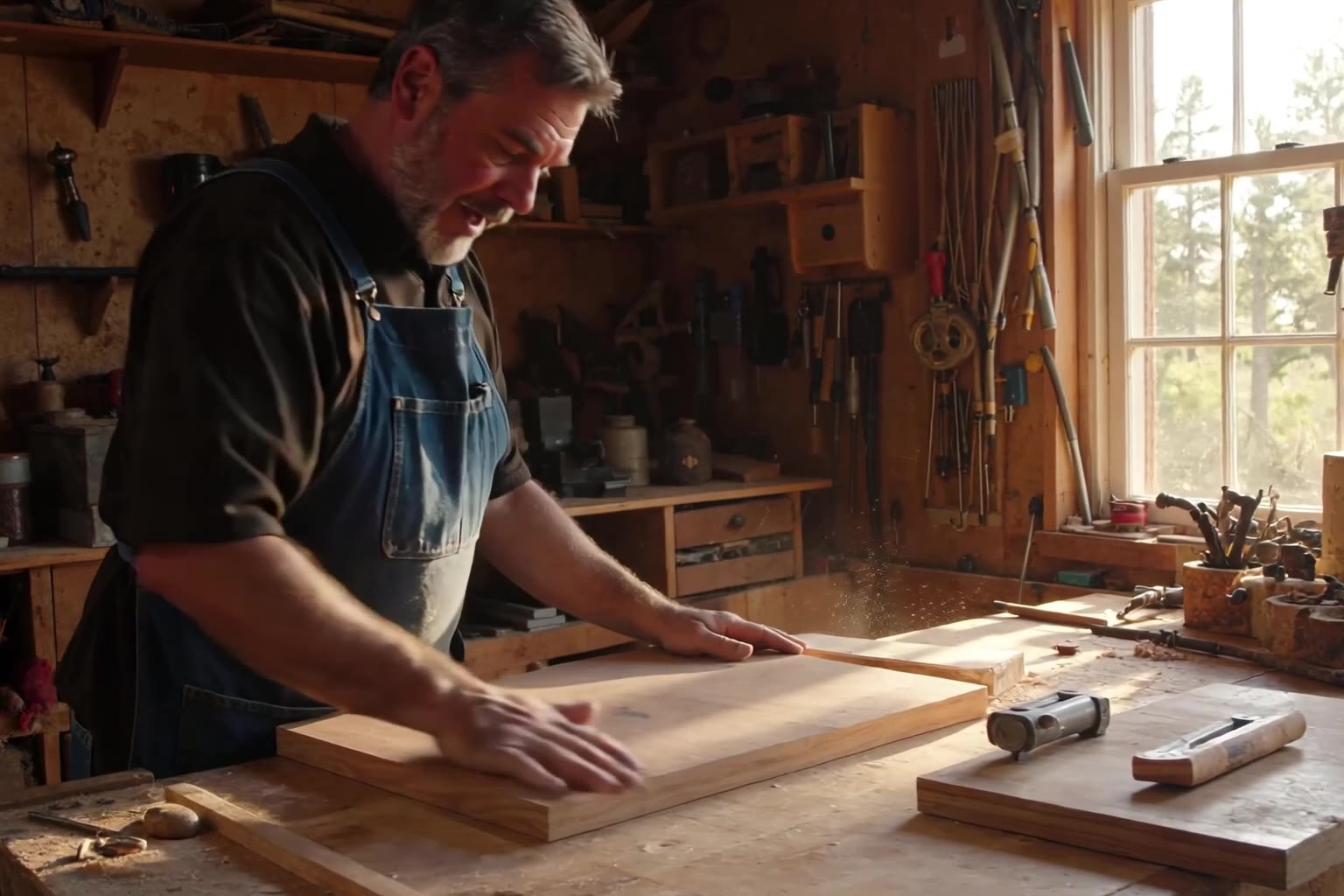
We asked for two text-to-video clips, a barista and a woodworker, each with one spoken line. We ran image-to-video with and without the Cinemagraph LoRA. Then we fed four of our own clips to LTX Trainer for 30 steps. The main card was an NVIDIA L40S with 48 GB on our cloud, and a 24 GB RTX 4090 covered the smallest-card question. Every clip in the comparisons below was 1536 x 1024, 121 frames, 5 seconds with stereo sound.
We ran one request at a time, with two prompts, not a benchmark. We ran only the fast version at 1536 x 1024: no 4K, no high-quality path, no multi-scene clips, and no side-by-side test against rival models. We did not run an actual 12, 16 or 32 GB card, or the smaller compressed model files. We did not judge visual quality beyond these prompts: watch the samples. The 30-step training run proves that training starts and saves a usable file on a 32 GB budget. It is not a finished custom LoRA, and we make no claim about its quality.
About a minute per clip, and both spoken lines came back word for word
A 5-second clip with sound took 62.8 to 66.2 seconds on the L40S. That includes loading every part of the model on each request, since the code loads each piece and drops it when done. The card used at most about 27 GB, a little over half of its 48 GB.
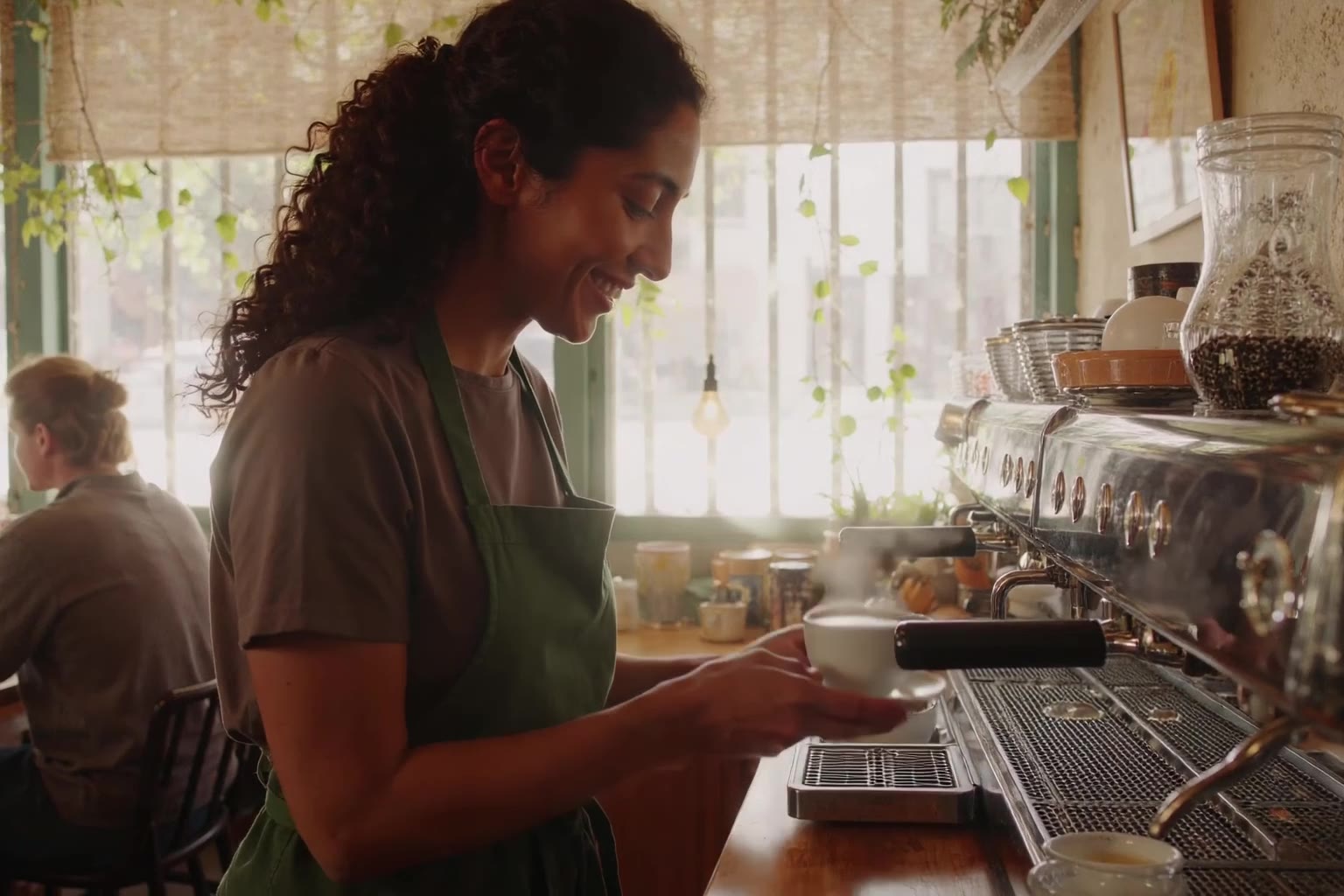
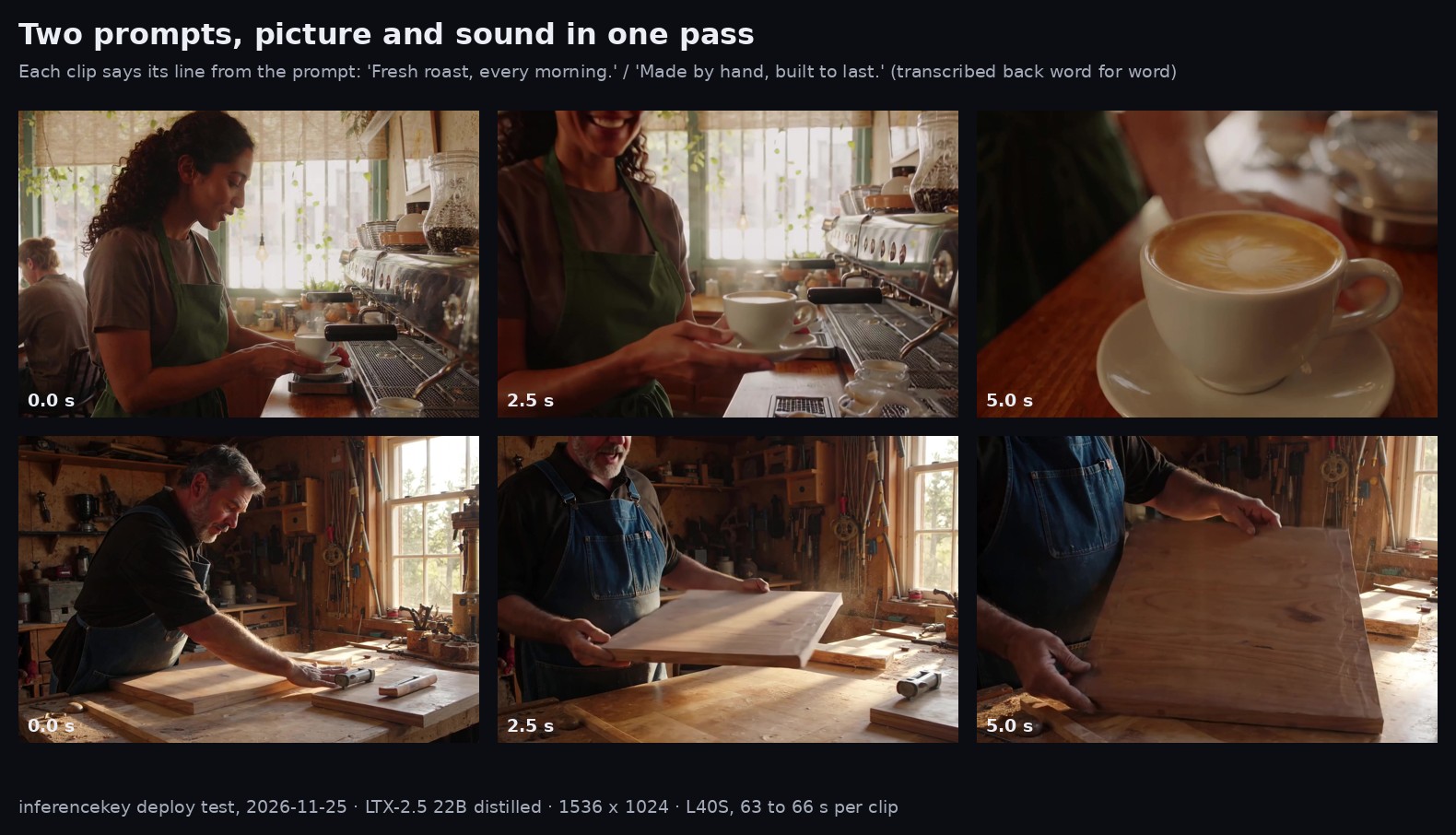
We ran each clip's audio through Whisper, a speech-to-text model, on a CPU. The barista said "Fresh roast every morning" and the woodworker said "Made by hand, built to last", exactly as prompted. Under the voice sat a café background you can clearly hear. We checked the words, not whether the lips and the sound line up.
The Cinemagraph LoRA did what its documentation promises, within the limits it sets. To measure "still", we compared every frame to the first and averaged the difference in brightness on a 0 to 255 scale. With the LoRA, the scene moved about four times less by the last frame (8.1 against 36.3). Generation time was the same, 64.0 against 63.4 seconds. When the still had a person in it, our barista, the camera stayed locked but she kept moving. Lightricks says so in the LoRA's documentation: it was trained on scenes with no moving people. Both LoRA clips averaged -59 dB, nearly silent. We did not measure the sound of the clip without the LoRA, so we have not isolated the cause.
A training run fit in 32 GB and saved a 214 MB LoRA that made a clip. We used the authors' 32 GB recipe on four of our clips, cut to 576 x 384 and about two seconds each. Preparing the data took 85 seconds, and training took about 70 seconds and at most 25.4 GB of memory.
Which GPU: a 24 GB RTX 4090 works, 113 s a clip against 66
The smallest actual card that worked was a 24 GB RTX 4090. It needs the authors' offload option, which keeps the big model in the computer's main memory and streams it to the card piece by piece. Same scene, same spoken line. The pixels differ, which is expected when the same seed runs on a different card.
So 48 GB is not a requirement. It buys speed and skips offload, which eats the computer's main memory. To map the rest, we capped how much memory the model could take on the L40S, to act like a smaller card.
| Card or memory limit | Offload | Seconds per clip | Result | Actual card? |
|---|---|---|---|---|
| L40S 48 GB | no | 62.8 to 66.2 | works | yes |
| 32 GB limit | no | 64.1 | works, identical output | simulated |
| 24 GB limit | no | none | out of memory loading the text model | simulated |
| RTX 4090 24 GB | yes | 113.2 | works | yes |
| 24, 16 and 12 GB limits | yes | 111 to 112 | works, identical output | simulated |
| 8 GB limit | yes | none | out of memory | simulated |
Read it this way. Without offload, 24 GB is too little, and 32 GB worked when we simulated it. With offload, a 24 GB card works, and the simulated limits suggest a 12 or 16 GB card might too. Offload also needs plenty of main memory on the machine. Ours had 124 GB and more, and we did not measure how much it used.
Training is the stricter side. Lightricks recommends 80 GB for its standard LoRA recipe and points 32 GB cards to the low-memory one we ran. Training the whole model, in its own words, "typically needs multiple high-end GPUs (e.g., 4-8x H100 80GB)".
Free under 10 million dollars of revenue, with four catches
For most small teams, the license makes this worth trying. The license says Lightricks "claims no rights in the Output you generate". The clips are yours to use, and so is the responsibility for them. The weights come under the LTX-2.x Community License. It is royalty-free for any purpose for companies with less than 10 million dollars a year in revenue. That revenue counts your whole group, subsidiaries and affiliates included. At or above that line, any production use needs a paid license. Only the code is open source, under Apache-2.0. The weights are not.
The catches are mostly in the clauses, not on the model card:
- Training for commercial use counts as production use. A company over the threshold cannot fine-tune a LoRA for a product without a paid license.
- Your LoRA is a derivative of their model. Fine-tuned weights and LoRA files must ship under the same license. You may not hand one to a company over the threshold that has no paid license. That matters if an agency trains a LoRA for a big client.
- No competing product. You may not use it in a product or service that directly competes with Lightricks' own without a separate license. Read this one carefully if you build video tools yourself.
- Watermarking and disclosure. You must not remove the model's watermarks or its labels saying where a clip came from, and you must follow rules such as the EU AI Act. Its invisible watermark is an optional add-on you switch on with one setting (
--marker-root-path). Our test and the example leave it off. The license does not say whether leaving an opt-in mark off counts as disabling it, so check with Lightricks before you publish without it.
One smaller thing: downloading the weights means accepting the terms on Hugging Face. That box also consents to receive offers and targeted advertising.
It is the bigger model: sound and an official trainer are the real difference
LTX-2.5 is not the light option. Size here means parameters, the billions of numbers a model learns. Counting its 12B text model with its 22B video model, LTX-2.5 is the largest of the group. The open models a team would compare it with are smaller or need less memory, by their own authors' figures.
| Model | Size | Smallest card, per its authors | Sound in the same pass | License |
|---|---|---|---|---|
| LTX-2.5 | 22B + 12B text model | 32 GB+ in Lightricks' general LTX-2 ComfyUI guide; our 4090 ran with offload | yes | free under 10M USD revenue |
| Wan2.2 TI2V-5B | 5B | 24 GB, an RTX 4090 | no | Apache-2.0, no revenue limit |
| Wan2.2 A14B | 27B | 80 GB | no | Apache-2.0, no revenue limit |
| HunyuanVideo-1.5 | 8.3B | 14 GB with offload | no | excludes the EU, UK and South Korea |
What the table cannot show is the work around it. The Wan2.2 and HunyuanVideo-1.5 model pages show silent video only. LTX's official trainer covers sound and picture together, and Lightricks publishes a catalog of ready-made LoRAs. HunyuanVideo-1.5's LoRA script trains video only.
The closest rival with sound is Kandinsky 6.0, which we covered in October: MIT license, a 3B Lite and a 29B Pro, picture and sound together. Our post on it mentions no official trainer or LoRA catalog; we did not re-check today.
On InferenceKey: ready in 87 seconds
The card is yours by the hour, and one API call returns the clip, its sound and its timings. We wrapped the authors' pipeline in a custom backend. That is a small Python file telling the machine that runs the model how to install it and answer requests.
From asking for the deployment to ready took 87 seconds on the L40S and 110 on the 4090. Most of that was downloading 71 GB of weights and checking each file's fingerprint against Lightricks' own. On a slower link, the download sets the wait. A short preview sent from the dashboard came back in 26 seconds.
Add your Hugging Face key to the settings and the example downloads from Lightricks directly. That is the path we recommend. Our test machines had no key, so we used third-party mirrors of the gated files, which is what the example falls back to without a key. The safeguard is a SHA-256 check: the example rejects any file whose fingerprint differs from Lightricks' own. The same license applies either way. The other rough edges, including a version clash in the audio library that we fixed in the example's setup, are in the appendix.
Should you use it? Yes for branded clips with sound, if your license math works
- Product films, ads and social clips with dialogue or sound effects: try it on a 48 GB card for about a minute per clip.
- A consistent product, character or style: start with the official LoRAs, and check the sound: the one we ran gave a nearly silent clip. For your own footage, see LTX Trainer.
- A 24 GB card: it works with offload, about 1.7 times slower than the L40S, fine for batch work.
- Revenue of 10 million dollars or more, or a product that competes with Lightricks: talk to Lightricks before you build. For a looser license, Wan2.2 is Apache-2.0, without sound.
- A team in the EU: factor in the AI Act disclosure duties the license points to, and skip HunyuanVideo-1.5.
To make the same clip with sound on your own NVIDIA card, run python publish.py and then python main.py from the LTX-2.5 SDK example.
For engineers
Credits
- Lightricks trained and released LTX-2.5 (transformer, Gemma 4 12B text encoder fine-tune, video and audio VAEs, upscalers), wrote the LTX-2 code (
ltx-core,ltx-pipelines,ltx-trainer, Apache-2.0) including theDistilledPipelinewe ran, thet2v_lora_low_vram.yamlrecipe we trained with, the official LoRAs and IC-LoRAs, the ComfyUI nodes and the LTX-2-Marking pack. Paper: arXiv 2601.03233. - Google released Gemma 4, the base of the text encoder Lightricks fine-tuned.
- Meta released VideoSeal/PixelSeal and AudioSeal, the invisible marking models in LTX-2-Marking (MIT).
- The Qwen team built Qwen3-Omni-30B-A3B-Thinking, the default captioner of the trainer's dataset scripts (not run here).
- OpenAI Whisper and the faster-whisper project: our transcript check of the spoken lines.
- Hugging Face users George-Costanza and Woovee published byte-identical copies of the gated files (
George-Costanza/ltx25-model-filesand a Woovee repo for the Cinemagraph LoRA; exact ids in the example'sFILES). We used them only because our test machines had no HF token; every file matched Lightricks' SHA-256, which is what makes the fallback safe. The recommended path is to accept the terms and setHF_TOKEN. - Our part: wrapping the authors' pipeline as an InferenceKey custom backend, running it on an L40S and a real RTX 4090, the memory ladder, the LoRA comparison and the trainer smoke run, and packaging the SDK example.
The model and its files
From the HF API (Lightricks/LTX-2.5, sha 49b093a3, last modified 2026-10-11, gated auto, license ltx-2.x-community-license-agreement, created 2026-07-23):
| File | Size |
|---|---|
| Transformer 22B dev, bf16 | 42,018,190,584 B |
| Transformer 22B distilled, bf16 | 42,018,190,584 B |
| Transformer, Comfy int8 (ComfyUI only) | 21,504,034,224 B |
Transformer distilled, NVFP4 (ComfyUI, or --quantization nvfp4-prequant on Blackwell) | 18,721,548,408 B |
Text encoder gemma4-12b-with-proj-ltx-2.5-bf16 | 26,263,858,182 B (Comfy int8 15.37 GB) |
| Video VAE (diffusion) / video VAE conv / audio VAE | 1.47 / 1.45 / 0.36 GB |
| Spatial x2 / temporal x2 upscalers | 1.00 / 0.26 GB |
| Distilled LoRA | 8.90 GB |
- HF tags: text-to-video, image-to-video, video-to-video, audio-to-video, text-to-audio, video-to-audio, audio-to-audio, text-to-audio-video, image-to-audio-video, image-text-to-audio-video. Card languages: en, de, es, fr, ja, ko, zh, it, pt.
- What is new in 2.5, per the card: native multishot generation (identity, environment, lighting and voice held across cuts), Diffusion Fidelity Rendering, a new diffusion video decoder, the custom Gemma 4 12B encoder, a prompt enhancer, an optional duration predictor and an improved distilled model.
- The README: the stock Gemma 4 "is not a substitute: loading checks the encoder's version against the one the checkpoint was trained with (gemma4-12b-ltx-v1)".
- Constraints:
num_frames % 8 == 1, width and height divisible by 32 (the example asks for multiples of 64). DFR defaults are 1024 x 1536 at 24 fps; UHD 4K is--width 3840 --height 2176. - Pipelines in the repo:
DistilledPipeline,DFRPipeline,TI2VidTwoStages(HQ),TI2VidOneStage,ICLoraPipeline,A2VidPipelineTwoStage,RetakePipeline,HDRICLoraPipeline,DubItPipeline. The published Dub-It IC-LoRA weights are for LTX-2.3 (Lightricks/LTX-2.3-22b-IC-LoRA-DubIt); we found no LTX-2.5 Dub-It repo. - Official LTX-2.5 LoRA repos (all gated auto, same license): IC-LoRA Layout-To-Render, Ingredients, Pixel-Spatial-Upscaler, Alpha-Gen, Day-To-Night, Restore, Water-Simulation, Clean-Plate, Deblur, Decompression, Colorization; LoRA Cinemagraph and Slow-Motion-Control (all last modified 2026-10-22); IC-LoRA Refine-Details (2026-09-28) and SDR-To-HDR (2026-09-30). Also
LTX-2.5-Diffusers(needs diffusers from main) andLTX-2.5-Pre-Trained. - The card says "the large majority of LoRAs and IC-LoRAs trained on LTX-2.3 run on LTX-2.5 without changes".
Trainer modes and hardware (from the docs)
training-modes.md: T2V, I2V and video extension generate video and audio ("The T2V and I2V recipes below generate audio as well as video"). V2V IC-LoRA is video only. A2V generates video from frozen audio; V2A (Foley) generates audio from frozen video. Also video inpainting and outpainting, T2A, audio extension, audio inpainting, A2A IC-LoRA and AV2AV IC-LoRA.ltx-trainer/README.md: Linux with CUDA (13+ recommended), "Nvidia GPU with 80GB+ VRAM - Recommended for the standard config. For GPUs with 32GB VRAM (e.g., RTX 5090), use the low VRAM config which enables INT8 quantization".quick-start.md: dataset as CSV, JSON or JSONL with video and caption fields;scripts/split_scenes.pysplits long videos; the captioner (serve_captioner.py+caption_videos.py) uses Qwen3-Omni-30B-A3B-Thinking via vLLM by default ("about 31 GiB for weights and fits on a 40 GB GPU" in FP8) or Gemini 3.5 Flash.- ComfyUI-LTXVideo README: "CUDA-compatible GPU with 32GB+ VRAM", "100GB+ free disk space", and low-VRAM loaders that "fit in 32 GB VRAM". The README's model badge points to LTX-2.3, so this is the generic LTX-2 floor.
GPU and backend choice
- Card. Planned order: RTX 5090 (32 GB, the card Lightricks names), then L40S 48 GB (Ada, FP8). The 5090 had no stock at create time (HTTP 409), so the L40S (46,068 MiB, driver 595.112.07, CUDA 13.2) ran the main test. A real RTX 4090 (24,564 MiB, same driver) covered the below-floor rung. Both on our cloud.
- Backend. A custom Python backend (
ltx-2-50.1.0) aroundpython -m ltx_pipelines.distilledfrom LTX-2 commitc3a7efb1(ltx-core / ltx-pipelines 1.6.3,transformers5.14.1, torch 2.13.0+cu132 with the authors' cuDNN 9.24.0.43 override). One subprocess per request through a small runner that sets the memory cap and reports peaks. Why custom: the pipeline is a CLI, not a server, and loads and frees each part per request; a subprocess isolates OOMs. - Files. Distilled bf16 transformer with
--quantization fp8-cast, Gemma 4 TE, conv video VAE (nonatten), audio VAE, spatial x2 upscaler, Cinemagraph LoRA: 71,295,827,532 B (66.4 GiB). DistilledPipeline: stage 1 runs 8 steps at about 1.7 s per step; stage 2 runs after the x2 latent upscaler. The README counts stage 2 as 4 steps (4 sigma values); our log reports 3. Same schedule, counted differently.
Step by step
- Have an InferenceKey project, SDK token and API key, and register a private NVIDIA worker: FP8-capable (Ada or newer), CUDA 13.2+ driver, about 85 GB of local disk (not a network volume), and plenty of system RAM for
--offload cpu. Copy its id. - Accept the terms on Lightricks/LTX-2.5 and the Cinemagraph repo and create a read token (optional, see problems).
- On your machine, from the SDK example:
cp .env.example .env   # INFERENCEKEY_SDK_TOKEN, INFERENCEKEY_API_KEY,
                       # INFERENCEKEY_PROJECT, IK_WORKER_ID, optional HF_TOKEN;
                       # for publish.py to upload: INFERENCEKEY_TENANT_ID and
                       # INFERENCEKEY_USER_TOKEN (a dashboard session token)
python publish.py      # once: packages backend.py into dist/*.tar.gz and uploads it;
                       # without those two, upload the .tar.gz from
                       # Dashboard -> Custom backends
python main.py         # text to video with sound, 1536 x 1024, 5 s
python main.py --offload cpu   # 24 GB card: about 1.7x slower
python main.py --image shot.jpg --lora cinemagraph --lora-strength 1.1 \
  --prompt "CINEMAGRAPH_MOTION, tripod locked-off static camera, ... only the steam moves ..."
main.py ensures the workload, waits until ready, makes one clip into outputs/ (MP4 plus a JSON with timings, memory and the last log lines) and deletes the workload unless IK_KEEP_ALIVE=1. setup() applies the cuDNN override, downloads the six files in parallel at pinned revisions and checks size and SHA-256 of each.
The request, on the data plane (ltx-2-5-video is the workload slug you set yourself):
POST {base}/endpoint/{project}/ltx-2-5-video/v1/images/generations
{"model": "default", "prompt": "A barista ... says: 'Fresh roast, every morning.' We hear ...",
 "width": 1536, "height": 1024, "num_frames": 121, "seed": 42,
 "quantization": "fp8-cast", "offload": "none"}
Options: image_b64, image_strength, lora, lora_strength, frame_rate, vram_limit_gib, wait_s. Long jobs answer {"status": "running", "clip_id"}; poll with the clip_id. The MP4 comes back in 2 MB parts with its SHA-256. Training check: {"train": {"clip_ids": [...], "steps": 30, "width": 576, "height": 384, "frames": 49}}, with the clips' prompts as captions.
Time to ready
- L40S:
ensure()to ready in 87 s. Venv about 26 s, then 71.3 GB downloaded and SHA-256 verified. - RTX 4090, from a fresh venv with the final example code: 110 s. Transformer 42.02 GB in 41.5 s plus 28.6 s hashing; text encoder 26.26 GB in 37.8 s plus 22.3 s.
- Dashboard tester preview (768 x 512, 49 frames):
ok · 26219 ms. Self-hostedpython -m inferencekey.backend.serve --port 8099:/healthz200 after about 4 s with files cached,/process768 x 512 x 49 in 28.0 s.
Full timings
All at 1536 x 1024, 121 frames, H.264 + AAC 48 kHz stereo, fp8-cast, model loads included.
| Request | Card / cap | Backend wall | Round trip | Peak reserved | Card peak | Result |
|---|---|---|---|---|---|---|
| barista T2V | L40S | 66.2 s | 72 to 73.5 s | 24,768 MiB | 25,722 MiB | OK, "Fresh roast every morning." |
| craftsman T2V, seed 7 | L40S | 62.8 s | 65 to 66 s | 24,768 | 25,720 | OK, "Made by hand, built to last." |
| Cinemagraph I2V cup, LoRA 1.1, seed 5 | L40S | 64.0 s | 66 s | 24,768 | 25,722 | change 1.2 / 2.8 / 8.1 at frames 30 / 60 / 120 |
| same, no LoRA | L40S | 63.4 s | 66 s | 24,768 | 25,720 | change 17.8 / 25.5 / 36.3 |
| Cinemagraph I2V barista (JPEG 174 KB) | L40S | 63.7 s | 66 s | 24,768 | 25,728 | camera locked, barista still moves |
| own 30-step LoRA, barista | L40S | 65.7 s | 67 to 68 s | 24,768 | 25,718 | loads and generates; no quality claim |
| preview 768 x 512 x 49 | L40S | 26.2 s | ok · 26219 ms |
Change is the mean absolute grey-level difference from frame 0 (0 to 255) on 384 x 256 copies. Barista ambience averaged -21 dB (max -2.8 dB); LoRA clips averaged -59 dB.
Memory ladder
Caps are torch.cuda.set_per_process_memory_fraction inside the generation subprocess, so they limit PyTorch allocations only. Every rung is emulated on the L40S except the 4090.
| GPU or cap | Configuration | Card peak | Seconds per clip | Output | Real or emulated |
|---|---|---|---|---|---|
| L40S 48 GB | fp8-cast | 25,722 MiB | 62.8 to 66.2 | yes | real |
| 31.5 GiB cap (32 GB) | fp8-cast | 25,722 MiB | 64.1 | yes, bit-identical (PSNR inf) | emulated |
| 23.5 GiB cap (24 GB) | fp8-cast | OOM at 7.6 s: "Tried to allocate 1.88 GiB ... 23.50 GiB allowed; 22.28 GiB allocated" (bf16 Gemma load) | emulated | ||
| 23.5 GiB cap | fp8-cast + offload cpu | 8,980 MiB | 111.2 | yes, bit-identical | emulated |
| RTX 4090 24 GB | fp8-cast + offload cpu | 8,895 MiB | 113.2 | yes, same line, PSNR 16.4 dB vs L40S | real |
| 15.5 GiB cap (16 GB) | fp8-cast + offload cpu | 8,978 MiB | 112.2 | yes, bit-identical | emulated |
| 11.5 GiB cap (12 GB) | fp8-cast + offload cpu | 8,978 MiB | 112.2 | yes, bit-identical | emulated |
| 7.5 GiB cap (8 GB) | fp8-cast + offload cpu | OOM at 20.6 s: "Tried to allocate 368.00 MiB ... 7.50 GiB allowed" | emulated |
Not tried: a real RTX 5090, real 12 to 16 GB cards, the int8 and NVFP4 transformer files, smaller resolutions on small cards. Offload keeps the transformer in host RAM; the machines had 124 GB (4090) and 755 GB (L40S), and peak host RAM was not measured.
Trainer smoke run
t2v_lora_low_vram.yaml (INT8-quanto transformer, 8-bit Gemma, rank 16, adamw8bit), 4 of our clips at 576 x 384 x 49, 31.5 GiB cap on the L40S. Trainer install 8.4 s; preprocessing 85.2 s (card peak 24,124 MiB); model prep and quantization 44 s; 30 steps at 0.43 steps/s (about 2.3 s per step); trainer-reported peak 25.42 GB, card 26,026 MiB, exit code 0. Checkpoint step_00030: 214 MB, 2,304 LoRA tensors, loaded back in a 65.7 s generation. Round trip 220.5 s. This shows a run starts on a 32 GB budget. Steps and time for a usable LoRA are unknown.
Samples and demo video

The demo uses Lightricks' LTX-2 teaser, heard in full and credited. The project in it is labelled as an example, not a customer.


Remaining problems
- Gated weights. Without a token every weight file returns 401. Recommended: accept the terms and set
HF_TOKEN. The example usesLightricks/*whenHF_TOKENis set and SHA-256-checked public copies otherwise.comfyicu/LTX-2.5carries an older text encoder (Lightricks updated the encoders on 2026-08-17) and is not used. - torch pin. With torch 2.12.1 the first request died in 7 s:
libtorchaudio.so: undefined symbol. torch 2.13 is required. Status: fixed inrequirements.txt. - cuDNN. torch 2.13.0 pins cuDNN 9.20.0.48; the authors override to 9.24.0.43, and the machines had a system cuDNN 9.12. Status:
setup()installs the override with--no-deps; validated from a fresh venv on the 4090. - Request size. A 2.0 MB PNG first frame returned HTTP 413. Status:
main.pyre-encodes images above 1.2 MB as JPEG. - 24 GB without offload runs out of memory loading the 26 GB bf16 text encoder. Status: use
--offload cpubelow 32 GB. - Cinemagraph with people keeps them moving, as its card says. LoRA clips come out nearly silent.
- Disk. The machines came up with a 100 GB disk although 150 GB was requested; 82 GB were used. Not investigated.
- Watermarking. We ran without
--marker-root-path(the flag that turns marking on). LTX-2-Marking is opt-in and its card says the marks are "not cryptographic signatures"; the license (Sec 6, Attachment A item 19) forbids removing provenance features. - Cosmetic:
nanobind: leaked 2 instancesat every pipeline exit. Same seed on another card gives a different clip, as expected. - Demo montage (our tooling): two screenshot failures and one hang under load; finished with 2 browsers.
License, clause by clause
LICENSE-2_x (dated 2026-08-11, amended 2026-11-11):
- 1.6: an Entity includes "all subsidiaries, affiliates, and other companies under common Control", counted together for the threshold.
- 2.1: royalty-free "for any purpose", but "Entities with annual revenues of at least $10,000,000" need a paid license for any use except a Non-Commercial Purpose. Contact: licensing@ltx.io.
- 2.2: training, fine-tuning or distilling any model "for commercial use" is not a Non-Commercial Purpose.
- 2.3: the Apache code grants no right in LTX-2.x.
- 1.5, 3.2, 3.5: Derivatives include "any fine-tuned or adapted weights"; they ship only under this Agreement; "You shall not transfer any Derivative of LTX-2.x to a Commercial Entity unless such Commercial Entity has obtained the required paid license". Section 3 allows hosting for third parties and redistribution, under conditions.
- 5: "Licensor claims no rights in the Output you generate using LTX-2.x."
- 6: comply with AI regulations (EU AI Act, California AI Transparency Act), do not "remove, disable, alter, or circumvent" watermarking or provenance features, pass the obligations on. Lightricks may revoke the license if those features are removed, and reserves the right to restrict usage remotely and to update the model.
- Attachment A item 18 (training other or competing models, except Derivatives of LTX-2.x), item 19 (watermark circumvention), item 20 (no use in a product that "directly competes with Licensor's commercial products or services" without a separate license).
- HF gate: accepting consents "to receive offers and updates including targeted and personalized advertisements".
Sources
- Lightricks/LTX-2.5 on Hugging Face (model card, file tree, API metadata) and Lightricks' Hugging Face page (official LoRAs)
- LTX-2 README and LICENSE-2_x
- ltx-trainer README, training modes, quick start
- ComfyUI-LTXVideo README
- LTX-2-Marking
- Wan2.2-TI2V-5B and Wan2.2-T2V-A14B (a mixture of experts: 27B in total, about 14B active per step)
- HunyuanVideo-1.5 and its license
- Our Kandinsky 6.0 post
- The SDK example, commit
5e68eba4