LTX-2.5 makes a 5-second clip with a spoken line in about a minute, and learns your look from your footage
LTX-2.5 made 5 s of video with a spoken line in 66 s on a 48 GB L40S and 113 s on a 24 GB RTX 4090, and its trainer ran in 32 GB.
Five seconds of video, a spoken line and the café noise under it, all from one open model in one pass. We ran LTX-2.5, the new video model from Lightricks, on an NVIDIA L40S with 48 GB on our cloud. Each 5-second clip at 1536 x 1024 took 62.8 to 66.2 seconds, with every model load included. A 24 GB RTX 4090 made the same scene and the same line in 113 seconds. Both lines we wrote into the prompts came back word for word when we ran the audio through a speech-to-text check.
That matters if you deploy models for product films, ads or social clips. Picture and sound come out of one model on a GPU you control, and that GPU does not have to be a 48 GB card. What you can do with it is make it yours: LTX-2.5 ships with a trainer that fine-tunes it on your own clips, and our SDK example deploys the same setup on your own NVIDIA card.
A video model that writes its own soundtrack
LTX-2.5 takes a prompt, a first image, a piece of audio or another video, and returns a clip with its sound. Lightricks built it to run on your own machines and to be retrained. The repository went up on Hugging Face in July 2026, and its counter shows about 3.0 million downloads in the last 30 days.
It is a kit rather than one file. The core video model alone is 42 GB, a retrained version of Google's Gemma 4 reads your prompt, and smaller pieces turn the result into pixels and sound. Getting started means downloading about 71 GB. The default clip is 1024 x 1536 at 24 frames a second, and a separate high-quality path goes up to 4K.
An official add-on cut the drift about four times
The customization is what makes it interesting for a team. Lightricks publishes small add-on files for LTX-2.5, called LoRAs, that teach the big model one habit. Think of a capo on a guitar: same instrument, one thing changes.
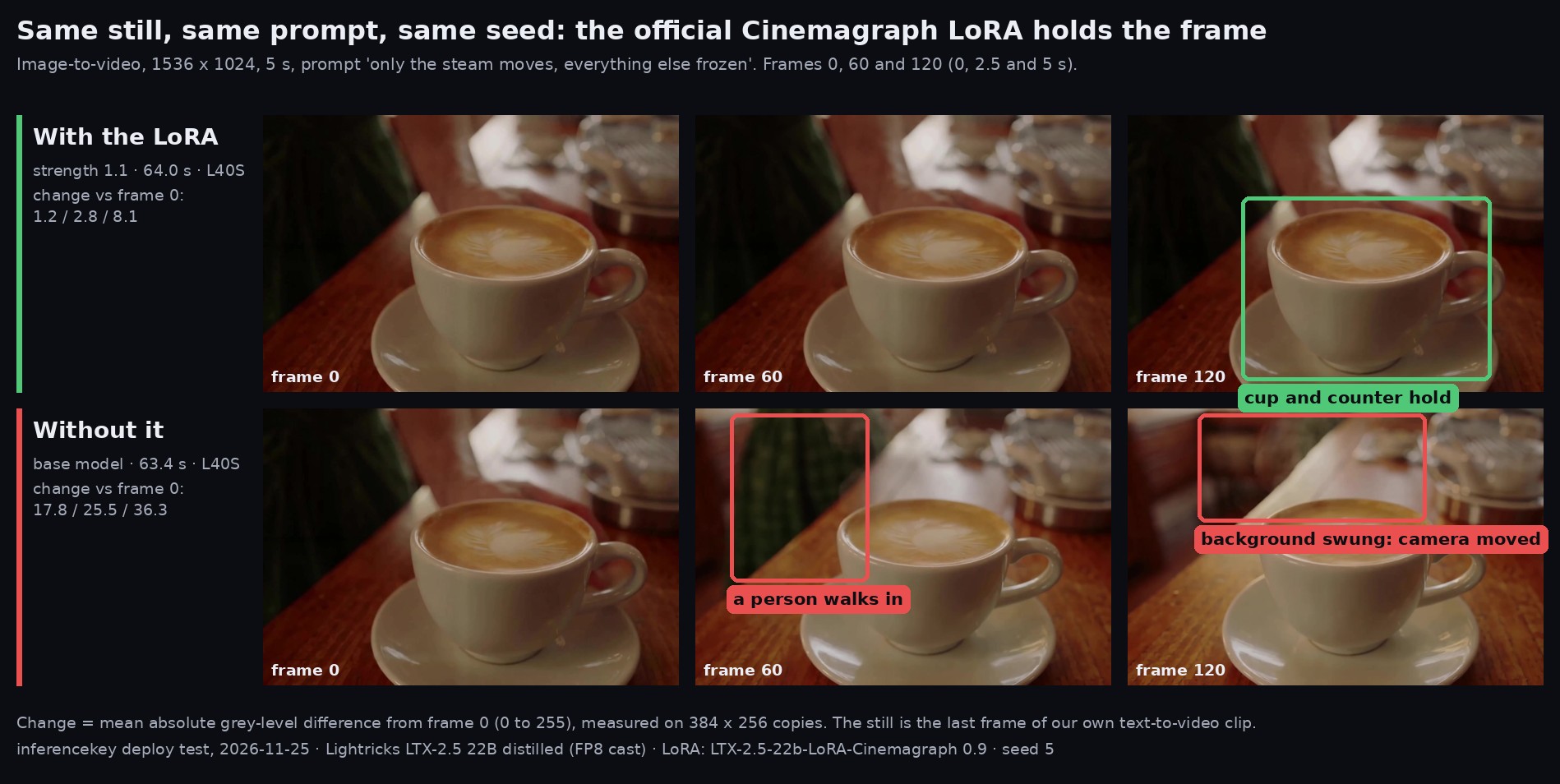
We tried the official Cinemagraph LoRA, which keeps a shot still except for one moving detail. We gave the model a still of a cappuccino and asked for five seconds in which only the steam moves. To measure "still", we compared every frame with the first one. With the LoRA, the scene had moved 8.1 points by the last frame, against 36.3 without it, on a 0 to 255 brightness scale. Without it, the camera drifted and a stranger walked into the shot. Generation time was the same, 64.0 against 63.4 seconds.
Two catches showed up. When the still had a person in it, the camera stayed locked but she kept moving, which the LoRA's documentation warns about. And both LoRA clips came out nearly silent, and we have not isolated why.
LTX Trainer, in Lightricks' open code, makes your own LoRA from your own footage: your product, your character, your house style. Its recipes train the sound along with the picture. We ran the authors' 32 GB recipe on four of our clips for 30 steps. It used at most 25.4 GB and saved a 214 MB LoRA that made a clip. Lightricks recommends 80 GB for its standard recipe.
A 24 GB card works, at 113 seconds a clip
On the RTX 4090 the model needs the authors' offload option. It keeps the big model in the computer's main memory and streams it to the card piece by piece.
| Card | Offload | Seconds per clip |
|---|---|---|
| L40S 48 GB | no | 62.8 to 66.2 |
| RTX 4090 24 GB | yes | 113.2 |
| 24 GB limit, simulated | no | out of memory |
So 48 GB buys speed, not the ability to run. Capping memory on the L40S suggested a 12 or 16 GB card might work too with offload, though we did not run one, and offload needs plenty of main memory on the machine. On InferenceKey the deployment was ready in 87 seconds on the L40S and 110 on the 4090, most of it spent downloading the 71 GB of weights.
Who should care, and the license math
Teams making branded clips with dialogue or sound effects should try it, especially if they want a consistent product or character across clips. The open models a team would compare it with, such as Wan2.2 and HunyuanVideo-1.5, show silent video on their model pages, and LTX's trainer covers sound and picture together.
The license is the part to read before building. The weights are free for any purpose for companies under 10 million dollars of yearly revenue, counting the whole group. Above that line, production use needs a paid license, and training a LoRA for commercial use counts. Your LoRA is a derivative of their model and ships under the same license. You may not use it in a product that directly competes with Lightricks' own without a separate license. The clips are yours: the license says Lightricks "claims no rights in the Output you generate". Only the code is open source, under Apache-2.0.
The honest limit: we ran one request at a time with two prompts on the fast 1536 x 1024 path only, and our 30-step training run proves that training starts, not that it makes a good LoRA.
Read the full test, with the memory map, the license clause by clause and the SDK example, in the Research post.