LFM3-Omni-2B hears, sees and talks back on a 16 GB card
Liquid AI's 2B omni model made a 10-second spoken answer in about 7 seconds of GPU time, on about 5 GB of memory. The fast server can't speak yet.
Hearing, looking, thinking and speaking now fit in about 5 GB of GPU memory. LFM3-Omni-2B, a new open model from Liquid AI, takes speech, photos and video and answers in text, in its own voice, or both. On a 24 GB RTX A5000 on our cloud, a 10-second spoken answer took about 7 seconds of GPU time. A real 16 GB card, the RTX 2000 Ada, gave the same results with no slowdown. For a team that deploys its own models, that means every stage of a voice assistant on one small card you own or rent. You can build on it today through a custom backend that drives the model's own code. Two catches before you do. The fast open-source server for it, SGLang, writes only text, and its support is not released yet. And the license stops commercial use once your annual revenue reaches 10 million dollars.
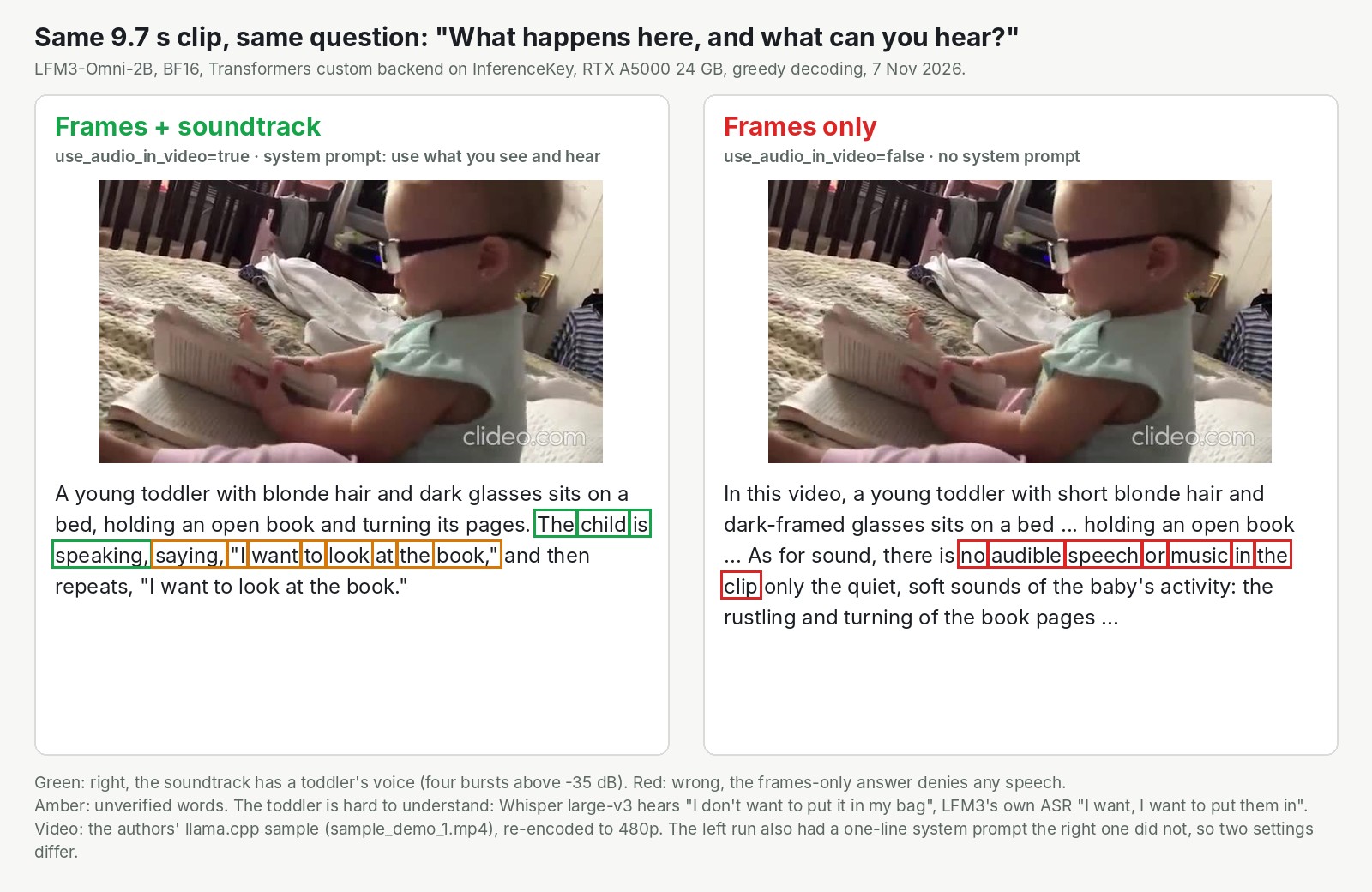
Same clip, same typed question. With the soundtrack, the model hears a child talking; with frames only, it calls the clip silent. The run with sound also carried a one-line instruction to use what it sees and hears, so two settings changed, not one.
Four jobs in one 4.5 GB set of weights
A voice assistant is usually a relay of four models: one hears, one looks, one thinks, one speaks. Liquid AI's model card says this one "replaces a separate ASR model, vision-language model, LLM and TTS model".
It is built on LFM3-1.7B, Liquid AI's new small language model, with an image reader, a sound reader and a part that turns its output into audio. By Liquid AI's list it speaks 19 language and accent combinations; we tried English and Spanish. The LFM3 announcement is dated 27 October, and we spotted the model in AI Search's news video.
What one small card did with it
We ran the full, uncompressed model through InferenceKey on two cards: the A5000 for the main run and the RTX 2000 Ada, a 70-watt workstation card, on a fresh machine. Every spoken answer took less time to make than to play.
| What we asked | GPU time (A5000 / 16 GB card) |
|---|---|
| Spoken question about Africa's tallest mountain, answer by voice (about 10 s of speech) | 7.4 s / 6.6 s |
| Concert flyer plus a spoken question on when and where | 0.84 s / 0.93 s |
| Spoken request to set the volume to 30, with a volume tool | 0.56 s / 0.45 s |
The flyer came back right: "The concert starts at 7:30 PM, and it is located at Pier 9 Warehouse, 410 Bay Street." The volume request came back as set_volume({"volume": 30}), a command an app can run.
The caller waited longer than the GPU did. A 10-second answer reached the caller after 8 to 10 seconds, because our setup sends the audio as one file at the end. Inside the server the first piece of speech was ready 0.2 to 0.5 seconds in, so streaming could cut that wait. We did not build or test it.
On memory, the model needs about 5 GB free for voice, photos and short clips, and about 6 GB for a one-minute video. When we capped its memory in software on the bigger card, everything passed at 4.8 GB and the 10-second video ran out of memory at 4.7 GB.
Where it slips: numbers and mumbled words
The plain facts were right. Asked by voice for the height of Kilimanjaro ten times, it got the meters right nine times and the feet wrong in most runs. A voice assistant that reads out numbers needs a check, or a tool, for conversions.
On the toddler clip, it quoted the child as saying "I want to look at the book". We could not verify that. Whisper, a separate speech recognizer, heard something else, and so did the model itself when asked only to transcribe. Treat quoted words from unclear audio as a guess.
The fast server writes four times quicker, and cannot speak
This is the wall you will hit first. Liquid AI's docs give a one-line SGLang command, but the released SGLang (0.5.23) has no support for this model and crashed on start-up on our card. The fix is a proposed change, #46858 by tugot17, still open on the day of the test. Built by hand, it wrote text about four times quicker with identical answers, 158 word pieces per second against 38 to 40. It returns text only.
So for speech we wrote a custom backend: a short Python file you upload to InferenceKey, which installs its dependencies on your GPU machine and sends requests to it. One backend on one GPU served voice, photos, video and commands from one address. It was ready 46 seconds after we asked on the A5000, and 59.5 seconds on the fresh 16 GB machine.
The model, its benchmarks and the sample clips are Liquid AI's work, the SGLang support tugot17's, the independent read-back of every recording Whisper's. Our part: the backend, the deployment on two cards, the tests and the SDK example.
Who should care
- Teams building a voice assistant on their own hardware. Worth building on, with a check for numbers it reads out. As tested, the caller waits for the whole answer.
- Teams that need fast text for heavy traffic. Not yet. Wait for the SGLang release.
- Teams with a card under 16 GB. The memory caps say about 5 GB free is enough, but we ran no real card that small.
- Companies with 10 million dollars or more in annual revenue. Talk to Liquid AI about other terms before the first deployment.
The honest limit: one request at a time, on our own short inputs, with no human judging the voice and no comparison against a chain of four separate small models on the same card.
Read the full test
The Research post has every timing, the memory ladder, the model's own voice and the SDK example. Read the full LFM3-Omni-2B test in the Research post.